Context
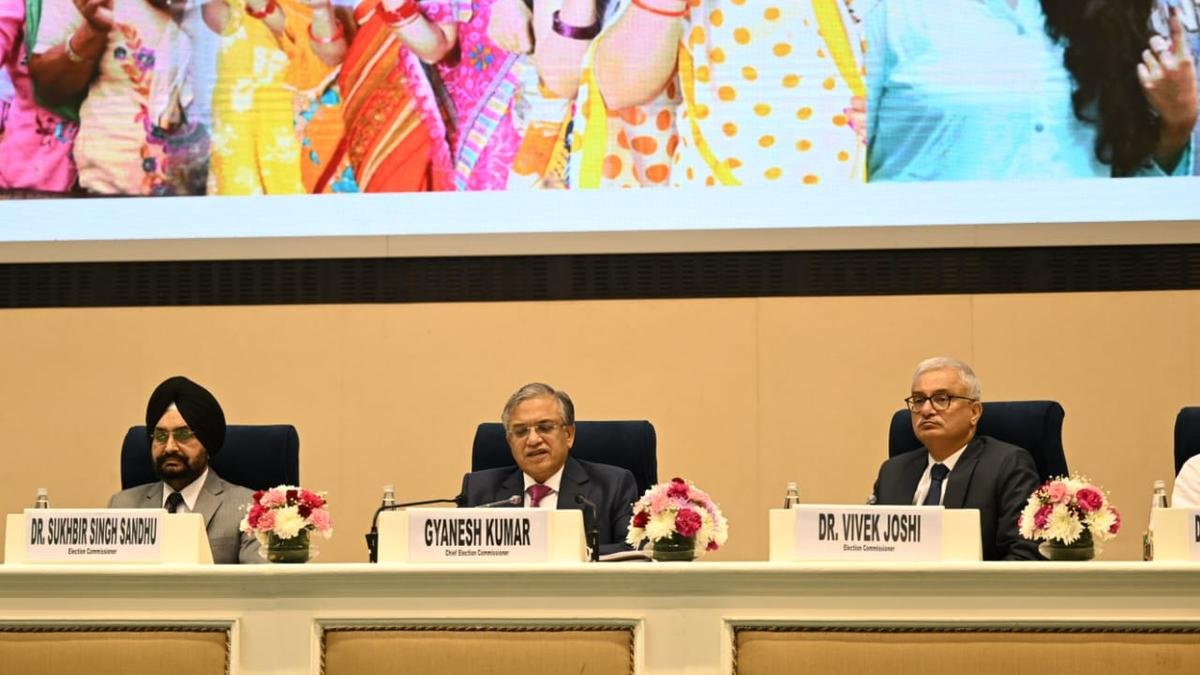
The Election Commission of India (ECI) has launched the Special Intensive Revision (SIR) 2025 across 12 States and Union Territories, covering nearly 51 crore voters.
Why are voter lists/electoral lists revised by EC periodically?
Every year, territorial constituencies face demographic shift because of birth/ death/ immigration/ emigration/ 18 age/ duplication/ bogus/ deletion/ manipulation. So, to keep voters authentic for fair election, addition & deletion are done in the electoral roll periodically.
How many methods of revision are used in ER/VL?
Normally there are 2 methods of revision:
- Regular Summary Revision (RSR)- It is an annual update where draft rolls are published, and citizens can request additions, deletions, or corrections without home visits.
- Special Intensive Revision (SIR)- It is more detailed verification of voters. It is done by house to house visit & reason for each addition/deletion is to be given.
About the Special Intensive Revision (SIR)
- Objective: To conduct a thorough enumeration and verification of existing voters to ensure the authenticity and accuracy of electoral rolls.
- Legal Basis: The exercise is notified under Section 21(3) of the Representation of the People Act, 1950, which empowers the ECI to revise electoral rolls.
- Coverage: Phase II (starting November 4, 2025) covers 12 States and UTs, including Tamil Nadu, Kerala, West Bengal, Uttar Pradesh, Madhya Pradesh, and others.
How ECI did SIR in Bihar?
ECI deployed 2.5 lakh volunteers & BLOs. ECI set up a camp for awareness and did newspaper ads. ECI asked Chief Election Officer (CEO) of other states to accept form 6 from migrants to reduce exclusion.
What is the purpose of form 6 under RPA 1950?
- New Voter Registration – For first-time voters who have attained the qualifying age of 18.
- Shifting Constituency – For voters who have moved from one constituency to another and need their name included in the new constituency’s roll.
- Reinclusion – For voters whose names were deleted from the roll and want to reapply.
What are the constitutional frameworks for SIR?
- Article 324 of the Constitution of India deals with the superintendence, direction and control of elections in the country. It vests these powers in the Election Commission of India (ECI) and forms the backbone of India’s independent electoral machinery.
- Article 325 of the Indian Constitution ensures that no person is ineligible for inclusion in a general electoral roll or denied the right to claim inclusion based on religion, race, caste, or sex.
- Article 327 empowers Parliament to make laws relating to elections to the Parliament and State Legislatures.
- Article 328 allows State Legislatures to make laws for elections to their respective Legislative Assemblies and Legislative Councils, provided Parliament has not already legislated on the subject.
What sections of RPA 1950 are relevant for SIR?
- Section-15 (Electoral roll for every constituency)—For every constituency there shall be an electoral roll which shall be prepared in accordance with the provisions of this Act under the superintendence, direction and control of the Election Commission.
- Section-16 (Disqualifications for registration in an electoral roll)
- A person shall be disqualified for registration in an electoral roll if he
- is not a citizen of India;
- is of unsound mind and stands so declared by a competent court;
- A person shall be disqualified for registration in an electoral roll if he
- is for the time being disqualified from voting under the provisions of any law relating to corruption practices and other offences in connection with elections.
- Section-19 (Conditions of registration)— every person who:
- is not less than eighteen years of age on the qualifying date,
- is ordinarily resident in a constituency, shall be entitled to be registered in the electoral roll for that constituency
- Section-21: Preparation and revision of electoral rolls
Process of the SIR
- Distribution of Enumeration Forms: Booth Level Officers (BLOs) visit every household to distribute pre-filled forms containing voter details such as name, EPIC number, and address.
- Verification by Voters: Voters must check, correct, and complete missing details, including date of birth, parent names, and contact information.
- Link to Past Electoral Rolls: Voters are required to trace their or a relative’s name in the previous SIR electoral roll (2002–2005) to establish continuity in the roll.
- Submission of Forms: Forms can be submitted offline to BLOs or online via voters.eci.gov.in. Acknowledgment is provided to ensure transparency.
- Document Verification (if needed): Those unable to link to past rolls must provide identity and citizenship documents like birth certificates, passports, or educational certificates.
- Publication and Appeals:
- Enumeration: November 4 – December 4, 2025
- Draft Roll: December 9, 2025
- Claims/Objections: up to January 8, 2026
- Final Roll: February 7, 2026
- Appeals against deletions can be made to the District Magistrate and, subsequently, to the Chief Electoral Officer.
What are the implications of SIR?
- Disenfranchisement of many- Electors- to- Adult- Population (EP) ratio may fall sharply in Bihar.
- Judicial oversight and potential directives: The Supreme Court’s involvement creates a legal test of the SIR’s method and transparency. The Court may require additional disclosure, procedural safeguards, or stay further deletions pending scrutiny.
- Some demographic pockets may be excluded.
- Courts may require procedural safeguards for proper verification of voters.
- Administrative burden on DEO, CEO, BLO and State Officers.
- Economic burden on states in arranging camps for awareness.
- Political trust decreases especially among opposition parties.
- Allegation of vote theft & partiality, especially by opposition parties.
- Transparency vs privacy.
Challenges and Way Forward
| Challenges | Way Forward |
| 1. Legal Ambiguity: Questions raised on the ECI’s power under Section 21(3) to conduct SIRs, especially without explicit statutory backing. | Clear Legal Framework: Parliament may consider statutory clarification or amendment to define ECI’s powers and procedures for intensive revisions. |
| 2. Citizenship Verification Concerns: The EC’s role in verifying citizenship is being challenged as this power lies under the Citizenship Act and Foreigners Act, not with the ECI. | Defined Jurisdiction: Limit ECI’s role to voter eligibility verification while excluding citizenship adjudication; ensure coordination with MHA when required. |
| 3. Procedural Complexity: Requirement to trace names in electoral rolls from 2002–2005 creates confusion, especially for younger or migrant voters. | Simplified Digital Process: Integrate automated record linking via digital archives to reduce burden on voters. |
| 4. Risk of Exclusion: Lack of awareness or inability to produce old records may lead to inadvertent disenfranchisement, especially among vulnerable groups. | Inclusive Outreach: Conduct awareness drives in rural and urban areas; allow multiple forms of valid documentation. |
| 5. Technological and Accessibility Barriers: Online form submission or roll verification may be difficult for digitally illiterate voters. | Hybrid Access Model: Ensure offline submission support through BLOs, kiosks, and local help centres. |
| 6. Transparency and Accountability: Concerns over arbitrary deletion and limited grievance redressal mechanisms. | Strengthen Oversight: Enhance BLO and ERO accountability; establish independent monitoring mechanisms and audit trails. |
Conclusion
The Special Intensive Revision 2025 is a major step toward ensuring clean, accurate, and inclusive electoral rolls, essential for the integrity of India’s democratic process. However, clarity on the legal framework, citizenship verification, and procedural safeguards is crucial to balance electoral integrity with citizens’ constitutional rights to vote. Strengthening transparency and inclusivity will help build public trust in this ambitious national exercise.
| Ensure IAS Mains Question
Q. The Election Commission’s Special Intensive Revision (SIR) seeks to update electoral rolls but has raised legal and constitutional concerns. Discuss the major challenges in implementing the SIR and suggest measures to make the process more transparent and inclusive. (250 words) |
| Ensure IAS Prelims Question
Q. Consider the following statements regarding the Special Intensive Revision (SIR) of electoral rolls conducted by the Election Commission of India: 1. The SIR is conducted under Section 21(3) of the Representation of the People Act, 1950. 2. Voters must trace their or a family member’s name in the electoral roll of the last intensive revision (2002–2005). Which of the statements given above is/are correct? a) 1 only b) 2 only c) Both 1 and 2 d) Neither 1 nor 2 Answer: c) Both 1 and 2 Explanation: Statement 1 is correct: The Special Intensive Revision (SIR) is conducted by the Election Commission under Section 21(3) of the Representation of the People Act, 1950, which empowers the ECI to revise electoral rolls to ensure they are accurate and up to date. Statement 2 is correct: As part of SIR 2025, voters must trace their or a parent’s/relative’s name from the electoral roll of the last intensive revision (2002-2005) to confirm continuity. If unable, they must later provide valid documents to prove eligibility. |