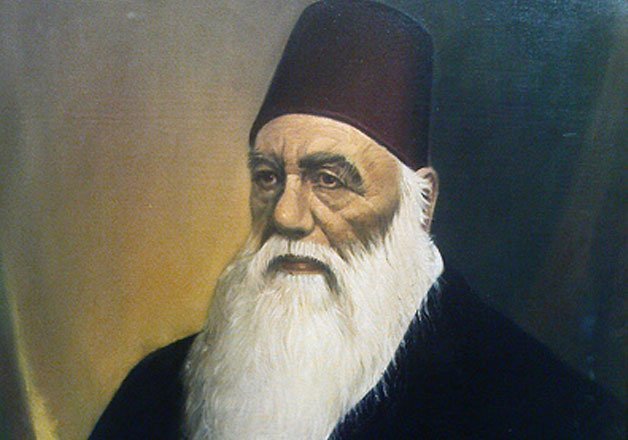
Why in the News?
- Sir Syed Ahmad Khan (1817–1898) remains central to debates on modern education, minority uplift, and communal harmony in India.
- His founding of the Mohammedan Anglo-Oriental (MAO) College which later became Aligarh Muslim University (AMU) continues to influence policy and public discussion on inclusive institutions.
- Re-reading his life helps students understand how contextual history prevents misinterpretation of reformers’ ideas about nation and community.
Key Highlights
- What was analysed by Sir Syed Ahmad Khan after the 1857 Revolt?
- Sir Syed lived through the 1857 Revolt, which deeply affected Indian society and especially the Muslim elite.
- He observed that many Muslims had fallen behind in modern education and public employment.
- He concluded that educational renewal was necessary for social recovery and civic participation.
- What was done by Sir Syed Ahmad Khan to rectify the condition of society?
- In 1875, Sir Syed started a school to teach modern subjects alongside religious studies.
- He believed that learning science, English, and practical skills would help Indians improve their economic and social position.
- He invited both Hindus and Muslims to join these educational efforts.
- In 1877 he established the Mohammedan Anglo-Oriental College to provide higher education.
- He described the college as a means of national progress and explicitly stated that “nation” included Hindus and Muslims.
- The college combined modern curriculum with religious sensitivity to prepare students for public life.
- Sir Syed’s idea of “Quam” and nationhood
- Sir Syed used the word “Quam” to mean both religious community and a broader civic nation, depending on context.
- He argued that people who share the same soil, laws, and hardships form a nation regardless of religion.
- This flexible usage shows that he did not set out an ideological basis for a separate nation-state.
- Interfaith engagement, cultural openness and legacy
- Sir Syed practised inclusive gestures: he welcomed Hindu participation, promoted comparative religious study, and wrote on non-Muslim scriptures.
- MAO College / AMU grew into a diverse university drawing students across India and abroad.
- Political leaders and educators cite Sir Syed’s work as a model for inclusive education and civic responsibility, as done in our National Education Policy (NEP).
- Aligarh Movement by Sir Syed Ahmad Khan
- The Aligarh Movement was a socio-educational reform movement launched in the late 19th century by Sir Syed Ahmad Khan to promote modern education and social awakening among Indian Muslims.
- Its goal was to reconcile Islamic values with Western scientific knowledge, enabling Muslims to regain confidence and participate in modern administration.
- The movement began with the establishment of the Scientific Society (1864) for translating Western works into Urdu, followed by the Mohammedan Anglo-Oriental College (1877) at Aligarh.
- It emphasized rational thinking, secular education, social reform, and interfaith cooperation, rejecting blind orthodoxy.
- The Aligarh Movement also encouraged political moderation, urging Muslims to engage constructively with the British and focus on education before politics.
- Over time, it produced a new class of educated Indian Muslims who contributed significantly to public service, journalism, and national development.
Implications
- Educational policy: Sir Syed’s model implies that combining modern science with moral and cultural education strengthens communities.
- Social cohesion: His practice of inviting interfaith cooperation shows that shared institutions reduce communal tensions.
- Institution building: The AMU example demonstrates how a single institution can catalyse social mobility for marginalized groups.
- Historical interpretation: Accurate, contextual reading of historical figures prevents misuse of their words for sectarian politics.
- Contemporary relevance: Sir Syed’s emphasis on inclusive education offers lessons for current policies on minority uplift and national integration.
Challenges and Way Forward
| Challenge | Way Forward |
| Misreading of Sir Syed’s ideas | Promote contextual historical education and include balanced modules on reformers in school and university syllabi. |
| Limited access to higher education for marginalized groups | Expand scholarships, outreach programs, and capacity building in historical institutions and new universities. |
| Communal polarisation affecting campuses | Encourage interfaith programmes, joint cultural events, and dialogue platforms within universities. |
| Conservatism vs modernization within communities | Support curriculum reforms that respect traditions while teaching modern skills and critical thinking. |
| Translating legacy into policy | Create policy cells that adapt Sir Syed’s principles into concrete educational and social inclusion programmes. |
Conclusion
Sir Syed Ahmad Khan combined practical reform with a broad civic vision. He championed modern education, built enduring institutions, and actively promoted Hindu–Muslim cooperation. His flexible notion of Quam shows that he saw nationhood as rooted in shared life and civic bonds, not only religion. For students and policymakers, his life teaches that inclusive institutions and contextual study of history are essential for social progress.
| Ensure IAS Mains Question
Q. Analyse Sir Syed Ahmad Khan’s contribution to modern education and his concept of nationhood. How can his ideas guide India’s policies on inclusive higher education today? (250 words) |
| EnsureIAS Prelims Question
Q. Consider the following statements: 1. Sir Syed Ahmad Khan founded the Mohammedan Anglo-Oriental College in 1877 with the aim of promoting modern education for both Hindus and Muslims. 2. Sir Syed’s use of the term “Quam” exclusively meant a separate religious nation that prefigured the two-nation theory. Which of the statements given above is/are correct? Answer: A Explanation: Statement 1 is correct: Sir Syed established the Mohammedan Anglo-Oriental (MAO) College in 1877 to promote modern learning and to encourage cooperation between communities. He explicitly described his educational project as contributing to the progress of the nation that included Hindus and Muslims. Statement 2 is incorrect: Sir Syed did not use “Quam” exclusively to mean a separate religious nation. He used the term in different senses and often emphasised shared civic bonds; common soil, governance and hardships; showing that his conception of nationhood was flexible and not a categorical endorsement of separatism. |