| Important questions for UPSC Pre/ Mains/ Interview:
1. What triggered the recent exchange between India and China? 2. Where is the Shaksgam Valley and why is it important? 3. What is the background of China’s presence in the region? 4. What was the 1963 China–Pakistan boundary agreement? 5. How did India respond at the time? 6. What is India’s official position today? 7. Why has Shaksgam Valley gained renewed significance now? 8. What are the broader implications for India? |
Context
Recent statements by China reaffirming its claim over the Shaksgam Valley, in response to India’s objections, have brought renewed attention to a long-standing territorial dispute involving India, China, and Pakistan. The issue is closely linked to the 1963 China–Pakistan boundary agreement and the China–Pakistan Economic Corridor (CPEC), both of which India has consistently rejected as illegal.
Q1. What triggered the recent exchange between India and China?
- A Chinese government spokesperson reiterated China’s claim over the Shaksgam Valley.
- The statement followed comments by Randhir Jaiswal, spokesperson of the Ministry of External Affairs, on Chinese infrastructure activity in Pakistan-occupied territories.
- India reaffirmed that:
- Shaksgam Valley is Indian territory.
- The 1963 China–Pakistan boundary agreement is illegal and invalid.
- CPEC is not recognised as it passes through illegally occupied Indian territory.
Q2. Where is the Shaksgam Valley and why is it important?
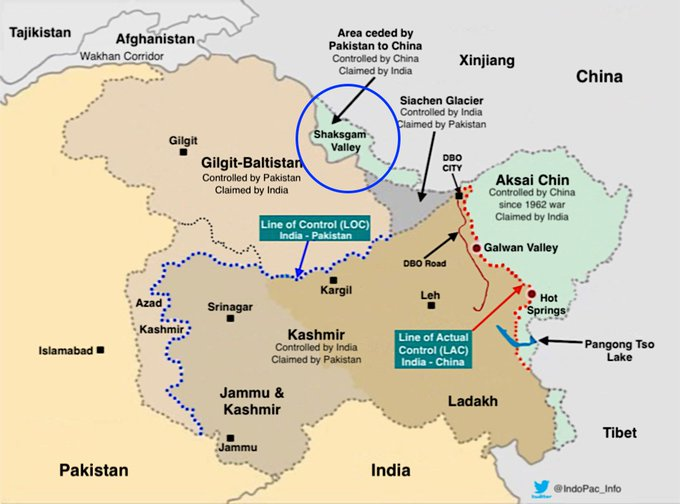
- Shaksgam Valley, also called the Trans Karakoram Tract, lies north of the Siachen Glacier.
- It covers more than 5,000 sq km and is part of the Hunza–Gilgit region under Pakistani occupation.
- The region has harsh terrain and climate, limiting habitation.
- India has consistently claimed the area as part of the former princely state of Jammu and Kashmir.
Q3. What is the background of China’s presence in the region?
- Pakistan exercised control over Shaksgam Valley until 1963.
- China had already asserted itself in the broader region earlier.
- In the 1950s, China built a highway connecting Tibet to Xinjiang through Aksai Chin, over which India has territorial claims.
- These developments formed part of a larger pattern of Chinese strategic expansion.
Q4. What was the 1963 China–Pakistan boundary agreement?
- The agreement was signed when China–Pakistan relations were deepening after the 1962 India–China war.
- Pakistan sought closer ties with China despite being allied with the United States during the Cold War.
- Under this agreement, Pakistan illegally ceded territory in the Shaksgam Valley to China.
- India immediately rejected the agreement as illegal and invalid.
Q5. How did India respond at the time?
- The issue was raised in Parliament in March 1963.
- Then Prime Minister Jawaharlal Nehru stated that:
- India desired a settlement with Pakistan.
- The timing of the China–Pakistan agreement was intended to prejudice talks on Kashmir.
- He accused China of interfering in India–Pakistan relations and pursuing expansionist policies.
- India lodged an official protest with China.
Q6. What is India’s official position today?
- A 2022 statement in the Lok Sabha reaffirmed that:
- China is in illegal occupation of around 38,000 sq km of Indian territory in Ladakh.
- Pakistan illegally ceded 5,180 sq km of Indian territory in Shaksgam Valley to China in 1963.
- India has never accepted the legality of this transfer.
Q7. Why has Shaksgam Valley gained renewed significance now?
- Shaksgam Valley lies close to the route of the China–Pakistan Economic Corridor.
- CPEC, launched in 2015, aims to connect Gwadar Port with Kashgar.
- For China, the corridor provides an alternative route for energy imports, reducing reliance on the Malacca Strait.
- India has opposed CPEC consistently as it passes through Pakistan-occupied Jammu and Kashmir.
Q8. What are the broader implications for India?
- The dispute affects India’s territorial sovereignty and national security.
- It highlights the strategic coordination between China and Pakistan.
- Infrastructure development in disputed regions complicates boundary negotiations.
- The issue remains relevant to India’s diplomacy, border management, and regional stability.
Conclusion
The Shaksgam Valley dispute reflects unresolved territorial issues involving India, China, and Pakistan. India’s consistent rejection of the 1963 agreement and CPEC underscores its stand on sovereignty, while renewed Chinese assertions highlight the strategic importance of the region in current geopolitics.