Context
Geopolitical conflicts, including US-Iran tensions, have spotlighted the growing use of GPS jamming and spoofing – cyber-electronic attacks that disrupt or manipulate satellite navigation signals for aircraft, ships, drones, and military systems.
Q1. What is GNSS (Global Navigation Satellite System)?
- GNSS (Global Navigation Satellite System) is a satellite-based technology that delivers Positioning, Navigation, and Timing (PNT) services worldwide. Example: Global Positioning System (GPS)
- GNSS is critical for civil aviation, maritime navigation, military operations, smartphones, logistics, and disaster management.
- Because satellite signals weaken significantly by the time they reach Earth, they are highly susceptible to interference and cyber manipulation.
Q2. What is GPS Jamming?
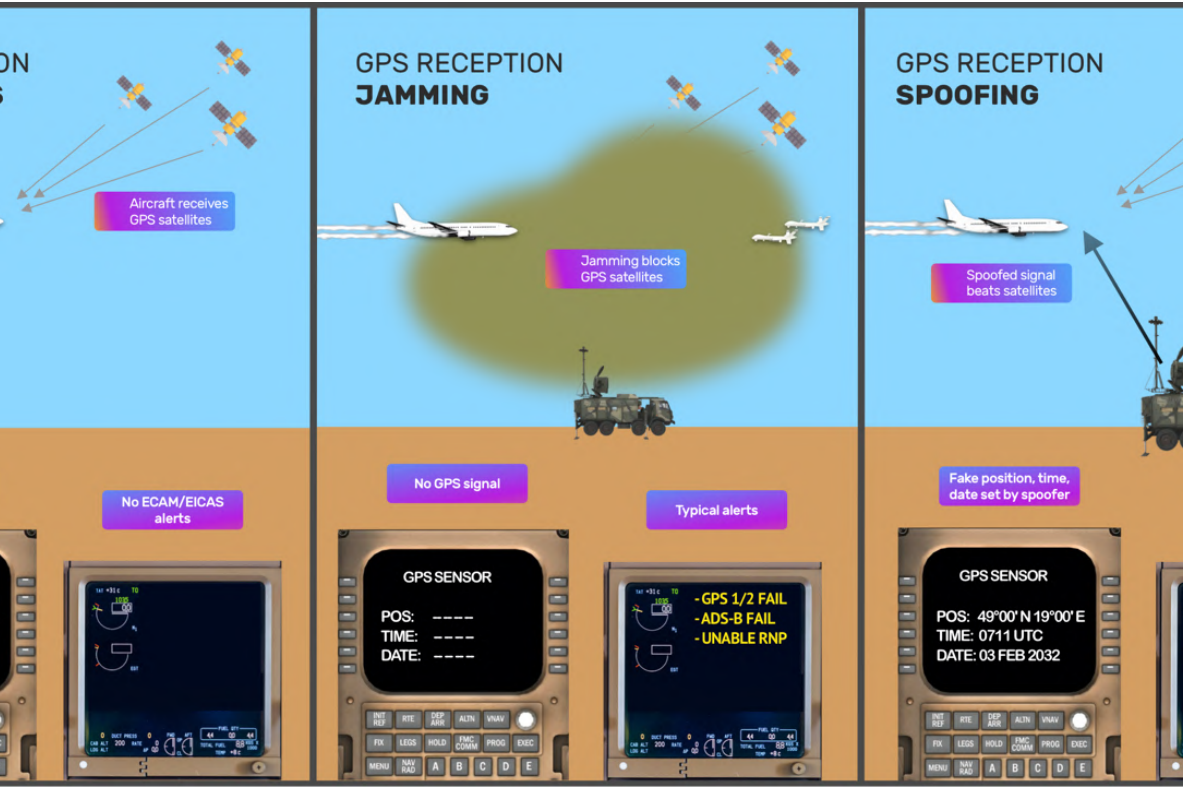
- GPS Jamming is a technique used to block or disrupt legitimate satellite navigation signals.
- It involves the use of a jamming device that emits radio frequency interference on the same frequency as GNSS signals.
- These stronger signals overpower the genuine satellite signals. As a result, the GPS receiver fails to detect authentic navigation signals.
- Impact of GPS Jamming
- Loss of navigation capability for aircraft and ships
- Disruption of drone operations and guided systems
- Failure of location-based services
- Interference with military navigation and communication systems
Q3. What is GPS Spoofing?
- GPS Spoofing is a more advanced cyber-electronic attack that deceives navigation systems by transmitting fake GPS signals. Instead of blocking signals, spoofing creates counterfeit signals that appear genuine to the receiver.
- Impact of GPS Spoofing
- Navigation systems display false positions.
- Ships, aircraft, or drones may be misdirected.
- Military systems dependent on GPS may operate incorrectly.
Conclusion
GPS jamming and GPS spoofing represent critical tools of modern electronic warfare, exploiting the vulnerability of satellite navigation signals. As global dependence on GNSS technologies increases, protecting navigation infrastructure from such cyber-electronic attacks has become essential for ensuring both civilian safety and national security.
FAQs
Q1. What is GNSS (Global Navigation Satellite System) and why is it vulnerable?
GNSS provides Positioning, Navigation, and Timing (PNT) services worldwide. Because satellite signals are weak when they reach Earth, they are highly vulnerable to interference and cyber‑electronic attacks.
Q2. What is GPS Jamming and how does it affect navigation?
GPS Jamming uses radio frequency interference to block genuine satellite signals, causing loss of navigation for aircraft, ships, drones, and military systems, and disrupting location‑based services.
Q3. What is GPS Spoofing and why is it more dangerous than jamming?
GPS Spoofing transmits fake GPS signals that appear authentic, tricking receivers into showing false positions. This can misdirect ships, aircraft, drones, and military systems, making it a critical tool in electronic warfare.
Q4. How do GPS Jamming and Spoofing impact civilian and military operations?
They can cause aviation risks, maritime misdirection, drone failures, and compromised military navigation, threatening both civilian safety and national security.