Context
The Supreme Court (October 2025) directed the Jharkhand government to notify 314 sq km of the verdant Sal Forests of Saranda as a wildlife sanctuary, reviving a long-ignored NGT order to protect its biodiversity.
About Saranda Forests
- Location: West Singhbhum district, Jharkhand; bordering Odisha.
- Size: 856 sq km total forest area.
- Meaning: Saranda translates to “seven hundred hills” in local Ho language.
- Ecological Importance:
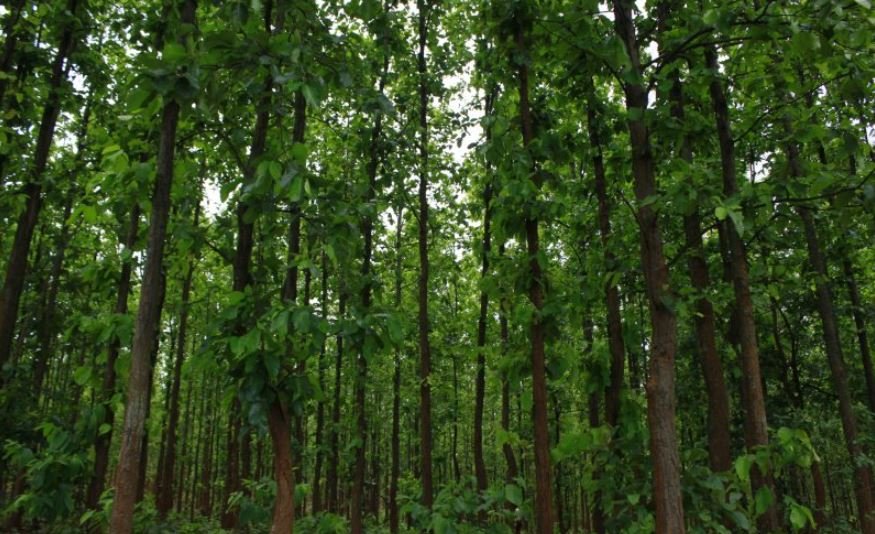
- Home to some of India’s finest Sal (Shorea robusta) forests.
- Houses elephants, four-horned antelopes, sloth bears, tigers (recently sighted), and diverse flora and fauna.
- Functions as an important elephant corridor and carbon sink.
- Wildlife Institute of India (WII) report: Anthropogenic pressures have fragmented the forest habitat. 2016 report highlighted reduction in mammals, butterflies and birds.
- Resources: Accounts for around 26% of iron ore reserves of India. Justice MB Shah Commission highlighted illegal mining of these ores leading to wildlife and biodiversity loss.
NGT Ruling (2020)
- A petitioner approached the National Green Tribunal (NGT) seeking “eco-sensitive zone” status for Saranda.
- NGT held that Saranda should be deemed a wildlife sanctuary under the Wildlife Protection Act, 1972, as it was already notified as a “game sanctuary” in 1968.
- It directed Jharkhand to consider the area for sanctuary notification and submit compliance.
Why the NGT Ruling Was Ignored
- The Jharkhand government delayed action despite repeated SC reminders (2021, 2022).
- The state argued that mining operations (generating a good amount of revenue) and tribal livelihood concerns (as the area is under 5th schedule) made sanctuary notification difficult.
Reason and Importance of Sanctuary Status
- Why Given Sanctuary Status:
- To ensure legal protection of biodiversity under the Wildlife Protection Act, 1972.
- To curb unregulated iron ore mining and deforestation threatening species diversity.
- To comply with judicial and environmental directives pending since early 2000s.
- Importance:
- Provides a statutory safeguard, prohibiting industrial exploitation and mining.
- Promotes eco-tourism and sustainable livelihoods through conservation-linked development.
- Helps India meet its Convention on Biological Diversity and SDG-15 (Life on Land)
Impact on Tribal Rights
- The region falls under the Fifth Schedule; inhabited by Ho, Munda, and other Adivasi communities.
- Sanctuary notification may restrict access to forest resources, criminalizing traditional sustenance activities.
- Could violate Forest Rights Act (2006) and PESA Act (1996) if tribal consultation is ignored.
- However, with proper implementation, co-managed conservation models can safeguard both ecology and livelihood.
Challenges and Way Forward
| Challenges | Way Forward |
| 1. Conflict between mining revenue and conservation | Conduct scientific carrying capacity assessment and phase-out mining from critical zones |
| 2. Threat to tribal livelihoods and displacement risk | Ensure Gram Sabha consent under FRA and promote community-based forest management |
| 3. Illegal mining and encroachment | Strengthen forest surveillance and inter-agency coordination |
| 4. Fragmented elephant corridors and biodiversity loss | Create eco-sensitive buffer zones and wildlife corridors |
| 5. Weak implementation and monitoring | Establish independent ecological monitoring committee with civil society participation |
| 6. Lack of sustainable livelihood alternatives | Introduce eco-tourism, NTFP value chains, and skill development for locals |
Conclusion
The Supreme Court’s move to accord sanctuary status to Saranda marks a crucial step toward reconciling development with ecological justice. Yet, the true success will depend on a participatory conservation model, where forest protection goes hand in hand with tribal welfare and livelihood security.
| Ensure IAS Mains Question
Q. The Saranda forest case highlights the complex intersection between environmental conservation, mining interests, and tribal rights. Discuss how a balance can be achieved between ecological protection and livelihood security in India’s mineral-rich forest regions. (250 words) |
| Ensure IAS Prelims Question
Q. Consider the following statements regarding the Saranda Forests: 1. The Saranda forests are located in Jharkhand and were originally notified as a game sanctuary in 1968. 2. The forests are rich in iron ore reserves and are part of an important elephant corridor. 3. The Wildlife Institute of India has reported an increase in faunal diversity in recent years. Which of the statements given above are correct? a) 1 and 2 only b) 2 and 3 only c) 1 and 3 only d) 1, 2, and 3 Answer: a) 1 and 2 only Explanation: Statement 1 is correct: Saranda is in West Singhbhum, Jharkhand; declared a game sanctuary in 1968. Statement 2 is correct: The area has rich iron ore deposits and forms part of a major elephant corridor. Statement 3 is incorrect: WII’s 2016 report found reduction, not increase, in faunal diversity due to anthropogenic pressures. |