Context
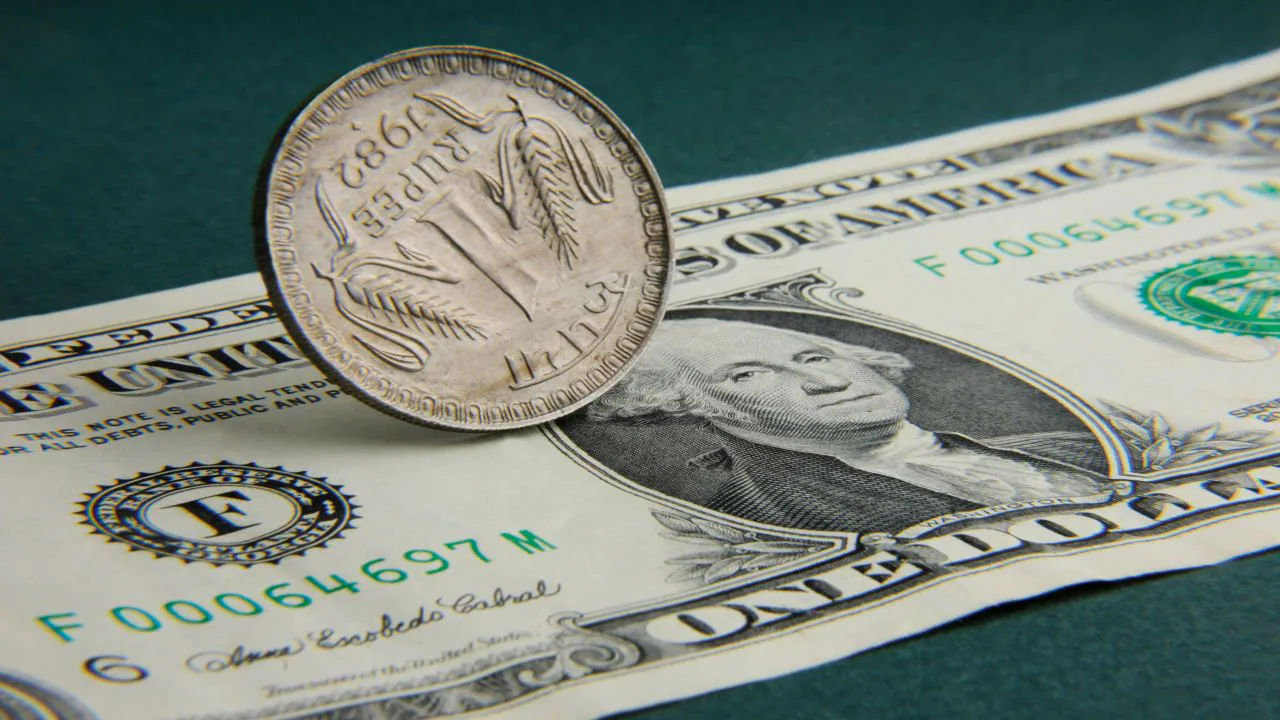
The IMF has reclassified India’s exchange rate regime from a ‘stabilised arrangement’ to a ‘crawl–like arrangement’, signalling more flexibility in rupee movement. The Finance Ministry clarified that the rupee’s gradual weakening is in line with other emerging market (EM) currencies, not due to domestic instability. Meanwhile, the inflation outlook is improving, giving room for possible rate cuts.
What is the Issue?
- The Indian Rupee traded between ₹87.8 – ₹88.8 per US dollar in October, very similar to September levels, showing low volatility.
- However, over a longer period (March-October 2025), the rupee depreciated by 3.5%.
- Recently the rupee crossed ₹89 per dollar, its lowest value ever, due to global factors and reduced RBI intervention.
What is a Crawl-Like Exchange Rate Arrangement?
| Term | Meaning |
| Crawl-like regime | Currency adjusts gradually in small steps, based on economic indicators, not kept strictly fixed |
| Stabilised arrangement (Earlier) | Central bank intervenes frequently to keep exchange rate within a narrow band |
Why is it important?
- Indicates greater market-driven pricing and higher exchange rate flexibility.
- Helps countries absorb global shocks better without exhausting forex reserves.
Why Did the IMF Change India’s Status?
- Reduced RBI intervention in forex markets:
- $400 billion sold in 2024-25 to defend the rupee.
- Only $44.3 billion sold in the first half of 2025-26.
- Rupee now shows more two-way movement, not artificially defended.
- India’s macro position is strong enough to allow market forces to play a bigger role.
Why is the Rupee Weakening?
- Stronger US Dollar globally: Higher US interest rates attract investment to America, making the dollar appreciate and EM currencies weaken.
- Global trade tensions & 50% US tariffs: Tariffs discourage exports and weaken investor confidence, leading to capital outflows.
- Foreign investors reducing exposure to emerging markets: Due to geopolitical risks, FIIs have pulled money out, increasing dollar demand.
- Reduced RBI support: RBI is not aggressively selling dollars anymore; without support, the rupee naturally adjusts to market forces.
- Risk-averse global financial environment: Conflicts, inflation worries, and economic uncertainty push investors toward safe assets such as the dollar.
RBI’s Position
- RBI does not target a fixed rupee level.
- It only intervenes to prevent excessive volatility, not to maintain a specific rate.
- Strategy ensures stability without exhausting forex reserves unnecessarily.
Inflation Outlook
- Inflation outlook is positive due to:
- Lower global commodity prices
- Stable energy markets
- Domestic supply-side interventions
- Retail inflation dropped to 25% in October (record low).
- Inflation expected to average below 2% in 2025-26, much lower than the 4% target.
- Repo rate cuts likely – MPC may reduce rates further after cutting 100 bps already this year to 5.5%.
Implications
- A weaker rupee improves export competitiveness because Indian goods become cheaper for foreign buyers.
- This can help sectors like textiles, IT services, and pharmaceuticals increase sales in global markets.
- However, the cost of imports becomes higher, especially for items like crude oil, electronic components, fertilizers, and edible oils.
- Since India imports a large share of these goods, a weaker rupee can increase the import bill and put pressure on domestic prices if the trend continues.
- Low inflation combined with expectations of interest rate cuts can stimulate economic growth.
- When inflation is under control, the RBI may reduce the repo rate, making loans cheaper. This encourages more investment and borrowing by businesses and households.
- Allowing the rupee to move more freely based on market conditions strengthens investor confidence. It shows that India is not artificially controlling the exchange rate and has strong financial fundamentals.
- This transparency improves the credibility of the economy and can attract long-term foreign investment.
Challenges and Way Forward
| Challenges | Way Forward |
| Import cost pressures from weak rupee | Promote export-led growth, expand manufacturing under PLI |
| Vulnerability to global shocks & tariffs | Build stronger forex buffers + diversify trade partnerships |
| Dependence on foreign capital inflows | Develop domestic capital markets, deepen bond market |
| Inflation may rise again if food/oil increase | Continue supply-side interventions & price-stabilisation buffers |
| Pressure on RBI to balance stability & flexibility | Transparent communication + calibrated intervention |
Conclusion
The rupee’s depreciation is moderate, gradual, and consistent with emerging market trends, not a sign of crisis. The shift to a crawl-like regime reflects greater confidence in India’s economy and reduces dependence on artificial RBI defence. With strong inflation control and potential rate cuts, India remains well-positioned, though continued caution against global instability is necessary.
| Ensure IAS Mains Question
Q. What is a crawl-like exchange rate arrangement? Discuss the reasons behind recent rupee depreciation and evaluate the implications of reduced RBI intervention. (250 words) |
| Ensure IAS Prelims Question
Q. Consider the following statements about exchange rate systems: 1. A crawl-like arrangement allows gradual adjustments in the exchange rate based on economic indicators. 2. RBI actively maintains a fixed rupee-dollar exchange rate through regular intervention. 3. A weaker rupee can improve export competitiveness. Which of the statements given above is/are correct? a) 1 and 2 only b) 2 and 3 only c) 1 and 3 only d) 1, 2 and 3 Answer: c) 1 and 3 only Explanation Statement 1 is correct: It refers to controlled, small, periodic adjustments rather than a fixed or freely floating rate, helping absorb external shocks smoothly. Statement 2 is incorrect: The RBI does not target a fixed rate; it only intervenes to prevent excessive volatility. It allows market forces to determine the exchange rate. Statement 3 is correct: When the rupee depreciates, Indian goods become cheaper for foreign buyers, boosting export demand and benefiting export-oriented industries. |