Context
The Indian rupee recently weakened sharply, breaching the ₹89 per US dollar mark for the first time, and also falling against the euro, pound, and yen. This decline has led to discussions on the nominal effective exchange rate (NEER) and real effective exchange rate (REER), which provide a clearer picture of the rupee’s movement. The rupee is now considered undervalued after significant changes in the last year.
What is Rupee Depreciation? How is it different from Devaluation?
- Rupee Depreciation means the market value of the rupee falls compared to other currencies because of market forces like demand and supply of foreign exchange.
- Example: ₹84 per dollar → ₹89 per dollar → rupee has depreciated.
- Devaluation happens only under a fixed exchange rate system when the government/RBI officially reduces the value of the rupee.
- Example: The Government declares ₹70 per dollar → ₹80 per dollar.
- Simple Difference:
- Depreciation = automatic, market-driven
- Devaluation = deliberate, government decision
What do you mean by Effective Exchange Rates (NEER & REER)?
- Effective exchange rates are broader measures of a currency’s strength compared to many countries at once, not just one.
- They show whether the rupee is getting stronger or weaker in global trade, not just against the US dollar.
- There are two types:
- NEER (Nominal Effective Exchange Rate)
- REER (Real Effective Exchange Rate)
What is NEER and REER?
- NEER is a weighted average exchange rate of the rupee against the currencies of 40 major trading partners.
- Base year = 2015-16 (value = 100)
- A fall in NEER means the rupee has depreciated.
- Does not adjust for inflation.
- REER is NEER adjusted for inflation differences between India and its trading partners.
- Shows whether a currency is overvalued, undervalued, or fairly valued.
- If REER increases → domestic goods become costlier globally → exports less competitive.
- If REER decreases → currency becomes more competitive.
Why is the Rupee’s Fall ‘Real’ This Time?
- The rupee is weakening not just in nominal terms but also in real economic value after adjusting for inflation.
- It has depreciated against all four major currencies: dollar, euro, pound, and yen.
- Decline in REER confirms real depreciation, not just nominal movement.
How the Rupee Has Moved?
- Bilateral Exchange Rate
- From Nov 2024 to Nov 2025, rupee fell from:
- ₹84.49 → ₹89.46 per dollar
- ₹89.12 → ₹103.63 per euro
- From Nov 2024 to Nov 2025, rupee fell from:
- ₹106.97 → ₹118.27 per pound
- ₹0.5574 → ₹0.5720 per yen
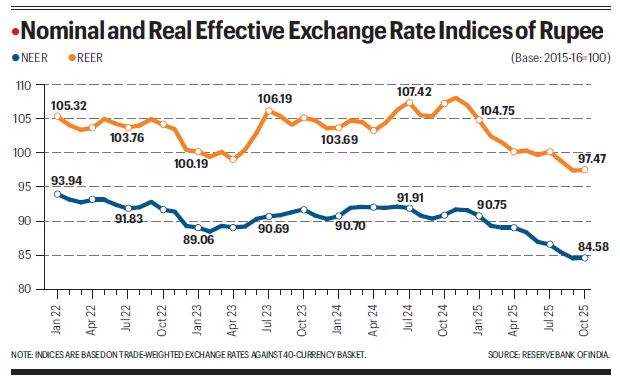
- NEER Trend
- Below 100 since 2018–19
- Fell from 75 (Jan 2025) to 84.58 (Oct 2025) — 6.8% decline in 9 months
- REER Trend
- REER hit an all-time high 06 (Nov 2024)
- Dropped to 47 (Oct 2025) — 9.8% fall
- Indicates the rupee has shifted from overvalued to undervalued
Why REER Fell More Strongly?
Two main reasons:
- Broad nominal depreciation
The rupee weakened against most major currencies including the Chinese yuan (11.66 → 12.63). - Lower inflation in India compared to other countries
India’s CPI inflation in Oct 2025 was 25%, while:- US, Japan = 3%
- UK = 6%
- Euro area = 1%
- Brazil = 7%
Low inflation + nominal depreciation = large fall in REER, making the rupee more competitive.
Implications of the Trend
- Rupee is now undervalued, helping exports become more competitive globally.
- Imports may become costlier, raising risks for oil and commodity prices.
- Reduced inflation pressure means RBI does not need a strong rupee to control prices.
- Encourages a more market-driven exchange rate policy.
Challenges and Way Forward
| Challenges | Way Forward |
| Sharp rupee depreciation increases import cost and risk of volatility | Strengthen forex reserves and manage orderly movements |
| Global trade uncertainty and tariff actions | Diversify export markets and improve production competitiveness |
| Risk of inflation rising again if imports become expensive | Monitor price trends closely and adjust interest rates when needed |
| Need for balanced intervention | Use limited RBI intervention to avoid excess volatility |
| Maintaining competitiveness without destabilising economy | Promote export-led sectors and maintain stable macro policies |
Conclusion
The rupee’s fall is significant because it reflects a real economic weakening after adjusting for inflation, not just a nominal drop. With REER now below 100, the rupee is undervalued, improving export competitiveness. The RBI is moving toward a more flexible exchange rate system, balancing intervention and market forces. Going ahead, India needs to maintain stable inflation, build export resilience, and manage external risks carefully.
| Ensure IAS Mains Question
Discuss the recent depreciation of the rupee against major global currencies and explain the significance of NEER and REER in assessing the real value of the rupee. Also evaluate the implications of an undervalued rupee for the Indian economy. (250 words) |
| Ensure IAS Prelims Question
Q. Consider the following statements regarding NEER and REER 1. NEER is a weighted average of the rupee’s exchange rates against the currencies of India’s major trading partners. 2. REER adjusts NEER for inflation differences between India and its trading partners. 3. A fall in REER means the rupee has become overvalued. Which of the statements are correct? a) 1 and 2 only Answer: 1 and 2 only Explanation: Statement 1 is correct: NEER represents the weighted average of the rupee against 40 currencies of key trade partners. Statement 2 is correct: REER adjusts for inflation differences across countries. Statement 3 is incorrect: A fall in REER means the rupee is undervalued, not overvalued. |