Context
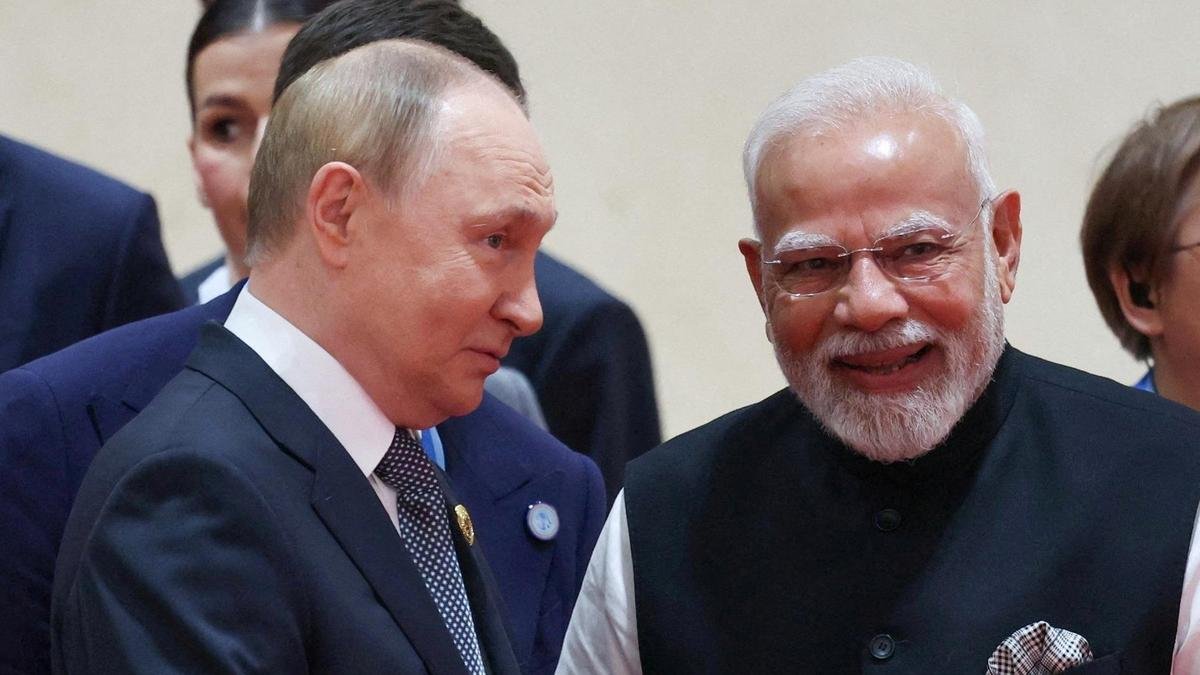
- Russian President Vladimir Putin is visiting India on 4–5 December 2025 for the 23rd India–Russia Annual Summit. This is his first visit after the 2022 Ukraine war, at a time when:
- Russia faces Western sanctions.
- India is under pressure due to US tariffs and secondary sanctions on Russian oil purchases.
- India–China tensions remain high.
- The visit reflects India’s attempt to maintain traditional ties with Moscow while deepening partnerships with the West.
India – Russia Relations
| Period / Year | Key Developments | Significance for India–Russia Relations |
| 1947–1955 | Early diplomatic ties established; Soviet support in industrialisation begins. | USSR becomes a major development partner—steel plants (Bhilai), power, heavy machinery. |
| 1955 | Nehru–Bulganin–Khrushchev visit to India. | High political goodwill; USSR supports India’s position on Kashmir. |
| 1962–1970 | India’s wars with China (1962) and Pakistan (1965). | USSR plays mediator at Tashkent (1966); emerges as India’s trusted partner. |
| 1971 | Indo-Soviet Treaty of Peace, Friendship and Cooperation signed. | Decisive support during Bangladesh Liberation War; strategic alignment peaks. |
| 1970s–1980s | Expansion of defence cooperation; MiG and Sukhoi production; nuclear cooperation. | USSR becomes India’s largest defence supplier; technology transfer deepens. |
| 1991 | Collapse of the Soviet Union. | India recalibrates ties with a weaker Russia; defence cooperation continues despite disruption. |
| 1998 | Pokhran-II nuclear tests → Western sanctions on India. | Russia continues support; signs key defence deals (Su-30 MKI, T-90 tanks). |
| 2000 | Putin’s first India visit; Strategic Partnership Agreement. | Institutionalises annual summits; new era of structured cooperation begins. |
| 2004 | “Next Steps in Strategic Partnership” (with US) begins. | India begins diversification, but Russia remains primary defence supplier. |
| 2007–2010 | BrahMos JV success; Kudankulam nuclear plant progresses. | High-end technology sharing boosts trust. |
| 2014 | Russia annexes Crimea → Western sanctions. | Russia pivots eastward; India maintains neutrality; ties deepen out of mutual needs. |
| 2016 | India signs defence deals: S-400, Kamov helicopters. | Shows India’s strategic autonomy despite Western objections. |
| 2022 | Russia invades Ukraine. | India adopts balanced stance; buys discounted Russian oil; faces Western pressure. |
| 2022–2024 | Oil trade surges; bilateral trade crosses ₹5.5 lakh crore. | Creates major trade imbalance; India becomes top buyer of Russian crude. |
| 2024–2025 | Secondary US/EU sanctions on Indian refiners; delayed Russian defence deliveries. | India reevaluates dependence; but maintains core strategic partnership. |
Background
- Current geopolitical setting
- Post-Ukraine war: Russia sanctioned → Russia tilts closer to China.
- India needs diversified partnerships to counter China and access advanced Western technology.
- India’s strategic doctrine
- India’s foreign policy uses multi-alignment:
- Defence + discounts from Russia.
- Markets + tech + capital from US/EU.
- India’s foreign policy uses multi-alignment:
- Stability against China through both blocs.
How did ties look during Putin’s first visit (2000)?
- India under Western sanctions (Pokhran-II).
- Russia weak after Soviet collapse.
- India–Pakistan tensions high post-Kargil.
- Putin’s visit signaled revival of old ties.
Why is the 2025 visit significant?
- First visit since the Russia–Ukraine war (2022).
- Russia under heavy sanctions; India facing secondary sanctions on energy imports.
- US tariffs on India raised vulnerability.
- India–Pakistan conflict resurfaced in May 2025.
- Security concerns after the Red Fort blast.
Defence partnership
- India has reduced dependence but still needs Russian spares & maintenance.
- Key systems: S-400, Sukhoi aircraft, submarines, BrahMos.
- Russia delivered only 3 of 5 S-400 units due to war constraints.
- Western sanctions affect Russia’s capacity for high-tech defence production.
The oil factor
- India bought discounted Russian crude → helped contain inflation.
- But secondary US/EU sanctions made purchases difficult.
- India’s trade with Russia reached $68.7 bn (imports hugely higher due to oil).
- This imbalance threatens the $100 bn by 2030 trade target.
Expected outcomes of the visit
Likely progress on:
- Labour mobility pact.
- Trade talks with the Eurasian Economic Union (EAEU).
- New defence purchases (S-400, Sukhois).
- Wider access for Indian agricultural & pharma exports.
India’s strategic balancing
- India wants:
- Western technology + markets, and
- Russian defence + geopolitical coordination.
- This balancing is shaped by:
- China’s closeness with Russia.
- India’s unresolved border tensions (50,000 troops deployed).
- Need to prevent Russia–China alignment from harming Indian security interests.
The China factor
India must ensure:
- Russian military technology given to India is not shared with China.
- Russia–China partnership does not undermine Indian security.
Putin’s reassurance that Russia does not transfer Indian-shared technologies to others must be constantly verified.
Implications
- For India’s China strategy: Partnership with both West and Russia strengthens deterrence against China.
- For defence procurement: India may secure spares and support for legacy Russian systems, reducing vulnerability.
- For energy security: New sanctions reduce the economic advantage of Russian oil; India may need alternative suppliers.
- For India–US relations: Close optics with Putin will be watched; India must avoid appearing to “tilt” toward Russia.
- For Russia: India remains one of Moscow’s few major economic partners, giving Russia diplomatic breathing space.
- For the Indo-Pacific balance: India’s multi-alignment model may emerge as a template for middle powers.
Challenges & Way Forward
| Challenges | Way Forward |
| Heavy Indian dependence on Russian legacy defence systems | Accelerate diversification + co-production + domestic defence manufacturing |
| US/EU pressure & sanctions on Russian oil | Negotiate exemptions; rebalance energy basket; expand Middle East & Africa sourcing |
| Russia–China strategic closeness | Maintain high-level political dialogue; verify technology transfer assurances |
| Trade imbalance (imports >> exports) | Expand agricultural, pharma, services exports; push for rupee-ruble mechanisms |
| Risk of irritating the West during Putin visit | Transparent diplomacy; emphasise India’s independent foreign policy |
Conclusion
Putin’s visit offers India an opportunity to stabilise defence and energy ties while signalling strategic autonomy. India must carefully balance its growing Western partnerships with its longstanding Russian ties to manage China and maintain room for manoeuvre in a rapidly shifting geopolitical landscape.
| EnsureIAS Mains Question
Q. Discuss how India’s strategic balancing between Russia and the West shapes its China policy, defence preparedness, and energy security. Illustrate with recent developments such as Putin’s 2025 visit. (250 Words) |
| EnsureIAS Prelims Question
With reference to India–Russia relations, consider the following statements: 1. Russia remains the largest source of India’s defence imports. 2. India’s trade with Russia is largely balanced, with exports and imports of similar value. 3. India has purchased the S-400 air defence system from Russia. 4. Russia is a member of the Eurasian Economic Union (EAEU). Which of the above statements are correct? Answer: (a) 1, 3 and 4 only Explanation: Statement 1 is correct: Over 60% of India’s military inventory is still of Russian origin. Statement 2 is incorrect: India–Russia trade is highly imbalanced. Imports ($63.8 bn) far exceed exports ($4.9 bn). Statement 3 is correct: India purchased five S-400 batteries from Russia; three have been delivered. Statement 4 is correct: Russia is a founding member of the Eurasian Economic Union (EAEU). |