| Important Questions for UPSC Prelims / Mains / Interview
1. Why has the Punjab border fence created a conflict between national security and farmers’ livelihoods, and how does this reflect the long-term consequences of emergency-era security policies? 2. What security conditions led to the construction of the Punjab border fence, and how relevant are those assumptions today? 3. What is the extent of land and population affected by the fence, and how does restricted access impact agriculture and rural incomes? 4. How do access controls and surveillance practices affect farmers’ rights, farming efficiency, and trust in governance? 5. What mechanisms like the Kapoor Committee and compensation schemes were introduced, and why have they failed to provide lasting relief? 6. Why are farmers demanding relocation of the fence, and how does modern surveillance technology support their case? 7. What security, administrative, and logistical hurdles have stalled the relocation of the Punjab border fence? 8. What lessons does the Punjab border fence issue offer for democratic governance and rights-based border management in India? |
Context
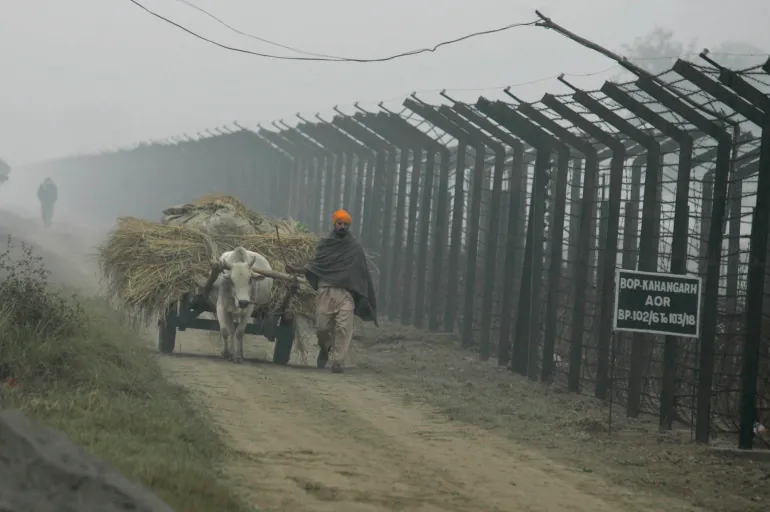
- Punjab shares a 532-kilometre-long international border with Pakistan, secured by an electrified barbed–wire fence constructed mainly during the late 1980s, a period marked by militancy and cross-border infiltration.
- Due to uneven terrain and security considerations, the fence was erected several metres to nearly 2 kms inside Indian territory at many locations.
- This resulted in large tracts of Indian farmland being trapped between the fence and the International Border, subjecting farmers to heavy restrictions on access.
- Recent indications that the Centre may consider shifting the fence have revived long-standing debates on security, livelihoods, and adaptive governance in sensitive border regions.
Q1. Why has the Punjab border fence created a conflict between national security and farmers’ livelihoods, and how does this reflect the long-term consequences of emergency-era security policies?
- The inward placement of the border fence converted legally owned farmland into a restricted security zone, directly affecting farmers’ ability to freely access and cultivate their land.
- National security considerations were prioritised during a period of militancy, with little scope for civilian consultation or resistance.
- Measures introduced as temporary security responses gradually became permanent administrative arrangements.
- Over time, this created a structural imbalance where livelihood losses were normalised in the name of security.
- The issue reflects how emergency-era decisions can produce long-term social and economic consequences if not periodically reassessed.
Q2. What security conditions led to the construction of the Punjab border fence, and how relevant are those assumptions today?
- The fence was constructed in 1988 when Punjab faced intense militancy, arms smuggling, and cross-border infiltration.
- Physical fencing was considered essential to slow militant movement and establish territorial control.
- Farmers did not openly protest due to fear and the extraordinary security environment of that time.
- Today, security threats are different in nature and more technologically mediated.
- This raises questions about whether static fencing should remain the primary security strategy decades later.
Q3. What is the extent of land and population affected by the fence, and how does restricted access impact agriculture and rural incomes?
- Around 21,500 acres of privately owned land and nearly 10,000 acres of government land lie beyond the fence.
- Farmers can access these lands only on designated days and for limited hours.
- Delays in farming operations affect irrigation schedules, harvesting cycles, and crop quality.
- Restricted access increases dependence on manual labour and reduces mechanisation efficiency.
- Over time, this undermines income stability and discourages long-term agricultural investment.
Q4. How do access controls and surveillance practices affect farmers’ rights, farming efficiency, and trust in governance?
- Mandatory escorts and fixed entry timings limit farmers’ autonomy over their work.
- Agricultural decisions are subordinated to security schedules rather than crop requirements.
- Excessive checks foster a perception of suspicion toward ordinary citizens.
- This weakens trust between border communities and security institutions.
- Prolonged restrictions erode confidence in responsive and citizen–centric governance.
Q5. What mechanisms like the Kapoor Committee and compensation schemes were introduced, and why have they failed to provide lasting relief?
- The Kapoor Committee acknowledged farmers’ difficulties and recommended compensation.
- An inconvenience allowance was introduced to offset restricted access.
- Payments were irregular and not revised over time.
- Compensation addressed income loss but not structural access issues.
- Without institutional follow-up, these measures gradually lost relevance.
Q6. Why are farmers demanding relocation of the fence, and how does modern surveillance technology support their case?
- Farmers argue that improved surveillance reduces dependence on inward fencing.
- Drones and sensors can monitor infiltration without isolating farmland.
- Shifting the fence would restore normal agricultural practices.
- Technology enables layered security without excessive civilian hardship.
- Farmers view relocation as a rational adaptation to modern security needs.
Q7. What security, administrative, and logistical hurdles have stalled the relocation of the Punjab border fence?
- The existing fence is old and would require complete dismantling.
- Reconstruction could temporarily weaken border security.
- Procurement and funding delays slow implementation.
- Bureaucratic caution discourages change to established systems.
- Political assurances have often lacked administrative execution.
Q8. What lessons does the Punjab border fence issue offer for democratic governance and rights-based border management in India?
- Security infrastructure must be periodically reviewed.
- Livelihood concerns should be integrated into border policy.
- Technology allows flexible security arrangements.
- Civil–military coordination must include civilian welfare.
- Adaptive governance strengthens legitimacy and trust.
Conclusion
The Punjab border fence issue highlights the need to recalibrate security policies in light of evolving threats and technologies. While border security remains essential, prolonged civilian hardship undermines democratic governance and economic stability. A balanced approach—combining modern surveillance, selective fence realignment, and fair compensation—can protect national interests while restoring dignity and livelihoods to border communities.