- In the Indian Parliament, around 80 ministers are taken from around 800 MPs only.
- It means that every minister is an MP or if a non-MP becomes minister, then he has to become an MP within 6 months, otherwise he will not remain a Minister.
- Ministers are normally from the ruling party and they are called public members or part of the Government.
- Some MPs who are not ministers are called private members.
- In parliament, anyone (public or private member) can initiate a bill.
- Bills introduced by Public or Private Members are respectively called public or private bills.
- Public members are normally from the ruling party (majority) so the bill introduced by them (Public bill) has more chances of getting passed.
- Private members are normally from a non-ruling party (minority) so the bill introduced by them (Private bill) has less chances of getting passed.
| Public (Government) Member’s Bill (Pub MB) | Private Member’s Bill (Pvt MB) |
| 1. It can be introduced by a Minister only. | It can be introduced by any non-minister Member of Parliament (MP). |
| 2. It represents the views of the Government. | It represents the views of an individual MP. |
| 3. It is drafted by the concerned ministry in consultation with the Law Ministry. | It is drafted personally by the MP. |
| 4. Less wait (Seven days’ notice), easy introduction. | Long wait (One month’s notice is required) |
| 5. No separate admissibility test beyond normal parliamentary procedure. | Examined by the Speaker (Lok Sabha) or Chairman (Rajya Sabha). |
| 6. Can be introduced on any working day of the Parliament (more opportunity) | Can be introduced on last two and a half hours of every Friday in LS and from 2.30 p.m. to 5.00 p.m. on every alternate friday in RS (less opportunity) |
| 7. Rejection can be taken as a loss of confidence in the government and may lead to resignation. | No impact on government stability |
Q1. When there are ministers (Public members) to introduce bills, what is the need of Pvt MB?
Answer: 1. Sometimes, some imp topics are ignored by the ruling party so non-minister MPs want to introduce bills on those topics.
- Some non-minister MPs bring innovative ideas in bills like in 2019, Right to disconnect bill.
- Some issues require involvement of all MPs irrespective of different parties for democracy.
- Non-minister MPs may introduce alternative policy and put some control on the ruling party.
Q2. In the last 75 years after 1947, why have only 14 private members’ bills passed while more than 3000 Public bills have been passed? Mention private members’ bills passed in the last 75 years.
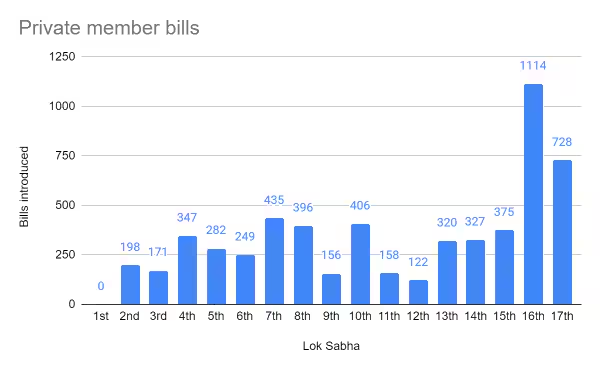
Answer: It is very strange that out of 4000+ public (govt.) bills, almost all 3500+ public bills got passed but out of 1400+ private bills, only 14 private bills could be passed.
Private members’ bills were passed in less numbers due to following reasons:
- Most Parliament time is used for Government business.
- Private Members’ Bills are taken up only on Fridays, often adjourned or disrupted.
- They usually lack government and party support.
- The government dominates law-making and often brings its own Bill on similar issues.
- Many Bills lapse with the dissolution of Lok Sabha.
- Frequent adjournments in Parliament sessions reduce time for Pvt MB discussions.
E.g., in the 17th Lok Sabha (2019-24), 729 Pvt MBs were introduced in the Lok Sabha and 705 in the Rajya Sabha However, only 2 in the Lok Sabha and 14 in the Rajya Sabha were ever discussed. - The Speaker/Chairman’s discretionary power to admit or reject Pvt MB.
- Limited time (only Friday & that too 2.5 hours weekly) is given to Pvt MB.
- Private members don’t have a proper research team (unlike government bills).
- Historically low passage rate of Pvt MBs discourages MPs from putting efforts in Pvt MBs. Only 14 Pvt MBs have passed in 75 years.
- Governments prioritize their own legislative agenda, sidelining Pvt MBs.
14 Private Members’ Bills Passed in India (Since 1947)
| Bill Name | Year | Bill Name | Year |
| 1. The Muslim Wakf Bill | 1952 | 8. The Code of Criminal Procedure Bill | 1957 |
| 2. The Code of Criminal Procedure Bill | 1953 | 9. The Orphanages and other Charitable Homes Bill | 1959 |
| 3. The Women’s and Children’s Institutions (Licensing) Bill | 1954 | 10. The Indian Marine Insurance Bill | 1959 |
| 4. The Ancient and Historical Monuments and Archaeological Sites and National Importance Bill | 1954 | 11. The Hindu Marriage (Amendment) Bill | 1963 |
| 5. The Indian Registration Bill | 1955 | 12. The Indian Penal Code Bill | 1963 |
| 6. The Parliamentary Proceeding (Protection of Publication) Bill | 1956 | 13. The Salaries and Allowances of Members of Parliament Bill | 1964 |
| 7. The Hindu Marriage Bill | 1956 | 14. The Supreme Court (Enlargement of Criminal Appellate Jurisdiction) Bill | 1970 |
Solutions to increase Pvt MBs:
- Allocate fixed, uninterrupted time for PMB discussions, digital tracking of such bills, etc. to ensure at least a few bills are debated each session.
- The criteria for admitting or rejecting Private Members’ Bills should be made clear, transparent, and rule-based.
- Time set aside for Private Members’ Bills should not be taken over by other work.
- A dedicated research team (like the UK’s Public Bill Committee) to help MPs in drafting bills.
- Regular passage of meaningful PMBs will encourage greater participation and legislative innovation among MPs.
- Parliament can introduce a dedicated review committee for screening Bills for quality, relevance, and constitutionality and recommend a priority list for discussion based on public importance and encouraging cross-party support.
- The UK’s 10-Minute Rule Model can also be adopted where MPs can introduce short bills with brief speeches to make their case for a new Bill