Context
Recently, the European Space Agency (ESA) lost contact with one of the spacecraft involved in Proba‑3 Mission, raising concerns about functioning of mission designed to study the Sun’s outer atmosphere.
Q1. What is the Proba-3 Mission?
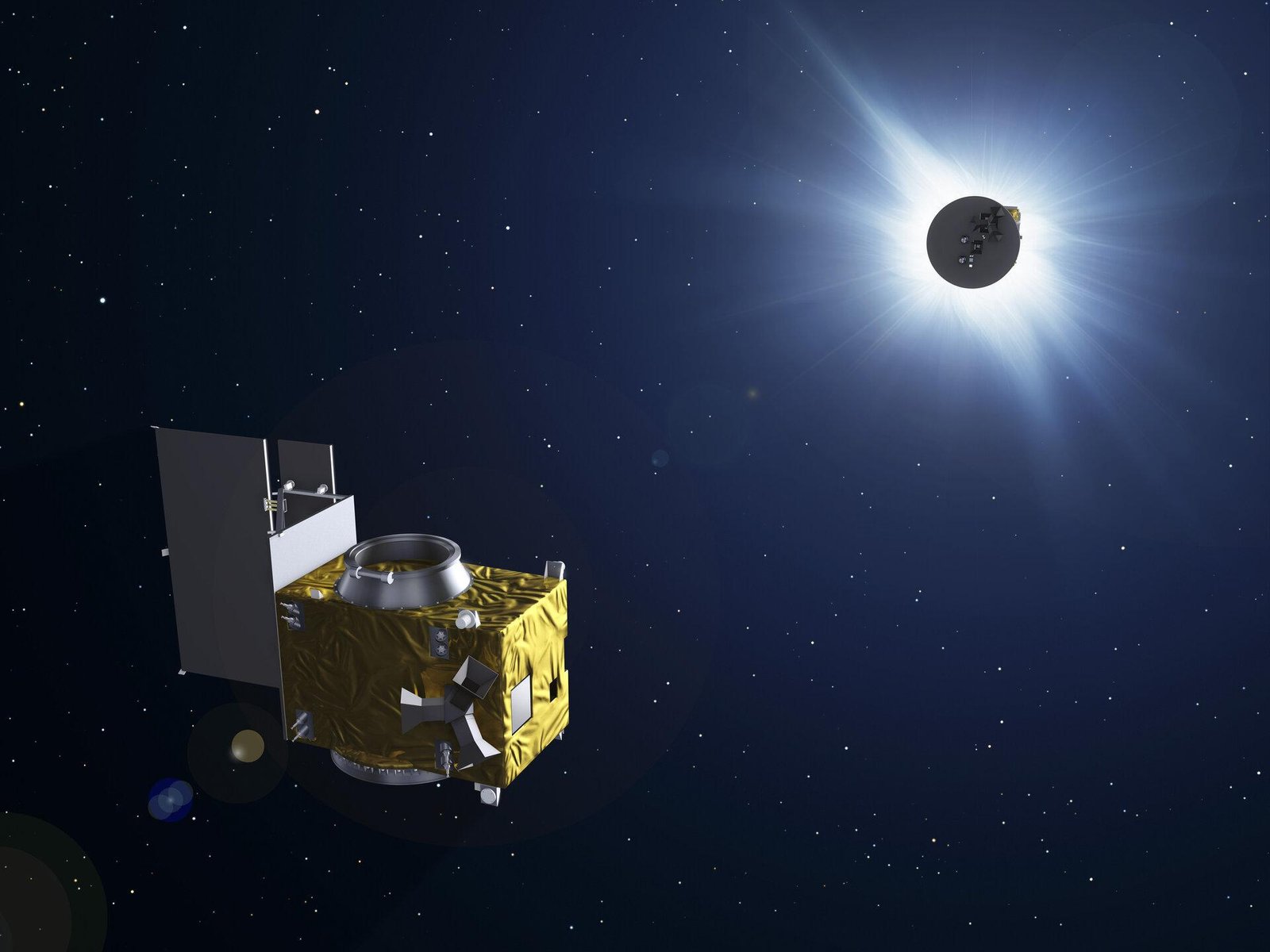
- It is a space mission by ESA to demonstrate high-precision formation flying between satellites.
- In this two spacecraft (Coronagraph spacecraft equipped with telescope & solar-disc-shaped Occulter spacecraft – to block direct light from sun) will operate in close coordination in orbit to stimulate a solar eclipse in space in order to enable direct observation of the Sun’s corona.
Q2. How does the Proba-3 mission create an artificial eclipse?
- The two satellites fly in extremely precise formation, separated by approximately 150 metres.
- The Occulter satellite positions itself between the Sun and the Coronagraph.
- It casts a shadow onto the telescope of the Coronagraph. This blocks the intense solar light.
- The Coronagraph can then capture detailed images of the faint solar corona.
- The telescope will observe the corona in Visible light, Ultraviolet light and Polarised light.
- This setup allows scientists to study the corona for several hours at a time, which is not possible during natural eclipses on Earth.
Q3. Why is studying the Sun’s corona important?
- Studying the corona will help scientists understand solar magnetic activity, solar storms, space weather and energy processes occurring in the Sun’s outer atmosphere better.
- Understanding Coronal Mass Ejections (CMEs): CMEs are massive eruptions of solar plasma and magnetic fields. These events can disrupt satellites, communication systems and power grids on Earth.
- Monitoring Solar Energy Output: The mission will also measure total solar irradiance, which represents the total energy emitted by the Sun. Changes in solar energy output can influence Earth’s climate system.
FAQs
Q1. What is the European Space Agency (ESA) Proba‑3 Mission?
A space mission to demonstrate high‑precision formation flying between two satellites to study the Sun’s corona.
Q2. How does the ESA Proba‑3 Mission create an artificial solar eclipse?
Two satellites fly in formation, about 150 metres apart. The Occulter spacecraft blocks sunlight, allowing the Coronagraph telescope to capture corona images.
Q3. Why is studying the Sun’s corona important in the Proba‑3 Mission?
It helps understand solar magnetic activity, solar storms, and space weather, which affect satellites, communications, and power grids.
Q4. How does the Proba‑3 Mission study Coronal Mass Ejections (CMEs)?
By observing the corona in visible, ultraviolet, and polarised light, scientists can track CMEs that disrupt Earth’s systems.
Q5. What role does the Proba‑3 Mission play in monitoring solar energy output?
It measures total solar irradiance, the Sun’s energy output, which influences Earth’s climate system.