1. Djibouti
Context
Djibouti became the 72nd country and eighth African country to sign the Artemis Accords during a ceremony held at NASA Headquarters in Washington, D.C.
Location
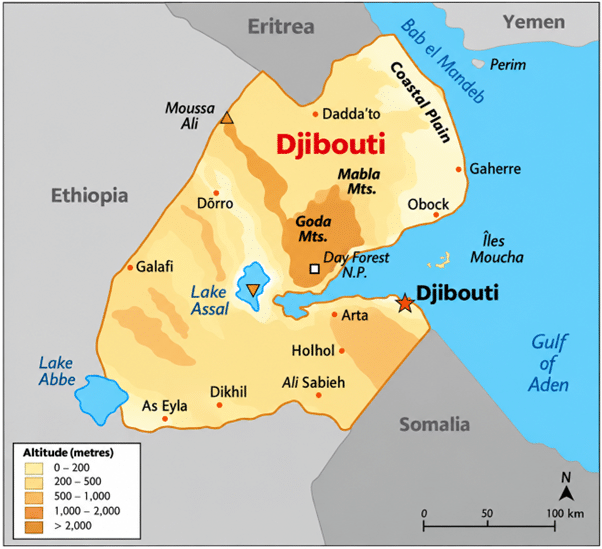
- Djibouti is an East African country located in the Horn of Africa. It occupies a strategic geographical position near the junction of the Red Sea, Gulf of Aden and East African Rift systems.
- The country is bordered by Eritrea to the north, Ethiopia to the west and south, and Somalia to the south.
- Djibouti has coastlines along the Red Sea and Gulf of Aden. Its capital city is Djibouti.
Geographical Features
- Climate: Djibouti experiences a dry tropical climate, characterised by high temperatures and high rates of evaporation throughout the year.
- Highest Point: Mount Moussa Ali is the highest point in the country, with an elevation of about 2,028 metres.
- Danakil Depression: The Danakil Depression covers parts of central and southern Djibouti and is characterised by an extremely arid and harsh landscape.
- Drainage: Djibouti does not have significant permanent rivers. However, temporary watercourses or wadis are present, particularly during the rainy season.
- Natural Resources: The country’s important natural resources include salt, petroleum, gold, clay, marble, pumice, gypsum and diatomite.
2. Lord Howe Island
Context
Lord Howe Island has recently gained attention following a 16-year study that found high levels of plastic ingestion among fledgling sable shearwaters
Location
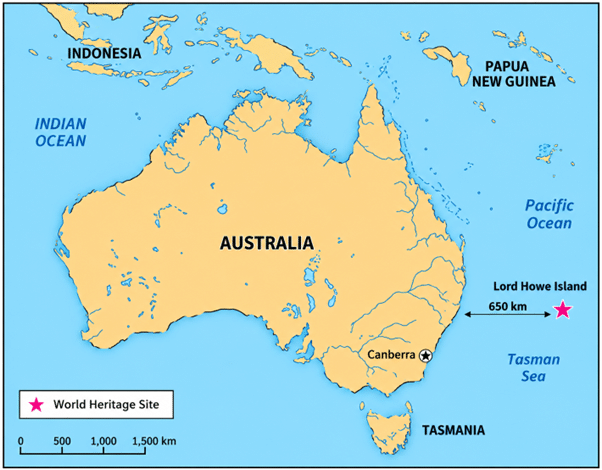
- Lord Howe Island is a crescent-shaped volcanic island located in the Tasman Sea, about 650 km off the eastern coast of Australia.
- The island was discovered in 1788 by Lieutenant Henry Lidgbird Ball of the British Navy and was named after Admiral Lord Howe.
Geographical Features
- The southern part of the island contains Mount Gower and Mount Lidgbird, both rising above 760 metres.
- Lord Howe Island has the southernmost coral reef in the world.
- Its volcanic origin and surrounding marine environment contribute to its distinctive terrestrial and marine ecosystems.
Biodiversity
- Around 47% of its vascular plant species are endemic, meaning they are naturally restricted to the region.
- The Kentia Palm (Howea forsteriana) is among its notable plant species.
- The island is home to endemic fauna such as the Lord Howe Island Phasmid, considered the world’s largest stick insect, and the flightless Lord Howe Woodhen (Gallirallus sylvestris).
- It supports the world’s largest known population of sable shearwaters, estimated at about 22,000 breeding pairs.
Conservation Significance
The Lord Howe Island Group is a UNESCO World Heritage Site, recognised for its distinctive plants, animals and high level of endemism.