Context
Leh recently became the centre of a significant spiritual event as the sacred Piprahwa relics of Gautam Buddha were brought to the high-altitude town, marking a notable moment of religious and historical importance in Ladakh.
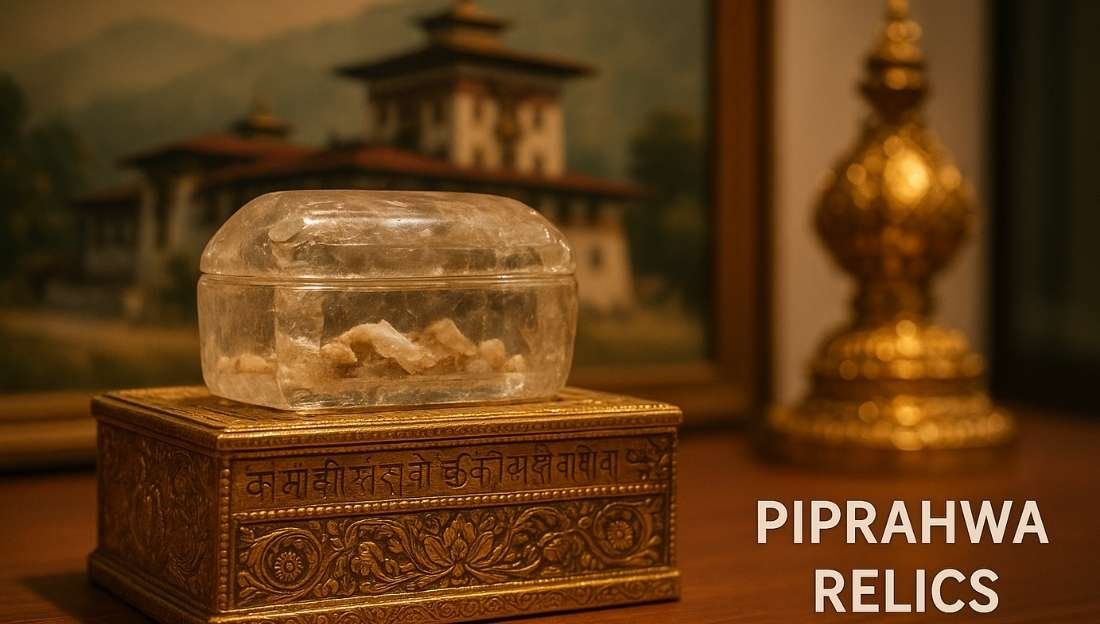
About Piprahwa Relics
- India has taken urgent steps after reports emerged of a planned Sotheby’s auction of certain Piprahwa relics in Hong Kong, with the Ministry of Culture issuing a legal notice to stop the sale.
- These relics, found in 1898 at the Piprahwa Stupa in Uttar Pradesh, are linked to ancient Kapilavastu and are traditionally associated with Gautam Buddha’s early life.
- The findings include sacred objects such as bone remains, crystal containers, gold ornaments, and other ritual items.
- A Brahmi inscription on one of the caskets connects the relics to Gautam Buddha and states they were placed by the Sakya clan.
- Legally, the artefacts are classified as ‘AA’ category antiquities in India, giving them the highest level of heritage protection.
- The find made by William Claxton Peppé was brought under British authority through the Indian Treasure Trove Act of 1878.
- A portion of the relics, including bone fragments and ashes, was subsequently presented to King Chulalongkorn of Siam (present-day Thailand), a revered Buddhist monarch.
- While most of the collection was transferred to the Indian Museum in Kolkata in 1899, some pieces remained with the descendants of British excavator William Claxton Peppé and have recently surfaced in the international market.
- Between 1971 and 1977, the Archaeological Survey of India carried out further excavations at the site and recovered more steatite caskets containing 22 sacred bone relics, which are currently housed in the National Museum in New Delhi.