Context
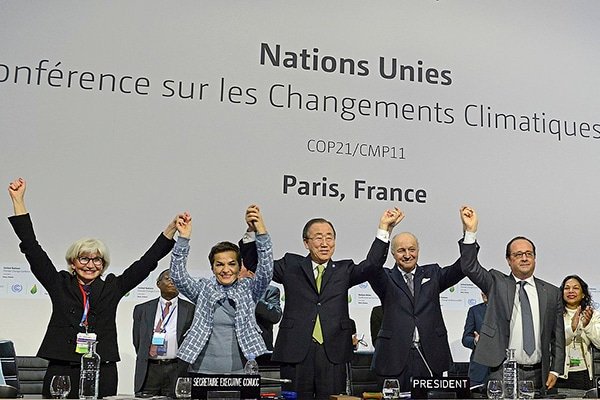
Ten years after the adoption of the Paris Agreement (2015, COP21), the world stands at a crucial juncture. Despite collective efforts, global emissions and temperatures continue to rise. However, the agreement has succeeded in bending the curve, the world is now on a 2-3°C trajectory, compared to the earlier 4-5°C projection.
About the Paris Agreement
- Adopted at COP21 in Paris (2015) under the UNFCCC
- Aim: To limit global warming well below 2°C and pursue efforts to limit it to 1.5°C above pre-industrial levels.
- Built on the principles of equity and common but differentiated responsibilities (CBDR).
- Each country submits Nationally Determined Contributions (NDCs) reflecting its national circumstances.
Progress over the Decade
| Area | 2015 | 2025 (Now) | Outcome |
| Projected Warming | 4-5°C | 2-3°C | Paris Agreement slowed warming trajectory |
| Energy Source | Fossil fuels dominant | Renewables (solar, wind, hydro) competitive | Major shift in energy economics |
| Electric Mobility | Nascent stage | 20% of new global car sales are EVs | Technological transformation |
| Multilateral Initiatives | Fragmented | Rise of ISA, CDRI | Strengthened climate cooperation |
International Solar Alliance (ISA): A Case Study
- Launched at COP21 by India and France.
- Now has 120+ member and signatory countries.
- Focus: To make solar energy accessible, affordable, and sustainable through capacity building and financing.
- Achievements:
- Global solar capacity-building programs.
- Support for underfunded clean energy transitions.
- India’s milestones:
- Achieved 50% of installed electricity capacity from non-fossil sources, 5 years ahead of target.
- Commitment: Net-zero by 2070 and Viksit Bharat by 2047 through a low-carbon path.
Five Priorities for COP30 (Belém, Brazil)
- Raise Global Ambition: Accelerate carbon reduction efforts.
- Ensure Just & Inclusive Transition: Focus on vulnerable communities.
- Protect Natural Carbon Sinks: Safeguard forests, oceans, mangroves.
- Empower Non-State Actors: Engage local bodies, civil society, businesses.
- Defend Climate Science: Support IPCC and counter misinformation.
Challenges and Way Forward
| Challenge | Way Forward |
| 1. Persistently High Emissions | Strengthen and revise Nationally Determined Contributions (NDCs) to align with the 1.5°C target; enhance carbon pricing and promote renewable energy adoption globally. |
| 2. Unequal Energy Transitions | Ensure technology transfer and concessional finance for developing nations; operationalize the Just Energy Transition Partnerships (JETPs) framework. |
| 3. Climate Finance Gap | Scale up funding for Green Climate Fund and Loss & Damage Fund; establish predictable and innovative sources such as global solidarity levies and green bonds. |
| 4. Neglect of Natural Carbon Sinks | Implement afforestation, mangrove restoration, and ocean-based carbon sequestration projects; promote community–led conservation models. |
| 5. Climate Disinformation & Political Backsliding | Strengthen global climate communication, support IPCC and scientific research, and foster climate literacy to build informed public consensus. |
Significance for India
- India’s leadership in ISA and CDRI underscores its climate diplomacy and green energy leadership.
- Aligns with Mission LiFE (Lifestyle for Environment) and India’s Green Hydrogen Mission.
- Strengthens India’s narrative of climate justice and equity at global forums.
Conclusion
The Paris Agreement has transformed global climate governance, shifting the world toward renewables and cooperative multilateralism. While challenges remain, the transition is irreversible, driven by science, markets, and public awareness. The next decade must focus on speed, scale, and solidarity to achieve climate justice and sustainable growth.
| Ensure IAS Mains Question
Q. “Ten years after its adoption, the Paris Agreement continues to shape global climate action. Evaluate its achievements and limitations in the context of India’s climate commitments.” (250 words) |
| Ensure IAS Prelims Question
Q. Consider the following statements about the Paris Agreement: 1. It is a legally binding international treaty adopted under the UNFCCC framework. 2. It aims to limit global warming to well below 2°C and pursue efforts to limit it to 1.5°C. 3. It provides the same emission reduction commitments for all countries. Which of the statements given above is/are correct? a) 1 and 2 only b) 2 and 3 only c) 1 only d) 1, 2 and 3 Answer: a) 1 and 2 only Explanation: Statement 1 is correct: The Paris Agreement is a legally binding treaty adopted under the UNFCCC to strengthen global response against climate change. Statement 2 is correct: It seeks to limit global warming to well below 2°C and pursue efforts to restrict temperature rise to 1.5°C. Statement 3 is incorrect: It follows the principle of Common but Differentiated Responsibilities; hence, all countries have different, not identical, commitments. |