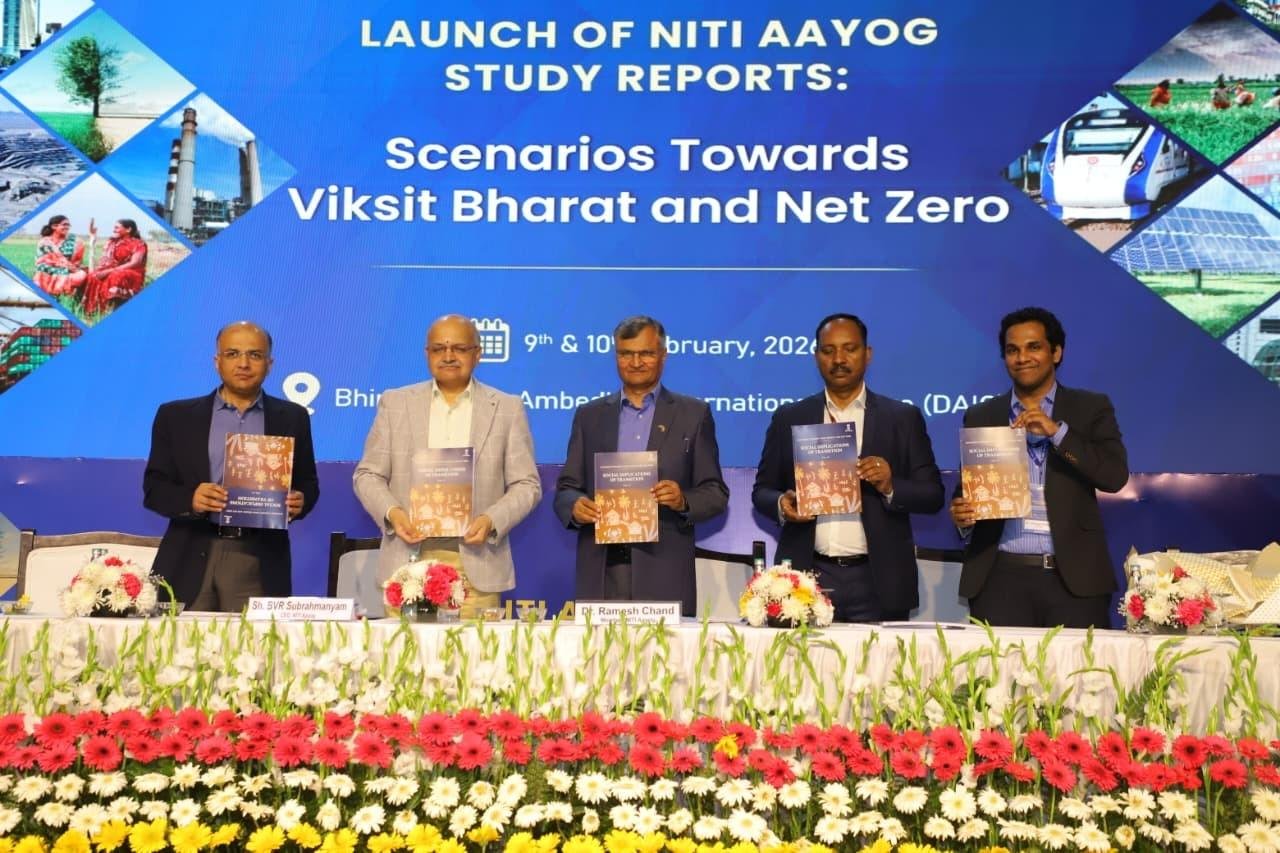
- News: NITI Aayog publishes a report, titled Scenarios Towards Viksit Bharat and Net Zero. This report provides a roadmap for how India can transform its agriculture to support a developed economy while cutting down environmental footprints.
- The Current State of Indian Agriculture
- Workforce & Economy: It supports 46% of our workforce and contributes about 14% to the Gross Value Added (GVA).
- Production Success: A massive jump in food grain production—from 285 million tonnes in 2011 to 332 million tonnes in 2023-24.
- The Environmental Cost: Agriculture sector accounts for 14% of national Greenhouse Gas (GHG) emissions. This is mainly due to methane from rice cultivation and livestock, and nitrous oxide from fertilizers. It also consumes 18% of national electricity, mostly for pumping groundwater.
- The Strategy: Strategic Sequencing: To reach “Net Zero” by 2070 without hurting farmers’ incomes, NITI Aayog suggests a plan called Strategic Sequencing. This means doing things in a specific, smart order:
- Resource Efficiency First: Focus on micro-irrigation (drip and sprinkler systems) and fertilizer optimization to save costs and improve soil health immediately.
- Crop Diversification: Shifting away from water-heavy crops like rice and sugarcane toward more sustainable options.
- Energy Transition: Increasing the use of solar and electric pumps to save energy and reduce carbon footprints.
- Future Emission Scenarios: The report compares two different paths for India:
- Current Policy Scenario (CPS): If we continue as we are, non-energy emissions will rise from 506 MtCO₂e today to 531 MtCO₂e by 2070.
- Net Zero Scenario (NZS): If we follow the new roadmap, we can bring emissions down to 399 MtCO₂e. This offers a 25% mitigation benefit while still keeping India on the path to becoming a developed nation (Viksit Bharat) by 2047.
- Key Policy Recommendations
- Integrate Demand and Supply: Create specific roadmaps that look at both what farmers produce and what the market needs.
- Institutionalize Agri-Food Systems: Treat agriculture not just as “farming,” but as an integrated system from the field to the fork.
- Support Small Farmers: Since the majority of Indian farmers are small and marginal, all new technologies must be affordable and accessible to them.
- By following this “Viksit Bharat” roadmap, India can ensure food security for its billions while also leading the world in sustainable, low-carbon farming.