Why in the News?
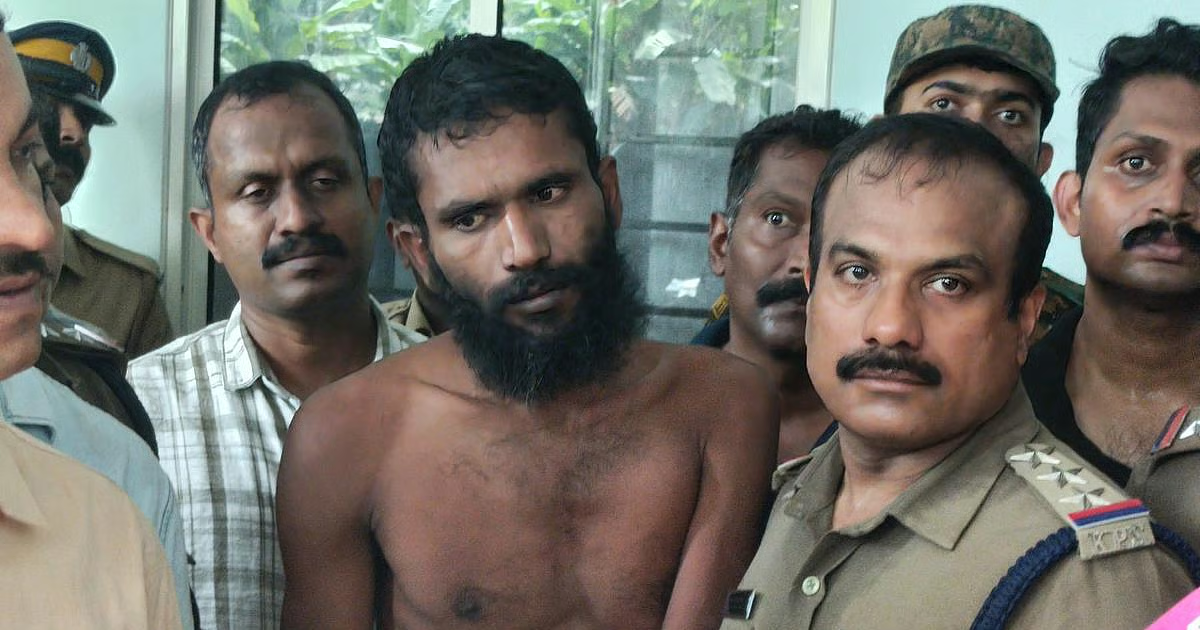
- A life convict, Govindachamy, convicted in a 2011 rape-and-murder case, escaped from Kannur Central Prison, sparking state-wide alert.
- The dramatic capture within hours exposed severe lapses in Kerala’s prison infrastructure, surveillance, and management.
- The incident has triggered a comprehensive review and debate on the condition of jails and the functioning of the Prisons and Correctional Services in Kerala and India at large.
Key Highlights
- The Escape and Recapture
- Govindachamy escaped around 1 a.m. using a rope made of collected cloth and scaled three walls with water drums.
- The absence of functional electric fencing and non-working surveillance systems aided his escape.
- He was spotted by a vigilant citizen and later found hiding in a well near a government office.
- Method of Escape
- He modified his diet to lose weight and squeezed through narrow iron bars using a suspected hacksaw blade.
- The escape went unnoticed until roll call, indicating poor internal vigilance.
- A makeshift rope and other escape tools were found, revealing the lack of material control inside the prison.
- Institutional Negligence
- Officers failed to observe changes like his sudden beard growth and weight loss.
- The CCTV systems were defunct, and routine patrols ignored loose materials that could aid escape.
- Block 10, meant for solitary confinement, housed two inmates in cramped cells of 6 ft x 6 ft, worsening conditions.
- Systemic Weaknesses in Prisons
- Kerala prisons are overcrowded with a 135% occupancy rate, higher than the national average.
- Many jails are old British-era buildings lacking modern surveillance infrastructure.
- Shortage of personnel– Only 2,289 officers against a requirement of 3,600 forces reliance on daily wage contract workers.
- Political and Structural Issues
- Allegations of political interference, especially in Kannur, with accusations that advisory panels have political control over operations.
- Inadequate funding and bureaucratic delays prevent maintenance of critical infrastructure like CCTV and electric fencing.
- The escape has led to a judicial and administrative probe ordered by the Chief Minister.
Constitutional Provisions Related to Prisons:
- Article 246 & Seventh Schedule – State List (List II), Entry 4
- Prisons and the reformatories fall under the exclusive legislative jurisdiction of the States.
- Entry 4: “Prisons, reformatories, Borstal institutions and other institutions of a like nature.”
- Article 39A – Directive Principles of State Policy (DPSP)
- Ensures free legal aid to the poor and weaker sections of society.
- Aims to promote justice on the basis of equal opportunity, especially relevant for prisoners’ rights and access to justice.
- Article 21 – Right to Life and Personal Liberty
- Interpreted by the Supreme Court to include prisoners’ rights, such as:
- Right to fair and speedy trial
- Protection from custodial violence
- Interpreted by the Supreme Court to include prisoners’ rights, such as:
- Humane conditions in prison
- Right to legal aid, parole, and rehabilitation
- Article 22 – Protection of Arrested Persons
- Safeguards available to those taken into custody:
- Right to be informed of grounds of arrest
- Right to consult and be defended by a legal practitioner of choice
- Safeguards available to those taken into custody:
- Right to be produced before a magistrate within 24 hours
- Article 14 – Right to Equality
- Prisoners are entitled to equal treatment under the law, without discrimination.
- Article 32 & 226 – Right to Constitutional Remedies
- Enable prisoners or their families to approach the Supreme Court or High Courts for enforcement of their rights, including habeas corpus petitions in case of unlawful detention.
Implications
- On Public Safety
- Immediate danger posed to the public due to escape of a high-profile life convict.
- Vigilant citizen response played a key role, but reliance on public effort indicates system failure.
- On Prison Administration
- Exposes the deterioration of prison oversight, including surveillance, staffing, and inspection protocols.
- Points to the need for a complete audit of prison security mechanisms.
- On Criminal Justice System
- Weak prison security undermines the finality of judicial punishment.
- May lead to public distrust in the justice system’s ability to securely hold convicts.
- On Policy and Governance
- Highlights need for reforms in jail staffing, equipment maintenance, and inmate management.
- Could push the government to finally implement modernisation schemes long left pending.
- On Political and Administrative Accountability
- Raises questions about politicisation of prison administration.
- Brings scrutiny on the efficacy of jail advisory committees and prison oversight bodies.
Challenges and Way Forward
| Challenges | Way Forward |
| Non-functional CCTV and surveillance systems | Immediate repair and maintenance contracts for prison security infrastructure |
| Overcrowded prisons with limited staff | Expansion of jail capacity and recruitment to meet standard occupancy and monitoring levels |
| Use of temporary contract workers lacking accountability | Establish a trained and permanent prison workforce governed by clear service rules |
| Political interference in prison management | Establish independent prison management boards with judicial oversight |
| Outdated infrastructure and poor monitoring | Implement state-wide Prison Modernisation Programme with proper funding and timelines |
Conclusion
The escape of Govindachamy from Kannur Central Prison has served as a wake-up call for India’s prison system. It revealed deep-rooted flaws such as outdated infrastructure, staff shortages, poor surveillance, and politicisation of jail administration. While the quick recapture avoided a major crisis, the incident underscores the urgent need for systemic reforms to ensure that prisons are secure, humane, and professionally managed. A robust follow-through on judicial inquiry recommendations will be critical in restoring public confidence and institutional efficiency.
| EnsureIAS Mains Question
Q. “The recent jailbreak incident in Kerala is not just a security lapse but a symptom of systemic weaknesses in the prison administration.” Critically examine the structural, institutional, and political challenges facing prison reforms in India. Suggest a multi-pronged strategy to strengthen prison governance. (250 Words) |
| EnsureIAS Prelims Question
Q. Consider the following statements regarding prison administration in India: 1. The average occupancy rate in Indian prisons is less than 100%, indicating underutilization. 2. Electric fencing and CCTV surveillance are mandatory in all central prisons. 3. The Prison system is a State subject under the Seventh Schedule of the Indian Constitution. 4. Contractual staff in prisons are governed by the same service rules as permanent staff. Which of the above statements is/are correct? Answer: b. |