Why in the News?
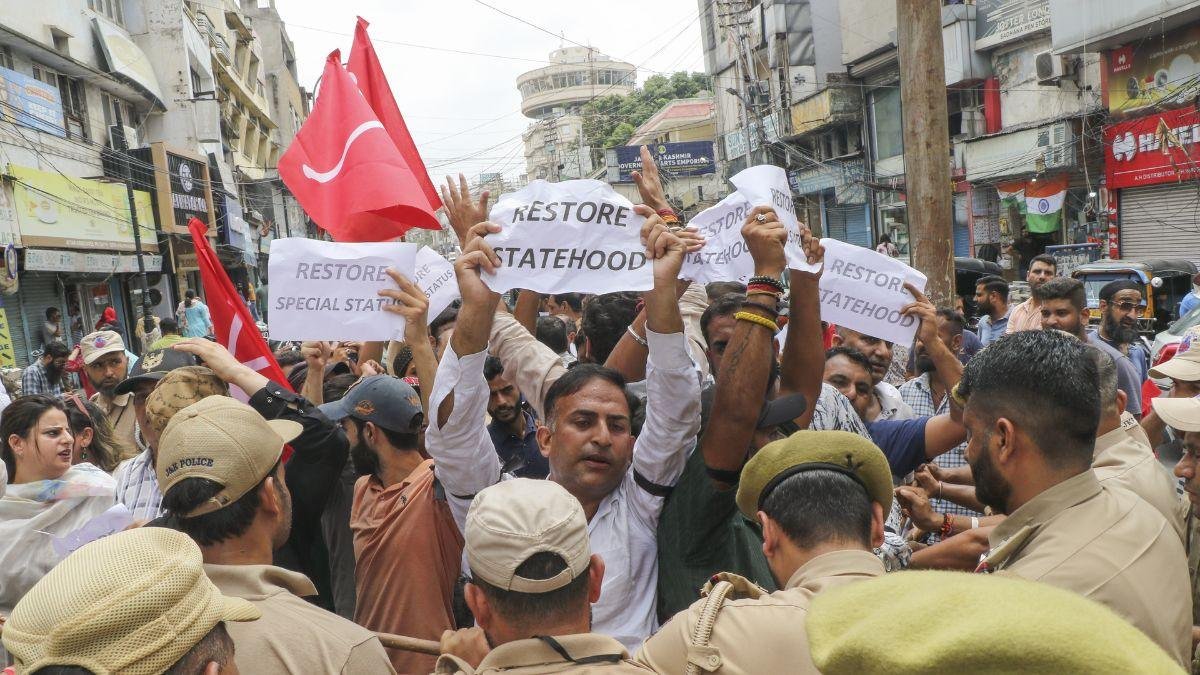
- August 5, 2025 marks six years since the abrogation of Article 370 which granted special status to Jammu & Kashmir (J&K).
- The event is seen as a turning point for political restructuring, security measures, and economic changes in the region.
- However, some security incidents like the Pahalgam terror attack have raised concerns about the stability narrative.
Key Highlights
- Political Representation with Restrictions
- Political activity has resumed in J&K after years of stagnation.
- Panchayat elections and formation of political parties have occurred.
- The region lacks full statehood, and legislative powers remain curtailed.
- Security Landscape
- Security forces have killed over 720 terrorists since 2019.
- Infiltration has declined (from 130 in 2019 to 27 in 2024).
- Despite progress, recent attacks like the Pahalgam ambush have shaken the perception of normalcy.
- Governance and Institutional Developments
- Introduction of three-tier Panchayati Raj.
- Increase in the number of districts (from 14 to 20).
- Growth in administrative decentralization and recruitment of locals in governance.
- Economic Growth and Investment
- 2022 saw ₹1,547 crore worth investment; 2023 saw ₹2,153 crore.
- Over 5 lakh crore investments proposed across sectors like health, education, IT, and infrastructure.
- Employment generation for over 50,000 locals.
- Tourism and Public Perception
- Tourist footfall surged to 11 crore in 2023.
- Tourism was recently hit by terror incidents, creating uncertainty (Pahalgam attack).
- Centre continues to promote J&K as a safe and secure destination, but confidence remains shaken.
About Article 370
- Background
Article 370 granted special autonomous status to Jammu and Kashmir (J&K), influencing the region’s governance and its constitutional relationship with India. Its origins lie in the unique historical and political circumstances surrounding the state’s accession to India in 1947.- Pre-Independence Context:
Before India’s independence, Jammu and Kashmir was a princely state ruled by Maharaja Hari Singh. Unlike many other princely states, J&K initially chose to remain independent after the British left in 1947. The state held strategic importance due to its borders with Pakistan, China, and Afghanistan. - Accession to India:
In October 1947, following an invasion by tribal militias supported by Pakistan, Maharaja Hari Singh signed the Instrument of Accession with India. Under this agreement, India assumed responsibility for defence, foreign affairs, and communications, while Jammu and Kashmir retained autonomy in other matters. - Drafting of Article 370:
To formalise the terms of this special arrangement, Article 370 was incorporated into the Indian Constitution, drafted by Gopalaswami Ayyangar. This article served to define the constitutional status of J&K within the Indian Union. - Temporary and Transitional Nature:
Article 370 was introduced as a temporary provision, until the Jammu and Kashmir Constituent Assembly draft the state’s own constitution and determine the final nature of its relationship with India. It was intended to provide a transitional mechanism to ease the integration process, especially in light of the volatile security situation at the time. - Scope of Autonomy:
The article granted broad autonomy to Jammu and Kashmir. The state was allowed to have its own constitution, and the Indian Parliament’s legislative powers were limited to specific areas unless extended with the state’s concurrence.
- Pre-Independence Context:
- Constitutional Provisions
- Special Autonomy: Jammu and Kashmir had their own constitution and autonomy over internal matters except for defence, communications, finance, and foreign affairs.
- Limited Legislative Powers: The Indian Parliament’s legislative powers over the state were limited to the subjects mentioned in the Instrument of Accession.
- Presidential Orders: Any extension of Indian laws to Jammu and Kashmir required the concurrence of the state’s government and a Presidential Order.
- Separate Constitution: The state had its own constitution, which was adopted on November 17, 1956, and came into effect on January 26, 1957.
- Residency Rights: Article 35A, derived from Article 370, granted special rights and privileges to the state’s permanent residents, including property rights and employment.
- Criticisms
- A barrier to Integration: Some argued that Article 370 acted as a barrier to Jammu and Kashmir’s full integration with the rest of India, instilling a sense of separateness and special status.
- Economic Development: Critics argued that the special status hampered regional economic development and investment because Indian property and business laws did not apply.
- Rights and Equality: The special rights and privileges granted to Jammu and Kashmir residents were interpreted as discriminatory against non-residents, affecting their rights to property and employment.
- Militancy and Insurgency: Some critics blamed Article 370 for the rise of militancy and insurgency in the region, claiming that the special status fostered a sense of alienation and separatism.
- Abrogation
On August 5, 2019, the Government of India abrogated Article 370 of the Indian Constitution, revoking J&K’s special status. This historic move was accompanied by the bifurcation of the state into two Union Territories: Jammu and Kashmir and Ladakh.- Process of Abrogation of Article 370 of the Indian Constitution
- This complex process involved a Presidential order, parliamentary approval, and the enactment of the Jammu and Kashmir Reorganisation Act 2019.
- Presidential Order: On August 5, 2019, President of India issued the Constitution (Application to Jammu and Kashmir) Order, 2019, which superseded the 1954 order and applied all provisions of the Indian Constitution to Jammu and Kashmir.
- Process of Abrogation of Article 370 of the Indian Constitution
- Parliamentary Approval: The Government of India introduced a resolution in the Rajya Sabha to abrogate Article 370, along with a bill to reorganise Jammu and Kashmir into two Union Territories. Both houses of Parliament passed the resolution and the bill with a two-thirds majority.
- Jammu and Kashmir Reorganisation Act, 2019: This act was passed by Parliament to reorganise the state of J&K into two Union Territories: Jammu and Kashmir (with a legislative assembly) and Ladakh (without a legislative assembly). The reorganisation took effect on October 31, 2019.
- Criticisms of the Abrogation of Article 370
- Legal Concerns: Critics argued that the abrogation bypassed the constitutional process, particularly the requirement for the J&K Constituent Assembly’s concurrence, which no longer existed.
- Political Opposition: Various political parties and leaders in Jammu and Kashmir viewed the move as an affront to the state’s autonomy and identity.
- Human Rights: Concerns were raised about the human rights implications, including restrictions on movement, communication blackouts, and detentions of political leaders.
- Local Sentiments: There were concerns that the move disregarded the sentiments of the local population, leading to political unrest and alienation.
Implications
- Governance & Representation
- Shift to direct control by Centre enhanced administrative efficiency.
- Decentralized governance with Panchayats boosted grassroots participation.
- Continued absence of legislative elections limits democratic legitimacy.
- Security and Stability
- Counter-insurgency success improved law and order.
- Reduced infiltration contributed to border security.
- Recurring attacks, however, raise questions about sustainable peace.
- Socio-Economic Transformation
- Real estate, hospitality, and IT sectors see investor interest.
- Increase in youth employment and industrial training programs.
- Disparities in economic development persist across regions.
- Tourism & Culture
- Jammu & Kashmir is branded as a global tourism destination.
- Revival of cultural festivals and public engagement.
- Safety perception critical to maintaining momentum.
- National Integration
- The abrogation of Article 370 integrated J&K more tightly with India.
- Mixed public reception; some view it as empowering, others see it as central overreach.
- Long-term peacebuilding efforts required for full integration.
Challenges and Way Forward
| Challenges | Way Forward |
| Recent terror attacks have disrupted tourism | Strengthen intelligence and surveillance systems in vulnerable zones |
| Delayed legislative elections and lack of full statehood | Create a timeline for restoring legislative democracy |
| Public mistrust and alienation in parts of the Valley | Increase dialogue, ensure justice and equitable development |
| Investment not evenly distributed | Focus on balanced regional development and sectoral diversity |
| Over-centralization of decision-making | Empower local governance institutions and ensure people’s participation |
Conclusion
Six years after the abrogation of Article 370, Jammu & Kashmir has seen marked improvements in security, investment, and administrative integration. However, challenges remain, particularly in balancing central oversight with democratic representation, ensuring sustained peace, and fostering inclusive development. The recent terror attack reminds us that while progress is visible, a permanent solution demands consistent and sensitive governance rooted in trust and participation.
| EnsureIAS Mains Question Q. Six years since the abrogation of Article 370, critically analyse the extent to which it has transformed governance, security, democratic representation, and socio-economic development in Jammu & Kashmir. Also discuss the persisting challenges and the way forward. (250 Words) |
| EnsureIAS Prelims Question Q. With reference to the Union Government’s actions in Jammu & Kashmir post-2019, consider the following statements: 1. The Panchayati Raj system in Jammu & Kashmir was made operative in a three-tier structure only after the abrogation of Article 370. 2. The Union Government has full legislative competence over Jammu & Kashmir after August 5, 2019. 3. The state of Jammu & Kashmir currently enjoys the status of a full-fledged state. Which of the statements given above is/are correct? a. 1 and 2 only Answer: a. 1 and 2 only Explanation: |