Important questions for UPSC Pre/ Mains/ Interview:
|
Context
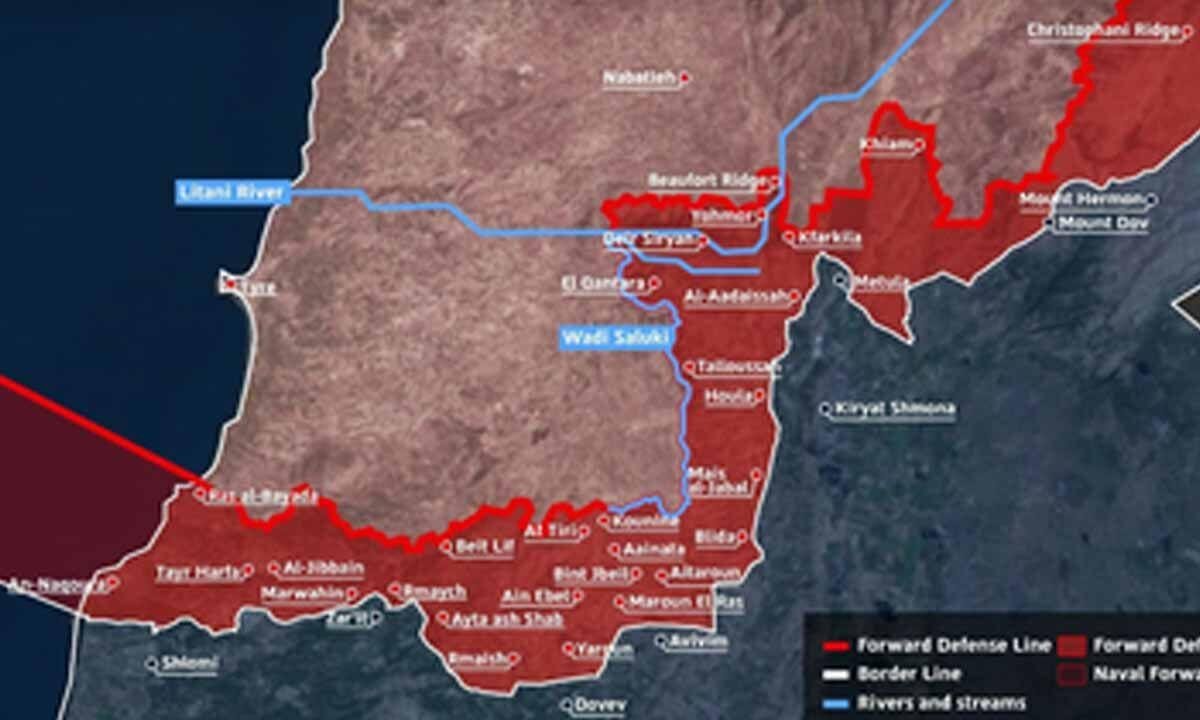
Israel’s announcement of a “Yellow Line” buffer zone in southern Lebanon during a ceasefire signals a shift toward forward defence and deeper territorial control, raising strategic and humanitarian concerns.
Q1. What is the “Yellow Line” strategy of Israel, and how has it evolved in recent conflicts in Gaza and Lebanon?
- The “Yellow Line” is a military buffer boundary created by Israel inside conflict zones to enhance security.
- It first emerged during the 2025 Gaza war as a demarcation between Israeli-controlled and Palestinian-held areas.
- Initially conceived as a temporary security measure, it is increasingly becoming a permanent feature of military doctrine.
- Recently, it has been extended into southern Lebanon up to the Litani River, reflecting a broader strategic application.
- The evolution shows a shift from short-term containment to long-term territorial control.
Q2. What are the strategic objectives behind Israel’s Yellow Line as a forward defensive doctrine?
- The strategy aims to create a forward defensive buffer beyond Israel’s borders.
- It seeks to prevent militant groups like Hamas and Hezbollah from regrouping near border areas.
- Enables pre-emptive control of territory, reducing immediate security threats.
- Facilitates monitoring and rapid military response in sensitive zones.
- Reflects a shift toward proactive defence rather than reactive military operations.
Q3. How has the Yellow Line redefined the operational theatre and military doctrine of the Israel Defense Forces (IDF)?
- The IDF has shifted from mobile warfare to a static defensive posture.
- The Yellow Line functions as a fixed, fortified boundary rather than a temporary frontline.
- It enables long-term territorial management of conflict zones.
- Large areas (e.g., significant parts of Gaza) are treated as restricted or free-fire zones.
- This marks a doctrinal change toward sustained control and battlefield restructuring.
Q4. What are the key features of the infrastructure and military deployment supporting the Yellow Line strategy?
- Construction of fortified defensive structures, including:
- Elevated earth mounds
- Communication towers
- Deployment of large troop formations, including multiple military divisions.
- Establishment of heavily monitored and restricted zones.
- High logistical and resource requirements to maintain continuous surveillance and control.
Q5. What is the “Gaza Model,” and how does it extend the Yellow Line strategy to other regions like Lebanon?
- The “Gaza Model” refers to replicating the Yellow Line approach beyond Gaza.
- It involves creating deep, militarised buffer zones inside neighbouring territories.
- In Lebanon, it extends up to the Litani River, aiming to dismantle militant infrastructure.
- Unlike earlier political boundaries (e.g., Green Line), it is a military-controlled zone within hostile territory.
- It represents a shift toward permanent, control-oriented security arrangements.
Q6. What are the humanitarian, legal, and international concerns associated with the Yellow Line strategy?
- Concerns of violation of international humanitarian law and ceasefire agreements.
- Reports of civilian casualties and restricted access to essential areas.
- Allegations of forced displacement and land control in affected regions.
- Limitation of civilian movement leading to economic and humanitarian distress.
- Criticism by international organisations regarding disproportionate military actions.
Q7. What are the internal criticisms and potential risks of Israel’s Yellow Line strategy?
- Critics argue it may become a strategic liability rather than an advantage.
- Static defence positions can expose troops to guerrilla attacks, snipers, and missiles.
- High resource and manpower requirements make it logistically demanding.
- Historical parallels with prolonged occupations suggest risk of long-term attrition warfare.
- Raises concerns about sustainability and escalation of conflict.
Conclusion
The Yellow Line strategy reflects a major shift toward forward, control-based defence, but it carries significant strategic, humanitarian and geopolitical risks. Its long-term impact will shape the future of regional security dynamics.