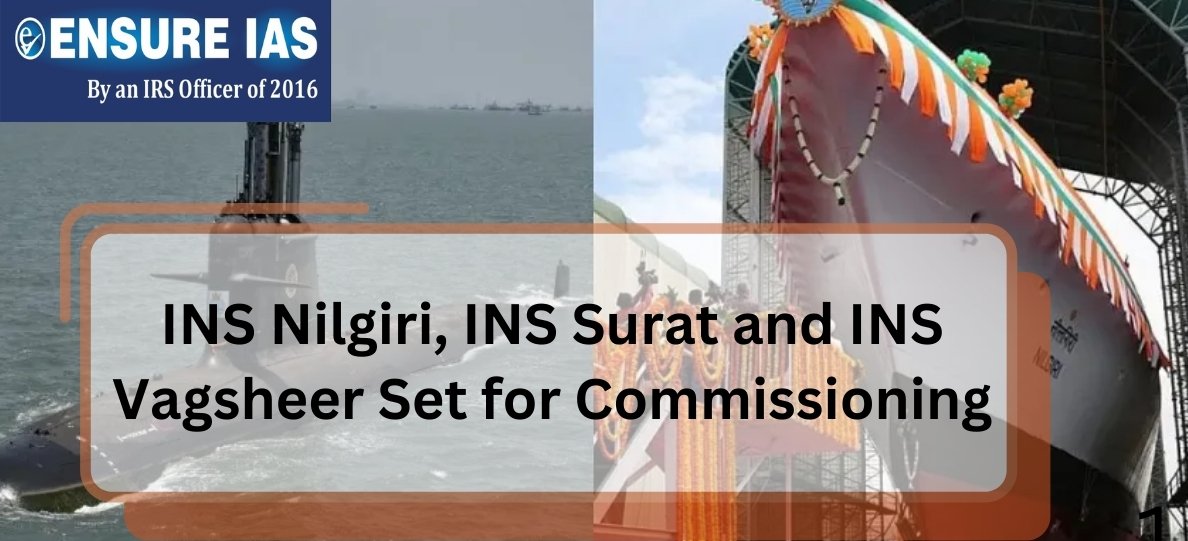
- On January 15, 2025, India will mark a landmark moment in its defense history with the commissioning of three frontline naval platforms:
-
- INS Vagsheer, the 6th and last submarine of the Scorpene-class under Project 75;
- INS Nilgiri, the lead ship of the Project 17A stealth frigates; and
- INS Surat, the 4th and final ship of the Project 15B stealth destroyers.
- This significant event highlights India’s increasing self-reliance in defense manufacturing and its efforts to strengthen maritime capabilities.
What is INS Vagsheer?
- INS Vagsheer is the 6th and final submarine under Project 75, marking the end of India’s Scorpene-class submarine program.
- Named after a deep-sea predator, Vagsheer represents one of the most silent and versatile diesel-electric submarines globally.
- Built at Mazagon Dock Shipbuilders Limited (MDL), Mumbai, under a $3.75 billion technology transfer deal with France’s Naval Group.
Key Capabilities
- Stealth and Combat: Designed for a variety of missions, including: anti-surface warfare, anti-submarine warfare, intelligence gathering and area surveillance, and special operations.
-
- Equipped with wire-guided torpedoes and anti-ship missiles, enhancing its strike capabilities.
- Sensors and Systems: Features advanced sonar systems for superior detection and tracking of enemy vessels.
-
- Equipped with modular construction, enabling easier integration of future technological upgrades.
-
Specifications:
-
- Dimensions: Length: ~220 feet and Height: ~40 feet.
- Speed: Has speed of around 11 knots (~20 km/h) when surfaced and 20 knots (~37 km/h) when submerged.
- Endurance: Operates independently without refuelling for around 50 days.
- Propulsion: Diesel-electric propulsion system:
-
- Diesel engines for surface operation.
- Electric motors for underwater operation.
-
- Technological Advancements: Future retrofitting of Air Independent Propulsion (AIP) systems will enhance underwater endurance by reducing the need to surface for oxygen.
- This also improves stealth, a critical factor for submarine operations in adversary territories.
- Operational Versatility: Vagsheer is adept at carrying out a wide range of naval missions, from direct engagement in combat to intelligence and surveillance roles.
- Modular design allows quick upgrades and advanced system integration, ensuring long-term relevance.
- Construction and Trials: Built in rigorous standards to ensure silent operations and combat readiness.
- Underwent comprehensive trials, including machinery, hull integrity, fire-fighting systems, damage control, and navigation systems.
- Strategic Significance: INS Vagsheer enhances the Indian Navy’s underwater warfare capabilities significantly.
- Contributes to addressing India’s submarine shortage and reinforces maritime security, particularly in critical regions like the Indian Ocean.
- Addresses submarine shortages and strengthens maritime security in critical areas like the Indian Ocean.
What is Project 75?
| Feature | Details |
| Origin |
|
| Construction |
|
| Timeline of Commissioning |
|
| Design |
|
| Armament |
|
| Operational Roles |
|
| Future Developments |
|
What is Warship Surat (Destroyer)?
- Surat is the 4th ship (after Visakhapatnam, Mormugao and Imphal) and the last ship under Project 15B.
- It is a highly capable stealth guided missile destroyer designed for various maritime warfare missions.
- It is a potent and versatile platform equipped with state-of-the-art weapons and sensors, including surface-to-air missiles, anti-ship missiles and torpedoes.
- Features: It has displacement of 7,400 tons and an overall length of 164 meters.
- Armed with: BrahMos supersonic surface-to-surface missiles and Barak-8 medium-range surface-to-air missiles.
- Powered by a Combined Gas and Gas (COGAG) propulsion set, comprising four gas turbines, and achieve speeds in excess of 30 knots (56 km/h).
- It is Indian Navy’s 1st Al enabled warship utilizing indigenously developed Al solutions which would enhance its operational efficiency manifolds.
What is Project 15?
| Feature | Details |
| Origin |
|
| Construction |
|
| Design |
|
| Armament |
|
| Helicopter Accommodation |
|
What is Warship Nilgiri?
- Nilgiri is the first-of-class (FOC) ship under Project 17A. It is a follow-on of the Shivalik class (Project 17) frigates active in service. Nilgiri is 1st among the seven P17A frigates under construction.
- It incorporates cutting-edge technology, making it one of the most advanced ships in its class globally.
- Capable of dealing with both conventional and non-conventional threats in the area of India’s Maritime Interests.
- Designed for improved survivability, seaworthiness, stealth, and mobility. Its stealth technology includes a uniquely shaped hull and radar-transparent deck fittings, reducing detectability.
- Built using ‘Integrated Construction’ philosophy, which involves extensive pre-outfitting at the Block stages to reduce the overall build periods.
- Powered by two Combined Diesel or Gas (CODOG) main propulsion plants, each comprising a Diesel Engine and Gas Turbine, driving a Controllable Pitch Propeller (CPP).
- It has state- of-the-art Integrated Platform Management System (IPMS).
- IPMS technology provides an advanced automation solution and integrates platform, propulsion, electrical, auxiliary and damage control systems into one integrated solution.
- The ship is fitted with supersonic surface-to-surface missile system, Medium Range Surface-to-Air Missiles system, 76 mm Upgraded Gun, and a combination of rapid-fire close-in weapon systems.
What is Project 17A?
| Feature | Details |
| Origin |
|
| Construction |
|
| Stealth Features |
|
| Key Milestones |
|
| Current Status |
|
| Indigenous Contribution |
|
What is the Difference Between Frigates and Destroyers?
| Aspect | Frigates | Destroyers |
| Role | Primarily used for anti-submarine warfare (ASW) and escort missions. | Designed for multi-role operations, including anti-air, anti-surface, and anti-submarine warfare. |
| Size and Displacement | Smaller in size with a lower displacement, typically between 2,000 to 4,000 tons. | Larger ships with higher displacement, generally between 5,000 to 10,000 tons. |
| Speed | Slightly slower due to smaller engines, usually 25–30 knots. | Faster with speeds exceeding 30 knots. |
| Armament | Equipped with fewer weapons, focusing on torpedoes, anti-submarine rockets, and surface-to-air missiles. | Heavily armed with long-range missiles, advanced radars, and guns for versatile combat roles. |
| Cost | Less expensive due to smaller size and lighter weaponry. | Significantly more expensive owing to size, advanced systems, and heavy weaponry. |
| Operational Scope | Best suited for regional defense and convoy protection. | Designed for blue-water navy operations and offensive missions in distant regions. |
Conclusion
India’s naval modernization efforts, boosted by the commissioning of these three frontline platforms, reflect the nation’s ambition to become a global defense leader. The advancements in warship design, technology integration, and inclusivity demonstrate remarkable progress. With state-of-the-art capabilities and a focus on self-reliance, India is charting a strong and sustainable path to strengthen its maritime security and defense ecosystem.