| Important Questions for UPSC Prelims / Mains / Interview:
1. Why is India overtaking China as the world’s largest rice producer a significant development in global agriculture? 2. What long-term and recent trends explain the sharp rise in India’s rice production and global share? 3. Why have India’s rice stocks risen far beyond food security requirements, and what does this indicate about procurement policy? 4. Why does paddy dominate Indian agriculture despite environmental and regional constraints? 5. How has the Minimum Support Price (MSP) and procurement system shaped cropping patterns in India? 6. What environmental and regional challenges arise from the excessive expansion of paddy cultivation? 7. Why do rice yields vary significantly across Indian States, and what does this reveal about agricultural productivity? 8. Why is the government pushing for crop diversification away from paddy, and what fiscal logic underpins this strategy? 9. How can promoting oilseeds and pulses address India’s long-term concerns of water stress, nutrition, and import dependence? |
Context
India has overtaken China to become the world’s largest rice producer in 2024–25, producing nearly 150 million metric tonnes and accounting for about 28% of global output. This milestone reflects a decade of steady growth in Indian rice production alongside stagnation in Chinese output.
However, behind this achievement lie serious concerns. Paddy’s profitability has driven its spread into water-scarce regions, rice yields remain uneven across States, and the dominance of a single crop raises questions about water security, crop diversification, fiscal sustainability, and long-term nutritional outcomes.
Q1. Why is India overtaking China as the world’s largest rice producer a significant development in global agriculture?
- India’s rise to the top position signals a structural shift in global food production, especially in staple cereals.
- It reflects:
- Sustained public investment since the Green Revolution
- Expansion of irrigation and procurement systems
- Strong domestic demand and export competitiveness
- India now produces more rice than China, Bangladesh, and Indonesia combined (except China individually).
- However, leadership in volume does not automatically translate into sustainability or efficiency, making this achievement a double-edged sword.
Q2. What long-term and recent trends explain the sharp rise in India’s rice production and global share?
- Long-term trend (1969–70 to 2024–25):
- Paddy area expanded by over 36%
- Yields tripled due to HYV seeds and irrigation
- Total production rose nearly fourfold
- Recent surge (last five years):
- Area increased from 43.66 to 51.42 million hectares
- Production jumped from 118.87 to 150 MMT
- As output rose, India’s global share increased from 95% (2011) to 28% (2024).
- The trend reflects policy-driven expansion, not just natural productivity gains.
Q3. Why have India’s rice stocks risen far beyond food security requirements, and what does this indicate about procurement policy?
- Sustained production growth combined with aggressive MSP-based procurement has led to record stock accumulation.
- As of January 1, 2026:
- Central pool stocks stood at 06 MMT
- Buffer norm requirement: 61 MMT
- Annual NFSA and welfare need: 2 MMT
- This indicates a mismatch between production incentives and consumption needs.
- Attempts to offload surplus through open market sales and ethanol diversion have had limited impact.
Q4. Why does paddy dominate Indian agriculture despite environmental and regional constraints?
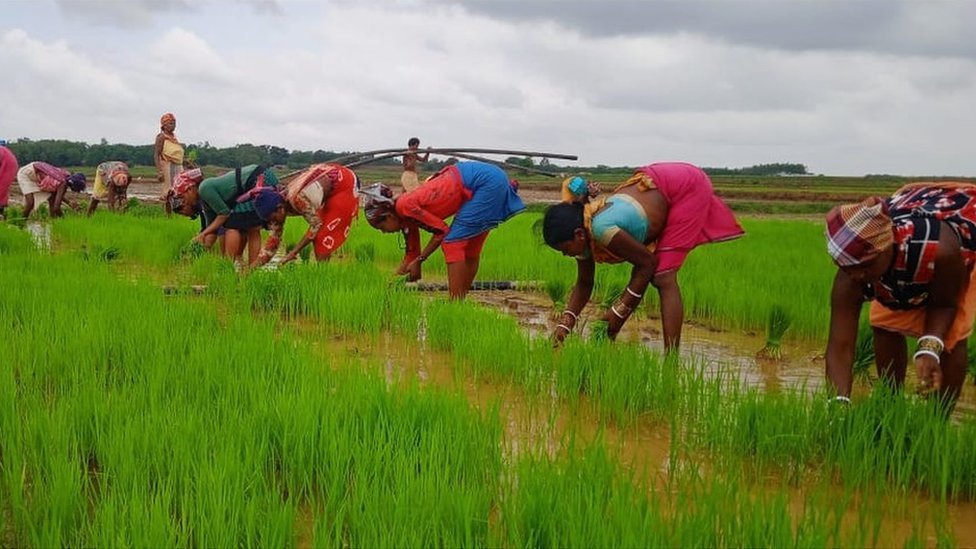
- Paddy is India’s most widely cultivated crop, grown in over 600 districts and covering more than 514 lakh hectares.
- Key reasons:
- High and assured returns
- Strong state support mechanisms
- Low price risk compared to other crops
- Paddy offers higher net income per hectare than crops like maize or moong.
- This dominance reflects economic rationality for farmers, even if it creates ecological stress.
Q5. How has the Minimum Support Price (MSP) and procurement system shaped cropping patterns in India?
- Assured procurement at MSP reduces market risk for farmers.
- Paddy enjoys:
- Guaranteed buyers (FCI and State agencies)
- Timely payments
- Lower price volatility
- In contrast, alternative crops lack strong procurement systems.
- This has led to policy-induced monocropping, especially in Punjab, Haryana, and parts of eastern India.
Q6. What environmental and regional challenges arise from the excessive expansion of paddy cultivation?
- Paddy is extremely water-intensive, requiring 1–3 tonnes of water per kg of rice.
- Consequences include:
- Severe groundwater depletion
- Ecological stress in Punjab and Haryana
- Expansion into already water-stressed regions
- Excessive groundwater extraction has also caused health and soil problems.
- Paddy dominance thus undermines long-term environmental sustainability.
Q7. Why do rice yields vary significantly across Indian States, and what does this reveal about agricultural productivity?
- Rice productivity differs due to agro-climatic and infrastructural variations.
- 2024–25 yields:
- Punjab – 4,428 kg/ha
- Andhra Pradesh – 3,928 kg/ha
- Bihar – 2,561 kg/ha
- Uttar Pradesh – 2,824 kg/ha
- National average – 2,929 kg/ha
- This reflects uneven access to irrigation, technology, and extension services.
- Low-yield regions contribute to surplus stocks but lower overall efficiency.
Q8. Why is the government pushing for crop diversification away from paddy, and what fiscal logic underpins this strategy?
- The push is driven by water conservation, fiscal prudence, and nutrition goals.
- Economic logic:
- FCI’s economic cost of rice ≈ ₹33/kg
- Average yield: 41.25 quintals/ha
- Government cost ≈ ₹1.36 lakh per hectare
- Diversification incentives can be funded from savings in rice procurement costs.
- Focus is on districts with below-average yields and lower paddy suitability.
Q9. How can promoting oilseeds and pulses address India’s long-term concerns of water stress, nutrition, and import dependence?
- Oilseeds and pulses are less water-intensive than paddy.
- Benefits include:
- Reduced groundwater stress
- Improved soil health through nitrogen fixation
- Enhanced nutritional security (protein intake)
- India remains heavily dependent on edible oil imports.
- Phased promotion aligned with agro-climatic suitability ensures farmer stability during transition.
Conclusion
India’s emergence as the world’s largest rice producer is a landmark achievement, reflecting decades of policy support and agricultural expansion. Yet, the accompanying surplus, water stress, and fiscal burden reveal the limits of production-centric success.
The challenge ahead lies in rebalancing incentives, promoting sustainable crop diversification, and aligning food security with environmental and nutritional priorities. India’s rice story now calls not for further expansion, but for strategic restraint and smarter agricultural policy.