| Important questions for UPSC Pre/ Mains/ Interview:
1. Why is the LR-AShM significant for India’s defence preparedness? 2. What is the Long Range Anti-Ship Hypersonic Missile (LR-AShM)? 3. What is the flight profile of the LR-AShM? 4. How does LR-AShM achieve low detectability and high survivability? 5. What propulsion and guidance technologies does LR-AShM use? 6. Why is high aerodynamic efficiency important in hypersonic missiles? 7. What is the strategic and operational significance of LR-AShM? 8. How does LR-AShM strengthen India’s sea denial capability? 9. What is the multi-service and multi-platform potential of LR-AShM? 10.How does LR-AShM leverage India’s existing missile technologies? 11.What are India’s parallel hypersonic missile development paths? 12.What is the difference between ramjets and scramjets? 13.What recent breakthroughs has India achieved in scramjet technology? |
Context
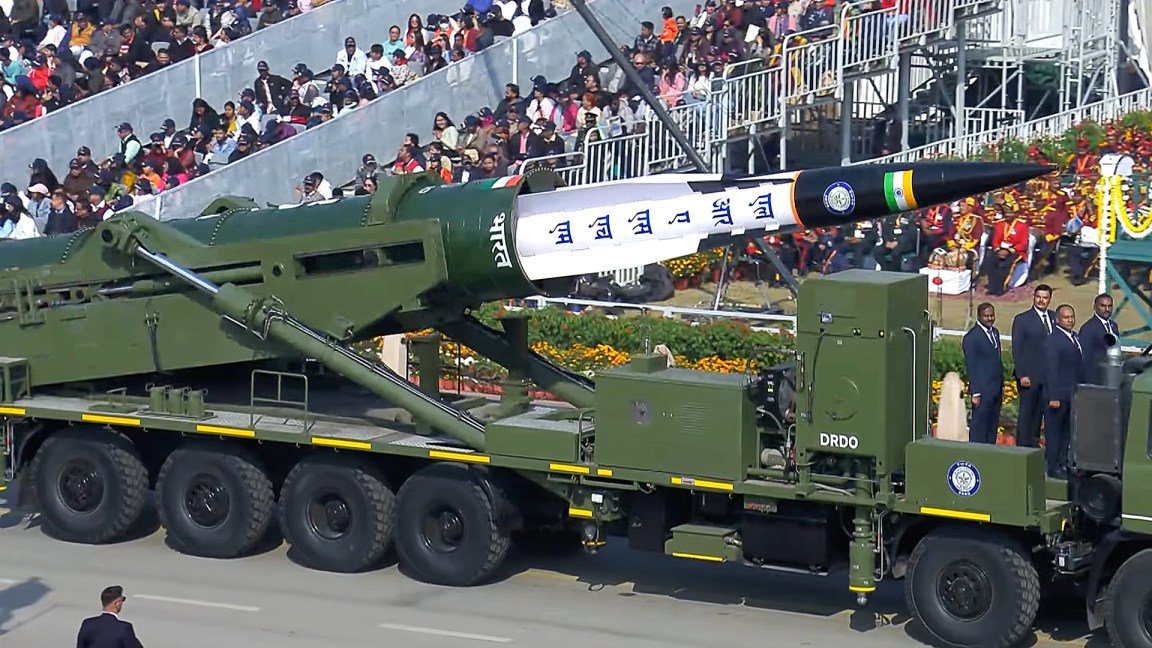
At the 77th Republic Day Parade, the Defence Research and Development Organisation unveiled the Long Range Anti-Ship Hypersonic Missile (LR-AShM), signalling India’s rapid advances in next-generation hypersonic warfare and maritime strike capabilities.
Q1. Why is the LR-AShM significant for India’s defence preparedness?
- Hypersonic weapons are redefining modern warfare due to extreme speed, manoeuvrability, and survivability.
- India faces growing maritime and strategic competition in the Indian Ocean Region (IOR).
- Existing missile defence systems have limited capability against hypersonic threats.
- LR-AShM strengthens deterrence, sea denial, and precision strike
- Its unveiling reflects India’s push towards self-reliance in advanced strategic weaponry.
Q2. What is the Long Range Anti-Ship Hypersonic Missile (LR-AShM)?
- LR-AShM is an indigenously developed hypersonic glide missile.
- It is designed primarily for the Indian Navy’s coastal battery requirements.
- Capable of engaging both static and moving maritime targets.
- Operational range is up to 1,500 km, with extended variants under development.
- Supports multiple payload configurations, enhancing mission flexibility.
Q3. What is the flight profile of the LR-AShM?
- The missile follows a quasi-ballistic trajectory.
- Initially ascends like a ballistic missile but flies at lower altitudes
- Achieves initial speeds up to Mach 10 and sustains average speeds of Mach 5.
- Uses multiple atmospheric skips to extend range and complicate interception.
- Mid-course manoeuvring enhances unpredictability and survivability.
Q4. How does LR-AShM achieve low detectability and high survivability?
- Flies at extremely high speed and low altitude, reducing radar detection windows.
- Continuous manoeuvring prevents accurate tracking by enemy sensors.
- Significantly shortens reaction time for ship-based and ground-based air defence systems.
- Its hypersonic glide phase makes interception by conventional missile defences extremely difficult.
Q5. What propulsion and guidance technologies does LR-AShM use?
- Two-stage solid rocket motor system:
- Stage I: Boosts the missile to hypersonic velocity and then separates.
- Stage II: Provides additional acceleration before burnout.
- After propulsion phases, the missile enters an unpowered hypersonic glide phase.
- During glide, it executes controlled aerodynamic manoeuvres before terminal strike.
Q6. Why is high aerodynamic efficiency important in hypersonic missiles?
- LR-AShM generates effective lift with minimal drag.
- Higher efficiency allows longer range, higher accuracy, and better energy utilisation.
- Reduces thermal and structural stress during sustained hypersonic flight.
- Enhances reliability and operational effectiveness with existing energy budgets.
Q7. What is the strategic and operational significance of LR-AShM?
- At hypersonic speed, the missile can cover 1,500 km in about 15 minutes.
- Severely constrains adversary decision-making and response time.
- Extended-range versions of up to 3,500 km are under development.
- Positions India among a small group of nations with operational hypersonic weapons capability.
Q8. How does LR-AShM strengthen India’s sea denial capability?
- Capable of neutralising all classes of warships, including high-value targets.
- Ideal for anti-access/area denial (A2/AD)
- Enhances control over critical sea lanes in the Indian Ocean Region.
- Restricts an adversary’s military and commercial maritime movement during conflict.
Q9. What is the multi-service and multi-platform potential of LR-AShM?
- Currently configured for naval coastal batteries.
- Army and Air Force variants are under consideration.
- Possibility of ship-launched and air-launched versions.
- Cross-platform adaptability maximises return on investment and operational flexibility.
Q10. How does LR-AShM leverage India’s existing missile technologies?
- Incorporates technologies from the K-15 (Sagarika) missile family.
- Draws propulsion, guidance, and systems expertise from BrahMos
- Represents technological convergence, reducing development risks and timelines.
- Demonstrates maturity of India’s indigenous missile ecosystem.
Q11. What are India’s parallel hypersonic missile development paths?
- Hypersonic Glide Vehicles (HGVs):
- Rocket-launched to high altitude, then glide and manoeuvre at speeds above Mach 5.
- LR-AShM represents this development track.
- Hypersonic Cruise Missiles:
- Fly within the atmosphere at hypersonic speeds.
- Use scramjet engines for sustained powered flight.
- Offer longer endurance and continuous manoeuvrability.
Q12. What is the difference between ramjets and scramjets?
- Ramjets:
- Compress air using forward motion.
- Operate best around Mach 3.
- Lose efficiency at hypersonic speeds.
- Scramjets:
- Maintain supersonic airflow in the combustion chamber.
- Efficient beyond Mach 5.
- Technologically complex due to extreme temperatures and pressures.
Q13. What recent breakthroughs has India achieved in scramjet technology?
- Successful ground testing of an Actively Cooled Full-Scale Scramjet Combustor.
- Achieved a continuous run time of over 12 minutes, a major milestone.
- Built upon a subscale test exceeding 1,000 seconds conducted earlier.
- Followed earlier demonstration via Hypersonic Technology Demonstration Vehicle (HSTDV) flight test in 2020.
- These advances lay the foundation for operational hypersonic cruise missiles.
Conclusion
The LR-AShM represents a decisive leap in India’s hypersonic warfare capabilities, significantly strengthening sea denial and strategic deterrence. Combined with advances in scramjet technology, it marks India’s transition into an elite group of hypersonic-capable nations, with far-reaching implications for regional security and maritime balance.