Context
- India’s 35-million-plus diaspora contributes through remittances, investment, entrepreneurship, skills, technology and global networks.
- India received about $143.6 billion in remittances in FY2025–26, the highest globally, supporting its Balance of Payments (BoP).
- The focus is now shifting towards mobilising diaspora savings for productive investment in India.
About India’s Diaspora Dividend
- The diaspora dividend refers to the economic benefits India gains from its overseas population through:
-
- Remittances
- Investment and entrepreneurship
- Technology and knowledge transfer
- Professional networks and market access
- Philanthropy and innovation
- It provides India with both financial capital and human capital, supporting long-term development.
Key Developments
- Shift towards investment-oriented engagement: Overseas Indians are moving beyond remittances and traditional assets like gold, real estate and bank deposits towards equities, mutual funds, debt, REITs, InvITs, startups, manufacturing and renewable energy.
- Stronger domestic financial ecosystem:
-
- India’s equity market capitalisation reached $5.18 trillion (July 2026).
- Mutual fund Assets Under Management (AUM): ₹85.76 lakh crore; monthly Systematic Investment Plan (SIP) inflows: ₹31,961 crore (July 2026).
- Reforms such as GST, Insolvency and Bankruptcy Code (IBC) and Production Linked Incentive (PLI) and a stronger banking system have improved the investment ecosystem.
- Digital infrastructure is reducing investment barriers:
-
- Aadhaar, UPI, DigiLocker, Account Aggregator and e-KYC simplify digital financial access and investor onboarding.
- UPI processed 66 billion transactions worth ₹29.88 lakh crore in July 2026.
- RBI, SEBI and International Financial Services Centres Authority (IFSCA) regulate the financial ecosystem, while GIFT IFSC facilitates international financial activities.
Significance
- External stability: Remittances provide foreign exchange and support India’s current account.
- Investment capital: Diaspora funds can finance infrastructure, manufacturing, startups and renewable energy.
- Knowledge and skills: Overseas Indians can bring technology, expertise and global best practices.
- Global linkages: Diaspora networks can connect Indian businesses with foreign markets, investors and partners.
- Regional growth: Diaspora investment in Tier-II and Tier-III cities can promote more inclusive development.
Challenges
- Regulatory hurdles: Complex rules, documentation and compliance can discourage diaspora investors.
- Tax-related issues: Unclear or differing tax rules can raise investment and compliance costs.
- Cross-border barriers: Complicated onboarding, fund transfer and repatriation processes can reduce ease of investment.
- Uneven investment: Diaspora funds remain concentrated in major cities and established sectors, limiting wider regional and sectoral participation.
Way Forward
- Create a Dedicated Diaspora Investment Framework: Develop a coordinated policy covering investment facilitation, taxation, repatriation and investor protection.
- Build Targeted Investment Products: Introduce suitable diaspora-focused bonds, funds and infrastructure investment vehicles to channel overseas savings into national priorities.
- Strengthen GIFT IFSC: Expand Non-Resident Indian (NRI)/ Person of Indian Origin (PIO)-oriented financial products and services through GIFT IFSC to attract global Indian capital.
- Develop a Single-Window Platform: Create an integrated digital platform for investment information, compliance, approvals and grievance redressal.
Conclusion
India’s diaspora is emerging as a source of capital, skills, technology and global networks, beyond remittances. Unlocking this potential requires policy stability, tax clarity, digital ease and diverse investment avenues to support sustained and inclusive growth.
Additional Information:
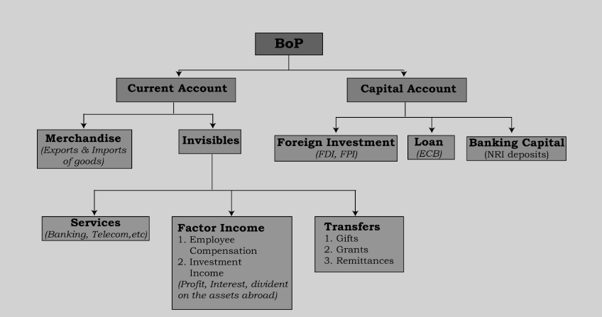
- The Balance of Payments (BoP) is a systematic record of all economic and financial transactions between the residents of a country and the rest of the world over a specific period, usually a financial year.
- REIT and InvIT:
- REIT (Real Estate Investment Trust): Enables investors to invest in income-generating real estate without directly purchasing property.
- InvIT (Infrastructure Investment Trust): Pools funds from investors to invest in infrastructure assets such as roads and power projects.
- GIFT IFSC
- It is located in Gujarat, is India’s first International Financial Services Centre (IFSC), aimed at attracting global capital and financial services.
- IFSCA, established under the IFSCA Act, 2019, is its unified regulator.
- It supports banking, capital markets, insurance, fund management, fintech etc.
- It is treated as a non-resident zone under FEMA, enabling financial entities to conduct specified international transactions in foreign currencies.
- It can help attract diaspora and foreign capital, develop India as a global financial hub, and reduce the need to route India-related financial business through overseas centres.
- Tax benefits: Units in GIFT IFSC enjoy specified tax exemptions and concessions, including a 10-year tax holiday within a 15-year period for eligible units, subject to applicable conditions.
FAQs
Q1. How can diaspora investment differ from remittances?
Ans. Remittances are mainly transfers to individuals or families, while diaspora investment involves deploying overseas savings into financial markets, businesses and productive assets.
Q2. What are AUM and monthly SIP inflows?
Ans. AUM (Assets Under Management) is the total market value of all the assets or investments that a mutual fund scheme or fund house manages on behalf of investors. Monthly SIP inflows refer to the total amount of fresh money that investors regularly invest into mutual funds through automated monthly installments.
Q3. Why are remittances important for India’s external sector?
Ans. Remittances provide a steady source of foreign exchange and help support the Current Account and overall, Balance of Payments.
Q4. How can the diaspora contribute beyond financial capital?
Ans. The diaspora can provide technology, skills, managerial expertise, innovation and international business networks, helping strengthen India’s productivity and global competitiveness.