Why in the News?
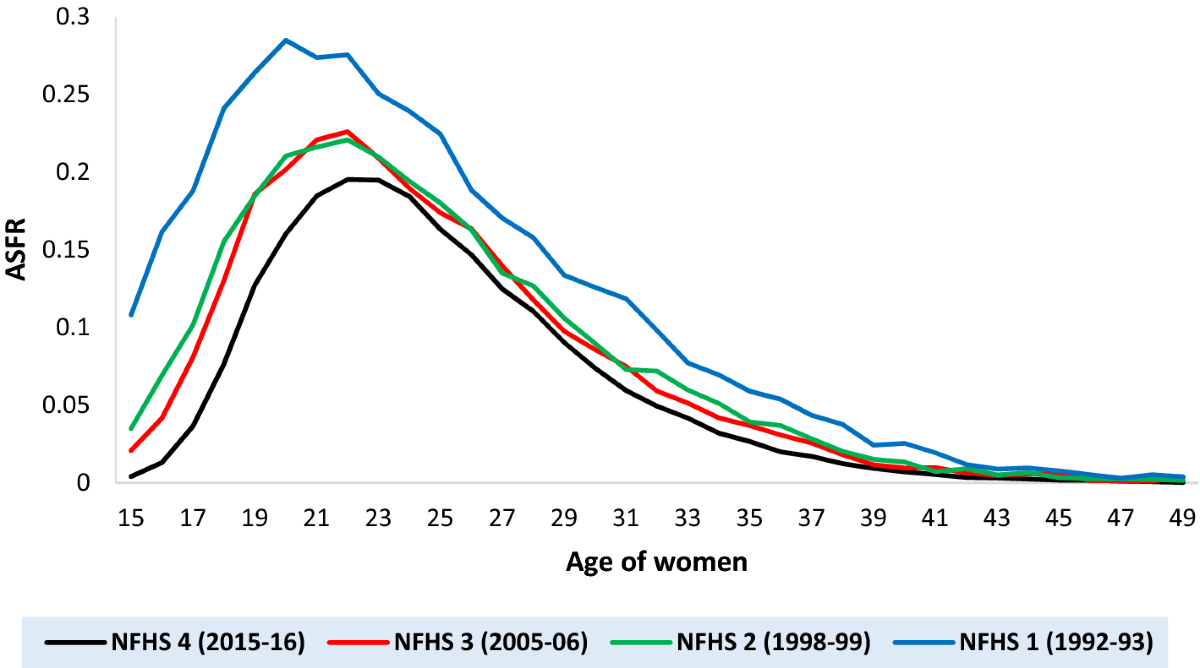
- The Sample Registration Survey (SRS) Statistical Report 2023 released by the Office of the Registrar General of India shows that India’s Crude Birth Rate (CBR) and Total Fertility Rate (TFR) have both fallen, with the TFR declining for the first time in two years.
- The report also presents data on elderly population growth and highlights significant regional disparities in fertility and age structure across Indian states and union territories.
Key Highlights
- Decline in Birth Indicators
- CBR dropped from 1 (2022) to 18.4 (2023), a fall of 0.7 points.
- TFR declined from 0 (2021–22) to 1.9 (2023), the first dip in two years.
- Regional Variation in Fertility Rates
- Highest CBR: Bihar (25.8); Lowest CBR: Tamil Nadu (12).
- Highest TFR: Bihar (2.8); Lowest TFR: Delhi (1.2).
- States above replacement-level TFR (2.1) are concentrated in northern India – Bihar, Uttar Pradesh, Madhya Pradesh, Rajasthan, and Chhattisgarh.
- Below Replacement Fertility
- 18 States and UTs have a TFR below replacement level (2.1).
- Examples: West Bengal (1.3), Tamil Nadu (1.3), Maharashtra (1.4).
- Replacement-level fertility is required for one generation to sustain the next.
- Ageing Population Trends
- Proportion of elderly (60+) increased from 9% in 2022 to 9.7% in 2023.
- Kerala has the highest elderly share (15%), while Assam, Delhi, and Jharkhand have the lowest (around 7.6–7.7%).
- Data Release Timeline
- In May 2025, delayed Civil Registration System (CRS), SRS, and Medical Certification of Cause of Death (MCCD) reports for 2021 were released.
- In June 2025, datasets for 2022 were made public.
- For 2023, SRS has been released, but CRS and MCCD datasets are still awaited.
| Crude Birth Rate (CBR)
1. CBR = Number of live births per 1,000 population in a given year. 2. It is called “crude” because it does not consider the age or sex composition of the population, it is a general measure. 3. CBR is often used in demographic studies to understand the speed of population growth in a country or region. 4. It is easy to calculate and provides a quick snapshot of fertility in relation to total population size. 5. CBR is influenced by factors like marriage patterns, cultural practices, education levels, and healthcare facilities. 6. It is less precise than other measures (like age-specific birth rate or TFR), but useful for broad comparisons across countries. Total Fertility Rate (TFR) 1. TFR = Average number of children a woman is expected to have during her reproductive years (15–49 years), if current fertility rates persist. 2. Unlike CBR, TFR adjusts for the age distribution of women, making it a more accurate measure of fertility. 3. It reflects family size preferences and effectiveness of reproductive health policies in a society. 4. A TFR of 2.1 is usually considered the replacement level fertility (needed to keep population stable, accounting for child mortality). 5. TFR is widely used in policy-making because it predicts future population trends more reliably than CBR. 6. It is influenced by factors like women’s education, workforce participation, urbanization, access to contraception, and cultural norms. |
Implications
- Demographic Transition
- India is clearly moving into the stage of low fertility and ageing population.
- This marks progress towards population stabilization.
- Impact on Workforce and Economy
- Declining fertility will eventually reduce the size of the working-age population.
- This may slow down economic growth unless productivity is enhanced.
- Pressure on Social Welfare Systems
- Rising elderly population will increase demand for pensions, healthcare, and elderly care infrastructure.
- States like Kerala will face these challenges earlier than others.
- Regional Development Challenges
- Northern states with high TFR (Bihar, UP, MP) may face strain on resources such as education, jobs, and health facilities.
- Southern and western states with low TFR may face faster ageing and workforce shortages.
- Policy and Governance Implications
- Population stabilization policies need to be region-specific.
- Health, education, and family planning programs must be designed to balance the dual challenge of overpopulation in some regions and ageing in others.
Challenges and Way Forward
| Challenges | Way Forward |
| Regional disparity in fertility rates: Northern states still above replacement level while southern/ western states are far below. | Implement state-specific strategies: strengthen family planning in high TFR states; incentivize labour migration in low TFR states. |
| Rising ageing population: Growing burden on healthcare, pensions, and social security. | Develop a national elderly policy with focus on healthcare access, pension coverage, and community-based care. |
| Declining workforce potential: Low fertility may reduce demographic dividend earlier than expected. | Invest in skills, automation, and productivity enhancement to compensate for smaller workforce. |
| Data delays and gaps: CRS and MCCD datasets for 2023 still pending. | Ensure timely and integrated release of demographic data for better planning and policy-making. |
| Health and social inequalities: Uneven access to reproductive healthcare and family planning. | Expand universal access to healthcare, maternal care, and contraceptive services, especially in rural and high TFR regions. |
Conclusion
India’s declining birth rate and fertility rate signal a major demographic transition, bringing both opportunities and challenges. While the stabilization of population growth may reduce pressure on resources, the simultaneous rise in elderly population requires urgent policy attention. The contrasting demographic realities of high-fertility northern states and low-fertility southern states highlight the need for region-specific strategies. Going forward, India must strike a balance between reaping its demographic dividend and preparing for an ageing society.
| Ensure IAS Mains Question
Q. India’s declining fertility rate and rising elderly population, as reflected in the SRS 2023 report, highlight a major demographic transition. Discuss the implications of these trends for India’s economy, social policies, and regional development. Suggest measures to balance the challenges of population stabilization and ageing. (250 words) |
| Ensure IAS Prelims Question
Q. Consider the following statements regarding the Sample Registration Survey (SRS) 2023 data: 1. Kerala has the highest proportion of elderly population in the country. 2. Delhi has reported the lowest Total Fertility Rate (TFR) among States and UTs. 3. All States with TFR above replacement level (2.1) are located in southern India. Which of the above statements is/are correct? a) 1 and 2 only b) 1 and 3 only c) 2 only d) 1, 2 and 3 Answer: a) 1 and 2 only Explanation Statement 1 is Correct: Kerala has the highest elderly population share at 15%. No other state has a larger proportion of people above 60. Statement 2 is Correct: Delhi has the lowest TFR at 1.2, which is below even other low-TFR states like West Bengal (1.3) and Tamil Nadu (1.3). Statement 3 is Incorrect: All states above replacement level are not in southern India. In fact, they are concentrated in northern and central India – Bihar (2.8), Uttar Pradesh (2.6), Madhya Pradesh (2.4), Rajasthan (2.3), and Chhattisgarh (2.2). |
|
Also Read |
|
| UPSC Foundation Course | UPSC Daily Current Affairs |
| UPSC Monthly Magazine | CSAT Foundation Course |
| Free MCQs for UPSC Prelims | UPSC Test Series |
| ENSURE IAS NOTES | Our Booklist |