| Important questions for UPSC Pre/ Mains/ Interview:
1. What does “democratisation of AI” mean in the Indian context? 2. Why is a strong AI stack essential for population-scale impact? 3. What role does the application layer play in India’s AI ecosystem? 4. How is AI being adopted across high-impact sectors in India? 5. Why is large-scale adoption critical at the application layer? 6. What is the AI model layer and why is it important? 7. How is India strengthening its AI model ecosystem? 8. What is the broader trend in AI model development? 9. Why is compute described as the “muscle” of AI? 10.What steps has India taken to expand AI compute capacity? 11.What trend does this represent in global AI compute access? 12.How does digital infrastructure support AI deployment? 13.What is the status of India’s AI-ready digital infrastructure? 14.Why is energy critical to the AI stack? 15.How is India aligning AI expansion with energy security and sustainability? 16.What is the global trend linking AI and energy demand? 17.What are the key challenges in building a population-scale AI stack? 18.What should be the way forward for India’s AI strategy? |
Context
India is advancing a population-scale, inclusive Artificial Intelligence ecosystem through the IndiaAI Mission, focusing on democratising AI by strengthening applications, models, compute, digital infrastructure, and energy foundations.
Q1. What does “democratisation of AI” mean in the Indian context?
- Democratisation of AI implies that artificial intelligence should benefit every citizen, not remain concentrated with a few firms or countries.
India’s approach frames AI as a public-good technology, aligned with social welfare, inclusion, and collective well-being. - The vision of “AI for Humanity” places people—not technology—at the centre of innovation.
- This requires AI systems to be:
- Affordable and accessible
- Scalable to population level
- Relevant to Indian languages, sectors, and governance needs
Q2. Why is a strong AI stack essential for population-scale impact?
- AI can deliver real impact only when it works reliably at scale, across sectors such as health, education, agriculture, finance, and governance.
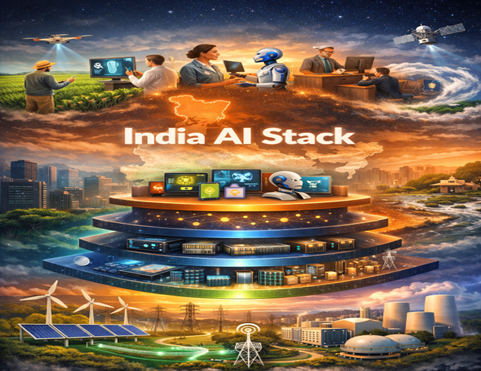
- This is enabled by an integrated AI stack—a layered system of hardware, software, data, networks, and energy.
- The AI stack ensures that AI solutions move:
- From experimentation to deployment
- From pilots to everyday services
- Together, these layers make AI scalable, resilient, and usable in real-world conditions.
Application Layer
Q3. What role does the application layer play in India’s AI ecosystem?
- The application layer represents user-facing AI services, translating complex algorithms into simple tools.
- Examples include:
- Health diagnostics and screening tools
- Agricultural advisory platforms
- Chatbots and language translation services
- Governance and citizen-service platforms
- This layer determines how citizens experience AI directly.
Q4. How is AI being adopted across high-impact sectors in India?
- Agriculture:
- AI-driven advisories improve sowing, irrigation, and input efficiency.
- State-level deployments in Andhra Pradesh and Maharashtra report 30–50% productivity gains.
- Healthcare:
- AI supports early detection of tuberculosis, cancer, and neurological disorders.
- Strengthens preventive and diagnostic care at scale.
- Education:
- National Education Policy 2020 integrates AI through CBSE curricula, DIKSHA, and YUVAi.
- Builds future-ready digital and AI skills.
- Justice delivery:
- e-Courts Phase III uses AI for translation, case scheduling, and citizen services.
- Enhances efficiency and vernacular access.
- Weather and disaster management:
- IMD deploys AI for rainfall, cyclone, fog, and fire forecasting.
- Tools like Mausam GPT aid farmers and disaster response agencies.
Q5. Why is large-scale adoption critical at the application layer?
- Like mobile and internet technologies, AI delivers transformation only when widely adopted.
- India follows an “AI diffusion” strategy, prioritising real-world use cases over narrow research breakthroughs.
- This ensures AI improves everyday decision-making, service delivery, and productivity across sectors.
AI Model Layer
Q6. What is the AI model layer and why is it important?
- The model layer is the intelligence core of AI systems.
- Models learn from data to:
- Recognise patterns
- Make predictions
- Generate responses
- They enable applications to perform meaningful tasks, such as diagnosis, translation, or forecasting.
Q7. How is India strengthening its AI model ecosystem?
- Under the IndiaAI Mission, India is developing 12 indigenous AI models for national use cases.
- Key initiatives include:
- Subsidised compute support, covering up to 25% of costs for startups.
- BharatGen, developing India-centric foundation and multimodal models.
- IndiaAIKosh, a national repository hosting thousands of datasets and models.
- Sectoral and language-focused efforts:
- Sarvam AI for Indian language LLMs and speech systems.
- Bhashini under the National Language Translation Mission, hosting 350+ models.
Q8. What is the broader trend in AI model development?
- Earlier AI advances were limited to a few firms with massive compute power.
- The rise of open-source models has reduced costs and enabled localisation.
- India is building a sovereign, inclusive model ecosystem, aligned with local languages, governance needs, and regulatory frameworks.
Compute Layer
Q9. Why is compute described as the “muscle” of AI?
- Compute provides the processing power required to train and run AI models.
- Advanced chips like GPUs, TPUs, and NPUs enable:
- Faster training
- Real-time inference
- Large-scale deployment
Q10. What steps has India taken to expand AI compute capacity?
- ₹10,300+ crore allocated over five years under the IndiaAI Mission.
- IndiaAI Compute Portal offers compute-as-a-service:
- 38,000 GPUs and 1,050 TPUs
- Subsidised rates under ₹100/hour
- Strategic infrastructure:
- Secure national GPU cluster with 3,000 next-gen GPUs.
- India Semiconductor Mission with ₹76,000 crore outlay.
- Indigenous chip initiatives like SHAKTI and VEGA.
- Supercomputing support:
- National Supercomputing Mission with 40+ petaflops.
- Systems like PARAM Siddhi-AI and AIRAWAT for AI workloads.
Q11. What trend does this represent in global AI compute access?
- Globally, AI compute remains expensive and concentrated.
- India’s model expands shared, affordable access, reducing entry barriers.
- This supports startups, research institutions, and public agencies alike.
Data Centres and Network Infrastructure Layer
Q12. How does digital infrastructure support AI deployment?
- Data centres house AI systems, while networks move data between users, models, and machines.
- Reliable connectivity ensures real-time, scalable AI services.
Q13. What is the status of India’s AI-ready digital infrastructure?
- Nationwide optical fibre backbone.
- 5G available across all States and UTs, covering 85% of the population.
- India has ~960 MW of data centre capacity (3% of global), projected to grow to 2 GW by 2030.
- Major hubs include Mumbai, Bengaluru, Hyderabad, Chennai, Delhi NCR, and Kolkata.
- Large investments by global firms (Microsoft, Amazon, Google) reinforce AI infrastructure growth.
Energy Layer
Q14. Why is energy critical to the AI stack?
- AI data centres are energy-intensive, operating continuously.
- Reliable, affordable, and clean energy is essential for sustainable AI growth.
Q15. How is India aligning AI expansion with energy security and sustainability?
- India met a record peak demand of 49 GW, with minimal shortages.
- Installed capacity stands at 7 GW, with over 51% from non-fossil sources.
- Planned expansion includes:
- Pumped storage projects
- Battery energy storage systems
- The SHANTI Act positions nuclear energy as a stable, clean power source for AI and data centres, including SMRs.
Q16. What is the global trend linking AI and energy demand?
- Global data centre power consumption is projected to more than double by 2030.
- India’s early transition to clean energy strengthens its ability to support AI growth without compromising climate goals.
Q17. What are the key challenges in building a population-scale AI stack?
- Ensuring equitable access across regions and sectors.
- Preventing excessive dependence on foreign hardware and models.
- Managing rising energy demand sustainably.
- Building skilled human capital alongside infrastructure.
Q18. What should be the way forward for India’s AI strategy?
- Deepen application-led AI diffusion in priority sectors.
- Strengthen sovereign models, datasets, and compute infrastructure.
- Expand affordable access for startups, States, and public institutions.
- Align AI expansion with clean energy and grid resilience.
- Embed ethics, inclusiveness, and public welfare in AI governance.
Conclusion
By building a comprehensive AI stack across applications, models, compute, infrastructure, and energy, India is democratising AI at scale. This integrated approach enables inclusive growth, technological self-reliance, and AI-led public welfare.