Context
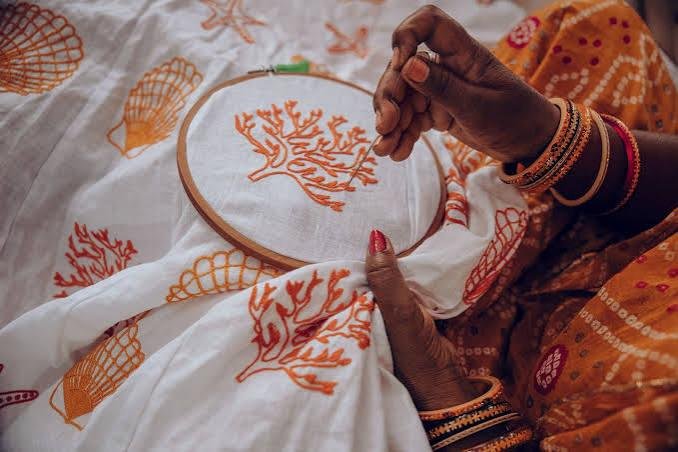
- Indian crafts and traditional textiles embody skills, techniques and visual traditions transmitted across generations within specific regions and communities. Their use by global luxury brands has raised questions about provenance, recognition and community participation.
- Recent instances involving aari embroidery from Gujarat and mirror-work resembling Indian craft traditions highlight the difficulty of applying conventional intellectual property (IP) rules to collective cultural expressions.
The Legal Challenge
Conventional IP systems generally identify an individual creator, owner or clearly defined rights-holder. Traditional crafts often do not fit this model because:
- knowledge develops collectively across generations;
- the original creator of a technique or motif may be unknown;
- successive artisans modify designs and production methods; and
- the tradition is maintained through continuing community practice.
This creates a distinction between cultural custodianship and formal legal ownership. A community may preserve and develop a tradition without holding an exclusive legal right over every component of it.
Geographical Indications: Scope and Limits
- A Geographical Indication (GI) protects the geographical identity of qualifying products whose characteristics, reputation or other qualities are linked to a particular territory.
- However, GI protection does not automatically extend to every motif, stitch, technique or visual feature associated with a craft.
- Under India’s GI framework, registered proprietors and authorised users can seek remedies against infringement, including injunctions, damages and account of profits. Enforcement across jurisdictions can involve substantial procedural and financial difficulties.
- GI protection can therefore provide enforceable rights in qualifying cases, but it does not cover every form of commercial use involving traditional cultural expressions.
Building Community Representation
Traditional craft communities may require collective institutions to exercise the rights available to them.
Producer organisations, cooperatives and representative bodies can:
- coordinate artisans and authorised users;
- represent collective interests;
- negotiate commercial arrangements; and
- support enforcement proceedings.
Public support can improve access to registration and legal enforcement while keeping decision-making connected to the community concerned.
Establishing Provenance
Disputes concerning traditional crafts often require evidence establishing the historical and geographical origins of a practice.
A carefully managed documentation system can record:
- traditional techniques;
- distinctive motifs;
- geographical associations;
- historical evidence; and
- custodial communities.
Oral testimony, regional practices and community knowledge can supplement documentary records.
Such evidence can establish the origin and continuity of a tradition and challenge inaccurate claims regarding its source. Documentation should protect sacred or restricted knowledge and should not itself be treated as automatic proof of exclusive ownership.
Protecting Living Traditions
Traditional crafts are not static. Artisans may alter motifs, colours, materials and production methods as practices develop.
A protection regime should distinguish ordinary cultural development from conduct that causes identifiable harm. Relevant concerns include:
- presenting a community tradition as an independently created work;
- obscuring cultural origin where attribution is appropriate; and
- commercially using protected expressions without required authorisation.
The objective is to address misappropriation and misrepresentation without preventing legitimate adaptation or cultural exchange.
A Sui Generis Legal Framework
A sui generis framework would establish specialised rules for traditional cultural expressions that are not adequately addressed by existing IP categories.
Its design could determine:
- who may represent a custodial community;
- when community consent should be required;
- how rights or interests should be administered;
- what remedies should be available; and
- which uses should fall within or outside the regime.
Such a framework remains a policy and legislative option. India does not currently have one comprehensive statute governing all traditional cultural expressions.
International Developments
- Traditional knowledge and cultural expressions have also become subjects of international IP negotiations.
- The World Intellectual Property Organization (WIPO) has undertaken work concerning traditional knowledge, genetic resources and related IP issues. In 2024, WIPO members adopted the WIPO Treaty on Intellectual Property, Genetic Resources and Associated Traditional Knowledge, covering matters within its defined scope.
- The Berne Convention and existing copyright principles may provide protection in particular circumstances. However, conventional copyright is primarily structured around identifiable authorship and does not fully correspond to collective, intergenerational traditions.
Way Forward
India can strengthen the framework through targeted measures:
- Improve access to GI registration and enforcement for eligible traditional products.
- Build institutional capacity among artisan organisations and cooperatives.
- Establish secure documentation protocols for traditional cultural expressions.
- Develop consistent attribution standards for appropriate commercial uses.
- Create transparent benefit-sharing arrangements for commercial activities that derive value from community-held traditions.
- Review gaps across copyright, design and GI law to identify areas requiring additional protection.
- Consult affected communities and stakeholders while developing future legal measures.
Conclusion
- The debate over traditional crafts reflects a broader question about how IP law should respond when cultural expressions develop through long-term collective practice rather than identifiable individual authorship.
- The issue requires a framework capable of recognising these distinctive forms of cultural production while maintaining workable boundaries for legitimate commercial and creative activity.
- A coherent approach should therefore combine existing IP mechanisms with institutional and legal measures suited to the distinctive nature of traditional cultural expressions.
FAQs
Q1. What is meant by traditional cultural expression?
It refers to cultural forms and knowledge developed and transmitted within communities, including artistic practices, designs, techniques and related expressions.
Q2. Does cultural significance itself create an IP right?
No. Cultural importance alone does not automatically satisfy the legal requirements of copyright, design, GI or another IP category.
Q3. What is the difference between custodianship and legal ownership?
Custodianship describes a community’s continuing relationship with a tradition, whereas legal ownership refers to rights recognised and enforceable under a particular legal framework.
Q4. Why are IP rights generally territorial?
IP protection is ordinarily governed by the law of the jurisdiction granting the right. Protection in one country therefore does not automatically create identical rights elsewhere.
Q5. What does attribution mean in this context?
Attribution involves acknowledging the relevant cultural, geographical or community source of an expression where such recognition is appropriate.
Q6. What is misappropriation?
In this context, it broadly refers to the unauthorised or inappropriate exploitation of traditional cultural expressions, particularly where their origin or community connection is obscured or commercially exploited.
Q7. Why is international cooperation relevant?
Traditional cultural expressions can enter international markets, while applicable IP protection is largely governed through national legal systems. International cooperation can therefore help address cross-border legal gaps.