| Important questions for UPSC Pre/ Mains/ Interview:
1. What led to the signing of the Interim Trade Deal? 2. What are the key provisions of the Interim Trade Deal? 3. How does the deal affect India’s export competitiveness? 4. How does the deal impact Indian agriculture? 5. What are the concerns regarding GM food imports? 6. Is the tariff arrangement asymmetric? 7. What are the sovereignty and geopolitical implications? 8. What are the broader economic implications? 9. What are the administrative and institutional considerations? 10.What are the benefits of the Interim Deal? 11.What are the concerns associated with the Interim Deal? 12.What safeguards and oversight mechanisms are necessary? |
Context
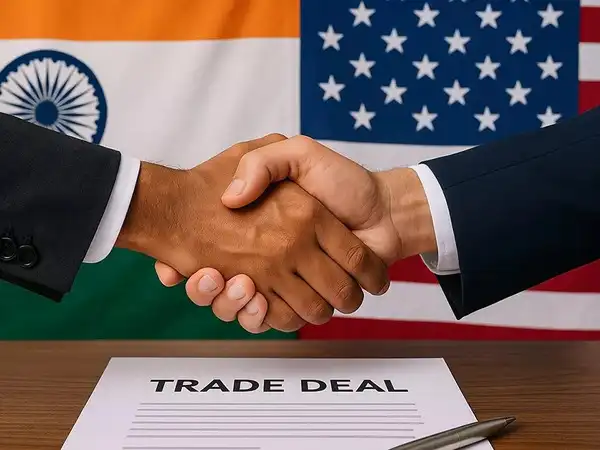
India and the United States have signed an interim trade agreement following tariff escalations in 2025. While the deal reduces certain tariffs and seeks to normalise trade flows, it has triggered debate over agricultural protection, tariff asymmetry, and strategic autonomy.
Q1. What led to the signing of the Interim Trade Deal?
- India–US trade expanded significantly over the last decade.
- The U.S. became one of India’s largest trading partners.
- In August 2025, the U.S. imposed:
- 25% tariffs on Indian imports.
- Additional 25% penalty linked to India’s Russian crude oil imports.
- Trade flows were disrupted.
- Both sides agreed to an interim agreement as a first step toward a comprehensive bilateral trade pact.
Q2. What are the key provisions of the Interim Trade Deal?
- What tariff relief has the U.S. offered?
- Reduction of tariffs on Indian imports from 50% to 18%.
- Still higher than earlier average U.S. tariffs (~2.5%).
- What concessions has India offered?
- Elimination or reduction of tariffs and non-tariff barriers on:
- Industrial goods.
- Agricultural and food products.
- What are the energy and purchase commitments?
- India has expressed intent to purchase $500 billion worth of:
- Energy products.
- Aircraft and parts.
- India has expressed intent to purchase $500 billion worth of:
- Elimination or reduction of tariffs and non-tariff barriers on:
- Technology goods.
- Coking coal.
- Spread over five years.
- What does the Russian oil clause indicate?
- S. Executive Order suggests cessation of direct or indirect Russian oil imports.
- Provision for reimposition of tariffs if imports resume.
- Indian government has not formally confirmed a binding commitment.
Q3. How does the deal affect India’s export competitiveness?
- Potential Benefits:
- Lower tariffs may improve access for:
- Textiles.
- Labour-intensive manufacturing.
- Signals improved bilateral relations.
- Boosts investor confidence.
- Lower tariffs may improve access for:
- Limitations:
- S. retaining 18% tariff still restricts competitiveness.
- Competing countries (e.g., Bangladesh) receive preferential arrangements.
- Relative advantage for Indian exporters remains constrained.
Q4. How does the deal impact Indian agriculture?
- What are the concerns regarding tariff protection?
- No explicit assurance that cereals and sensitive crops remain protected.
- India traditionally shields agriculture in trade agreements.
- Reduced protection may expose farmers to subsidised U.S. agribusiness.
- Why is this significant?
- Agriculture supports a large share of India’s population.
- Income vulnerability in rural regions is high.
- Food security considerations remain critical.
Q5. What are the concerns regarding GM food imports?
- The U.S. has criticised India’s restrictions on GM products.
- Reference to resolving “long-standing concerns” may imply regulatory relaxation.
- Potential implications:
- Biosafety risks.
- Impact on domestic seed industry.
- Public health considerations.
- Reduced regulatory autonomy.
Q6. Is the tariff arrangement asymmetric?
| Basis | India’s Concessions | U.S. Position |
| Tariff Reductions | Eliminating/reducing on U.S. goods | Retaining 18% tariff on Indian goods |
| Pre-dispute Tariff Level | High Indian tariffs historically | Earlier U.S. average ~2.5% |
| Current Outcome | Greater Indian liberalisation | Higher protection for U.S. market |
Observation:
- The 18% tariff represents a net increase from earlier U.S. levels.
- Raises questions on negotiating leverage.
Q7. What are the sovereignty and geopolitical implications?
- Conditionality tied to Russian oil imports.
- Risk of external monitoring of India’s energy purchases.
- Potential constraint on foreign policy autonomy.
- Historically, India has maintained strategic independence.
Comparison:
- Countries like China and Brazil resisted similar tariff pressures.
- Debate over accommodation versus assertion.
Q8. What are the broader economic implications?
- Serves as precursor to comprehensive trade agreement.
- May integrate supply chains in energy and technology sectors.
- Could reshape agricultural trade policy.
- Impacts long-term industrial competitiveness.
Q9. What are the administrative and institutional considerations?
- Requires coordination between Commerce, Agriculture, and External Affairs Ministries.
- WTO compatibility must be maintained.
- Parliamentary scrutiny and transparency are essential.
- Monitoring compliance mechanisms needed.
Q10. What are the benefits of the Interim Deal?
- Restores trade stability after tariff escalation.
- Reduces immediate export barriers.
- Strengthens strategic alignment.
- Signals commitment to structured trade dialogue.
Q11. What are the concerns associated with the Interim Deal?
- Tariff asymmetry.
- Agricultural vulnerability.
- Risk of GM product entry.
- Potential erosion of energy sovereignty.
- Political backlash from farmers and opposition.
Q12. What safeguards and oversight mechanisms are necessary?
- Clear carve-outs for sensitive agricultural sectors.
- Transparent disclosure of final negotiated terms.
- Strong biosafety regulations for GM imports.
- Regular review of tariff impact on domestic industry.
- Parliamentary oversight over strategic clauses.
Conclusion
The India–US Interim Trade Deal seeks to normalise trade ties after tariff escalation, but it raises substantive economic and strategic questions. While offering potential export relief and diplomatic reset, concerns persist over agricultural protection, tariff imbalance, and strategic autonomy. The final comprehensive agreement must balance trade expansion with domestic economic resilience and sovereign decision-making.