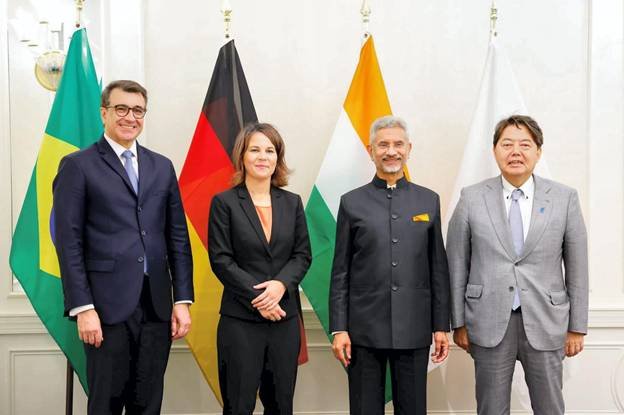
News : G4 Grouping, a coalition of four nations—India, Brazil, Germany, and Japan—that has recently reiterated its demand for a total reform of the United Nations Security Council (UNSC). This group represents a significant push to update the 1945 global governance architecture to reflect the realities of 2026.
What are the core objectives and membership of the G4?
The G4 nations are unified by their shared aspiration for permanent seats on an expanded UN Security Council.
- The Membership: Four major global powers—India (the world’s most populous democracy), Brazil (largest economy in South America), Germany (economic powerhouse of Europe), and Japan (fifth_argest economy and major contributor to the UN budget).
- The Demand: A comprehensive expansion of the UNSC in both permanent and non-permanent categories.
- The Justification: The G4 argues that the current Council, dominated by the five permanent members (P5), is an “anachronism” that fails to represent the modern world, specifically the Global South.
What is the specific reform proposal put forward by the G4?
- Representative Diversity: The G4 supports greater representation for developing regions that are currently underrepresented, specifically Africa, Latin America, and Asia.
- Veto Power: While the G4 seeks permanent status, they have previously indicated a willingness to forgo veto power for a certain period (e.g., 15 years) to break the deadlock and allow the reform process to begin.
- Size of the Council: The proposal typically suggests expanding the Council from 15 members to around 25 or 26, adding six new permanent seats (G4 plus two from Africa).
Why is the G4’s mission critical for the 2026 International Order?
The G4 highlights the challenges of multilateralism in a fragmented world.
- Democratic Deficit: The UNSC is the only UN body with the power to pass binding resolutions and authorize military force. The G4 argues that its lack of representation leads to a loss of legitimacy and effectiveness in solving global conflicts.
- Counter-Groupings (Coffee Club): The G4 faces opposition from the Uniting for Consensus (UfC) group, led by countries like Italy, Pakistan, Mexico, and Turkey, who oppose adding new permanent seats and prefer expanding only the non-permanent category.
- India’s Role: India’s claim is backed by its role as a “Net Security Provider,” its contribution to UN Peacekeeping (UNPKF), and its leadership in the Global South.