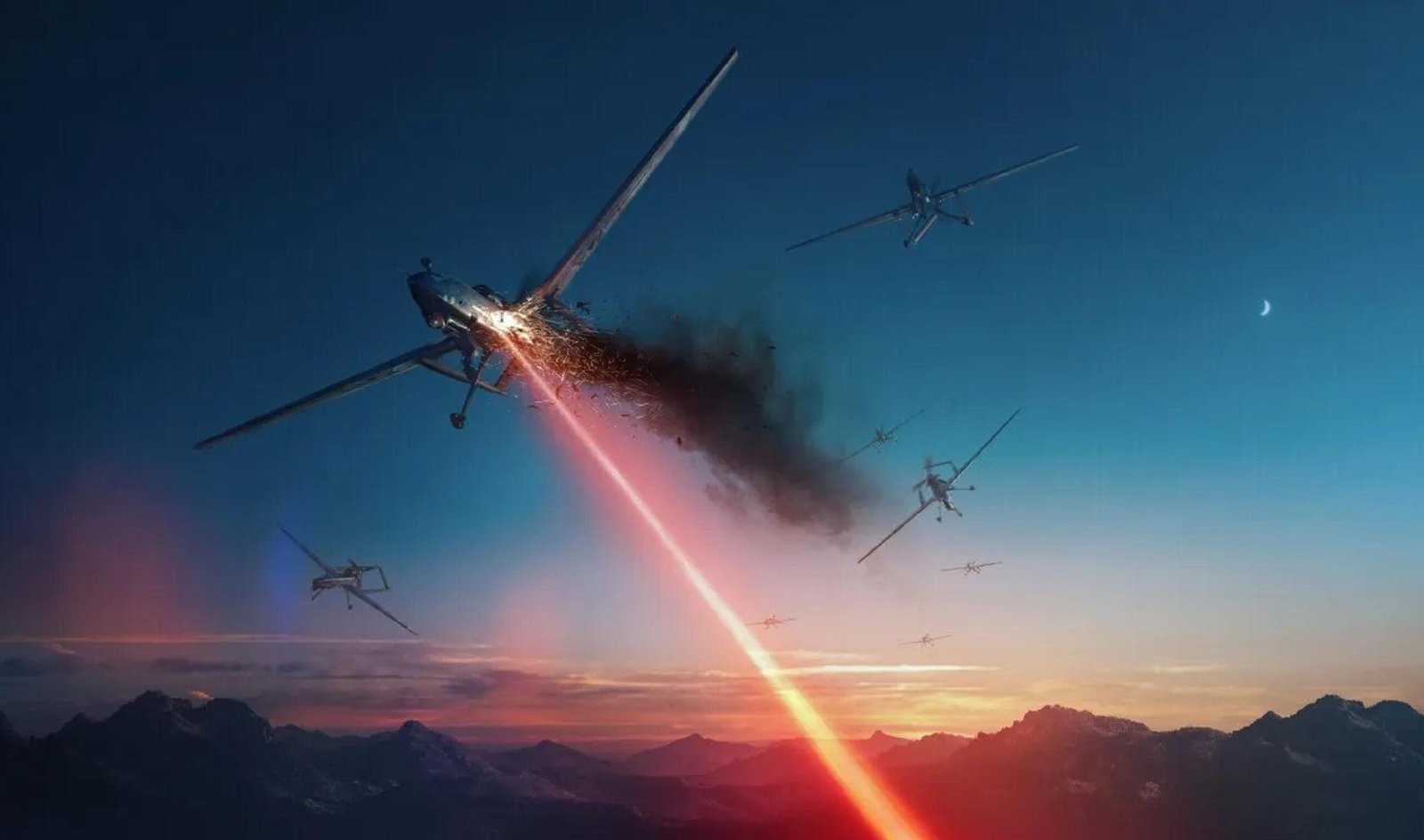
- In April 2025, The Centre for High Energy Systems and Sciences (CHESS) under DRDO has successfully demonstrated the MK 2(A) version of its vehicle-mounted laser directed energy weapon.
- This is a major achievement in India’s quest for homegrown high energy laser weapons to counter aerial threats like drones, missiles, and low flying aircraft.
About MK 2(A) demonstration-
CHESS (Centre for High Energy Systems and Sciences)
- It is a DRDO lab based in Hyderabad.
- Specializes in directed energy technologies, including lasers, microwave weapons, and beam control systems.
- Plays a key role in India’s Durga II and laser weapon research programs.
- System Name: MK 2(A) Land version of a vehicle mounted Laser Directed Energy Weapon (LDEW).
- Location: DRDO’s testing range in Kurnool.
- Platform: Mounted on a tactical military vehicle, making it mobile and battlefield-ready.
- Target: Demonstration involved neutralizing aerial threats like drones using a precisely focused high-energy laser.
Key Features of MK 2(A) LDEW
| Feature | Details |
| Laser Power | ~30 kW (estimated) |
| Platform | Mounted on heavy military vehicle |
| Mobility | Can be deployed quickly in different terrains |
| Target Capability | Drones, UAVs, low-speed missiles |
| Range | Up to 5 km (short-range battlefield application) |
| Sensors | Electro-optical & Infrared tracking system |
| Developer | CHESS (DRDO), Hyderabad |
What is MK series?
- The MK series refers to India’s vehicle mounted Laser Directed Energy Weapon (LDEW) system developed by DRDO’s Centre for High Energy Systems and Sciences (CHESS).
- The MK projects represent the evolution of India’s directed energy weapons, aimed at defending against a variety of aerial threats, particularly drones, UAVs, and missiles.
- The MK series began with the MK 1 prototype and has evolved into the MK 2(A) system.
Comparison of MK 1 and MK 2(A) Laser Directed Energy Weapons
| Feature / Project | MK 1 | MK 2(A) |
| Type | Laser Directed Energy Weapon | Advanced Laser Directed Energy Weapon (Updated) |
| Developed by | DRDO, CHESS (Centre for High Energy Systems) | DRDO, CHESS (Centre for High Energy Systems) |
| Power Output | ~10 kW (Experimental Phase) | ~30 kW (Increased Power for Enhanced Capability) |
| Purpose | Initial Testing for UAVs and Drones | Enhanced Testing for UAVs, Missiles, Drones |
| Deployment Platform | Mounted on Light Vehicles | Mounted on Heavy Military Vehicles |
| Technology Used | Laser Beam Technology for short-range threats | Advanced Laser Beam, Improved Tracking Systems |
| Range | ~1-2 km (Limited Range) | ~5 km (Extended Range for Tactical Use) |
| Target | Primarily UAVs and Drones | UAVs, Drones, Low-Speed Missiles |
| Tracking System | Basic Electro-optical Sensors | Advanced Electro-optical & Infrared Sensors |
| Status | Prototype stage, limited trials | Successful Demonstration (Tested at Kurnool) |
| Mobility | Semi-mobile, mounted on light vehicle | Fully mobile, mounted on military tactical vehicles |
| Operational Use | Experimental for Defense Research | Operational for Combat Situations |
| Significance | Marked India’s entry into LDEW research | Major step in indigenous LDEW capabilities |
What is a Laser Directed Energy Weapon?
- A Laser Directed Energy Weapon (DEW) is a system that emits highly focused energy, typically in the form of lasers, to damage or destroy enemy targets.
- Unlike traditional weapons, DEWs can engage targets at the speed of light, offering precise targeting with minimal collateral damage. They are effective against a range of threats, including drones, missiles, and other aerial platforms without using bullet and explosives.
How does it work?
- A powerful laser beam is generated using energy (usually electricity or chemical reactions).
- This beam is aimed precisely at a target using advanced sensors and tracking systems.
- The laser travels at the speed of light, so it hits the target almost instantly.
- It heats up the target and can disable or destroy it by burning through its outer layer or electronics.
Technology Behind Laser DEWs-
1. Laser Generator
- The core part of the weapon is a laser source.
- It creates a high-energy beam of light.
There are different types of laser generators:
- Solid-state lasers: Use solid materials (like crystals) to generate the beam.
- Fiber lasers: Use optical fibers and are compact, powerful, and more efficient.
- Chemical lasers: Use chemical reactions to produce high-energy beams (used earlier, but bulky and toxic).
2. Power Supply
- The system needs a lot of energy to fire the laser.
- Power is usually supplied from:
- Batteries
- Generators
- Vehicle engines (in mobile DEWs)
3. Beam Control System
- This part makes sure the laser beam is aimed correctly.
- It includes:
- Mirrors and lenses to focus the laser
- Gimbals or turrets to move the laser in any direction
- Cooling systems to keep the laser from overheating
4. Targeting & Tracking Sensors
- The weapon has advanced cameras and sensors (like EO/IR – Electro-Optical/Infrared sensors).
- These help in:
- Detecting incoming threats like drones
- Tracking them in real-time
- Locking on to them with precision
5. Command & Control System
- This is like the brain of the weapon.
- It takes input from the sensors, processes it, and decides when and how to fire the laser.
Uses of Laser DEWs
1. Defense Against Drones- Can detect and destroy enemy drones before they reach military bases or important buildings.
2. Missile Defense- Can be used to shoot down missiles in the air by burning or damaging their sensors or outer shell.
3. Air and Naval Defense- Mounted on ships, trucks, or aircraft to protect against aerial attacks. Useful for coastal defense and protecting navy ships from enemy boats or aircraft.
4. Electronic Warfare- Can disrupt enemy communication systems or damage satellites and radars.
5. Border Security- Helps the army to monitor and protect borders, especially from aerial surveillance or drone attacks.
Benefits of Laser Weapons
1. Speed of Light Attack- Lasers hit the target instantly much faster than missiles or bullets.
2. High Accuracy- Can target very small or fast-moving threats with extreme precision.
3. Silent and Invisible- Operates quietly, and the laser beam is mostly invisible making it hard for enemies to detect.
4. Low Cost Per Shot- Once the system is built, firing the laser costs very little just electricity. Much cheaper than firing missiles or rockets.
5. No Ammunition Needed- Doesn’t need physical ammo like bullets or shells just power supply. This means no logistics or storage issues for ammunition.
6. Unlimited Shots- As long as there is power, it can keep firing again and again.
7. Minimal Collateral Damage- Because it’s so precise, it’s less likely to harm nearby people or buildings.
India’s Laser Directed Energy Weapon Program (key projects by DRDO)-
1. Aditya Project
- First initiated to explore chemical laser systems.
- Prototype tested to neutralize low-flying aerial targets.
- Now serves as a base for newer fiber-laser systems.
2. Durga II (Directionally Unrestricted Ray-Gun Array)
- A major ongoing project to build a 100 kW class laser weapon.
- Aims to deploy high-energy DEWs on fighter aircraft, naval ships, and trucks.
- Will be India’s most advanced laser weapon system once completed.
3. Other Related Programs
- CHESS (Centre for High Energy Systems and Sciences) under DRDO is leading the DEW research.
- Integrating AI and tracking systems for automatic target detection and destruction.
Global Context: Countries Developing Directed Energy Weapons (DEWs)
United States
- Systems:
- HELIOS (High Energy Laser with Integrated Optical dazzler and Surveillance) – deployed on US Navy destroyers.
- THOR (Tactical High Power Operational Responder) – counters drone swarms using microwave energy.
- LaWS (Laser Weapon System) – tested successfully on ships.
- Focus: Navy, Air Force, and drone defense; battlefield deployment in real-time.
- Agencies: DARPA, Lockheed Martin, Raytheon, U.S. Department of Defense.
United Kingdom
- System: DragonFire laser weapon.
- Use Case: Naval ship defense, drone neutralization, and precision strikes.
- Development Partners: UK Ministry of Defence with MBDA, Leonardo, QinetiQ.
- Milestone: Successful test conducted in 2023.
Israel
- System: Iron Beam (by Rafael Advanced Defense Systems).
- Use Case: Complements the Iron Dome by shooting down rockets, drones, and mortar shells using 100 kW class laser.
- Advantage: Lower cost per shot compared to interceptors like Tamir missiles.
Russia
- System: Peresvet laser weapon system.
- Use Case: Primarily for anti-satellite operations and missile defense.
- Deployment: Officially inducted into the Russian armed forces in 2018.
- Other Tech: Also developing microwave-based systems for electronic warfare.
China
- Systems: Silent Hunter – used for low-altitude drone defense.
- Use Case: Urban defense, battlefield lasers, space warfare.
- Concerns: Alleged use of lasers to blind foreign satellites and pilots.
France
- System: Developing the HELMA-P (High-Energy Laser for Multiple Applications – Power) system.
- Use Case: Drone and low-flying aircraft defense.
- Partners: CILAS and the French Defence Innovation Agency (DGA).
Comparison of India’s DEW Projects
| Feature / Project | Aditya | Durga II |
| Type | Laser Directed Energy Weapon | Laser Directed Energy Weapon |
| Developed by | DRDO + Indian Army | DRDO (CHESS Lab) |
| Power Class | ~25 kW (experimental) | ~100 kW (proposed, under testing) |
| Status | Initial trial complete (2022–2023) | Under development/trial (since 2021) |
| Mobility | Mounted on trucks/vehicles | Vehicle-portable (future aim: aircraft/navy adaptable) |
| Target Capability | UAVs, light missiles, optical sensors | UAVs, missiles, drones, artillery shells |
| Range | Few hundred meters to 1 km | Up to 2–5 km (planned) |
| Use Case | Tactical battlefield use (Army) | Strategic defense (air/naval/space ops) |
| Special Feature | Compact, good for border defense | High-energy precision attack |
| Related Labs | DRDO, LRDE | CHESS, DRDO Hyderabad |