Context
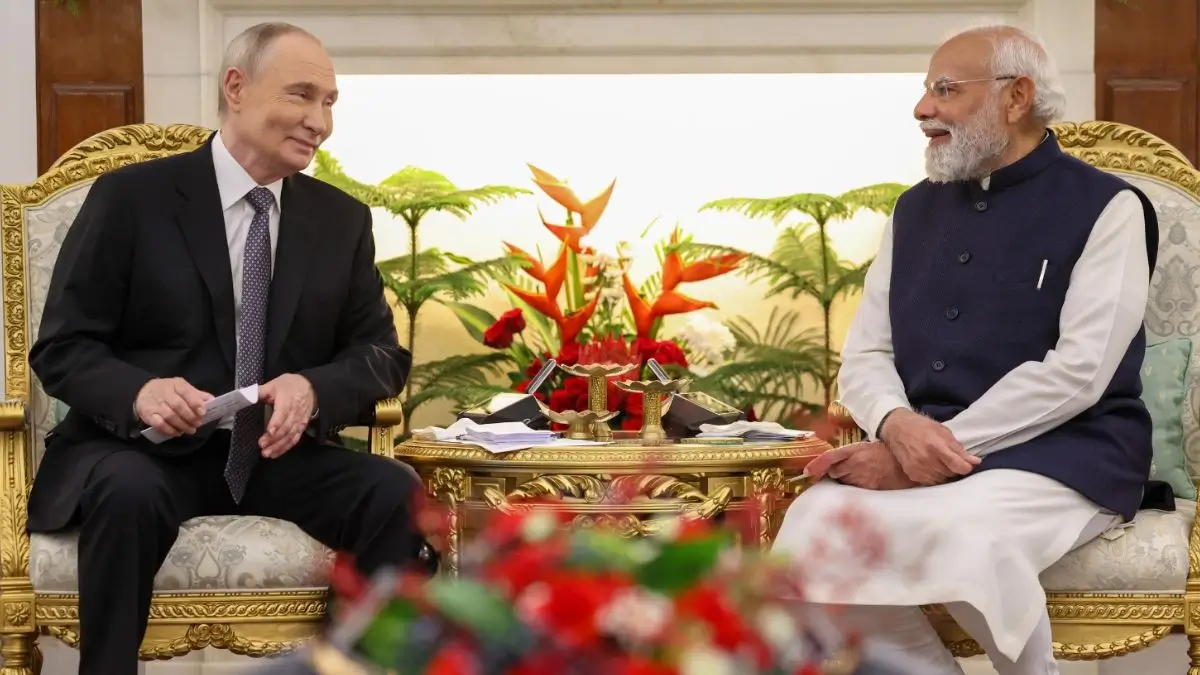
Russian President Vladimir Putin visited India for the annual India-Russia Summit in New Delhi. The visit was his first since the Ukraine war began in 2022, taking place at a sensitive geopolitical moment when India is negotiating major trade partnerships with the US and EU, and facing challenges due to Western sanctions on Russia.
What Happened During the Summit? (Key Outcomes)
- Focus on Economic and Trade Cooperation
- The summit prioritised economic ties over expected defence announcements.
- Both sides agreed to strengthen the roadmap for India-Russia economic cooperation till 2030.
- Discussions focused on improving bilateral trade settlement in national currencies and logistics through the Chennai-Vladivostok Maritime Corridor and International North-South Transport Corridor.
- Labour Mobility Agreement
- Russia expects a labour shortage of nearly three million workers by decade-end.
- To overcome this, India and Russia signed a Labour Mobility Agreement to enable Indian skilled workers to take up employment in Russia.
- Industrial and Manufacturing Links
- Fertiliser companies signed an MoU to set up a urea plant in Russia.
- Agreements were concluded on ports, maritime cooperation and customs processes.
- Limited Defence and Energy Announcements
- Expected announcements on defence co-production, aircraft and missile systems did not materialise.
- No new announcements on oil imports, nuclear or space cooperation due to Western sanctions, pressure and concerns around CAATSA.
| CAATSA
1. It stands for Countering America’s Adversaries Through Sanctions Act, a US law passed in 2017 to impose sanctions on countries engaging in significant defence or energy trade with Russia, Iran, and North Korea. 2. The law penalises entities involved in major defence purchases or strategic deals with these countries through financial and trade restrictions. 3. For India, CAATSA is relevant due to major defence acquisitions from Russia (like the S-400 air defence system), creating a risk of secondary US sanctions. 4. The US President can grant waivers under certain circumstances, and India has sought such waivers to protect its strategic autonomy and defence readiness. |
India’s Position on the Ukraine Conflict
- PM Modi stated: “India stands on the side of peace”, reiterating India’s diplomatic balancing stance.
- Putin expressed hope for progress in the US-Russia peace talks.
- The Ukraine war remained a backdrop to discussions, affecting India’s strategic decisions.
Why is the visit significant?
| Dimension | Significance |
| Energy security | Russia promised continued fuel supplies; but imports have dropped sharply due to sanctions. |
| Strategic autonomy | India aims to balance ties with Russia while deepening ties with the US and EU. |
| Economic diversification | Efforts to rebalance trade that is heavily skewed due to oil imports. |
| Diplomatic timing | Visit occurs ahead of key US and EU leadership visits to India. |
| Managing geopolitical pressure | Europe and US have signalled concern over India-Russia proximity. |
Challenges and Way Forward
| Challenge | Way Forward |
| Impact of Western sanctions: EU and US sanctions have reduced India’s Russian oil imports and affected Indian companies. | Expand payments in national currencies to reduce vulnerability to sanctions and dollar-linked disruptions. |
| CAATSA risk: Defence cooperation announcements may trigger US sanctions under CAATSA. | Maintain strategic autonomy & diplomacy through calibrated defence engagements, seeking waiver assurances where required, and balancing relations with Russia and the West. |
| Trade imbalance: Russian exports (mainly oil) dominate bilateral trade; Indian exports remain limited. | Diversify non-energy trade by boosting exports in pharmaceuticals, textiles, machinery, agricultural products, and services to correct the trade imbalance. |
| Russia’s deepening pivot to China: Russia’s increasing reliance on China could affect India’s long-term strategic space. | Advance labour mobility and technology partnerships to deepen economic cooperation, expand strategic footprints, and reduce dependence on any single partner. |
| Diplomatic tightrope: Balancing ties with Russia while negotiating FTAs with US and EU requires careful diplomacy. | Improve logistics through maritime corridors & INSTC to expand trade routes, reduce transit costs, and strengthen diversified connectivity supporting balanced diplomacy. |
Conclusion
The 2025 India-Russia Summit delivered incremental but important economic and mobility-based outcomes, though expected defence and energy breakthroughs were absent. The visit highlights India’s effort to safeguard national interests, secure energy supplies, diversify strategic partnerships, and sustain strategic autonomy amid heightened global polarisation. The long-term direction of ties will depend on the resolution of the Ukraine conflict, Western sanctions policy, and the balance of India’s relations with the U.S., Europe and Russia.
| Ensure IAS Mains Question
Q. Evaluate the key outcomes of the 2025 India-Russia Summit and analyse their implications for India’s strategic and economic interests. (250 words) |
| Ensure IAS Prelims Question
Q. Consider the following statements about the India-Russia Summit 2025: 1. India and Russia signed a Labour Mobility Agreement to enable regulated movement of skilled workers from India to Russia. 2. Major defence procurement and technology transfer agreements were announced at the summit. 3. The summit prioritised improving economic cooperation and trade logistics, including the Chennai-Vladivostok Maritime Corridor. Which of the statements given above are correct? a) 1 and 3 only b) 2 and 3 only c) 1 and 2 only d) 1, 2 and 3 Answer: a) 1 and 3 only Explanation Statement 1 is correct: A key outcome of the summit was the signing of a Labour Mobility Agreement to address Russia’s expected labour shortage and create employment opportunities for Indian workers. Statement 2 is incorrect: Contrary to expectations, no major defence procurement, co-production or technology transfer announcements were made due to geopolitical sensitivities and CAATSA-related risks. Statement 3 is correct: The focus was on strengthening economic ties, national currency settlement mechanisms and improving connectivity through the Chennai-Vladivostok Maritime Corridor and the International North-South Transport Corridor (INSTC). |