Context
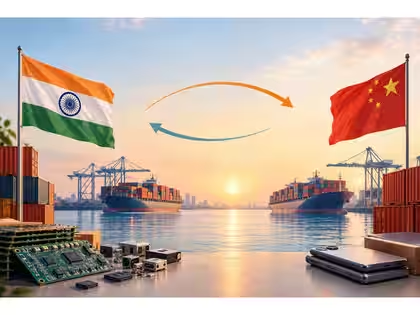
India’s growing trade deficit with China reflects rising dependence on Chinese intermediate and capital goods, highlighting gaps in India’s domestic manufacturing and component capabilities.
Key Trends in India–China Trade
- Rising Imports: Imports from China rose from $87.5 billion to $149.5 billion over five years, widening the trade deficit from $64 billion to $131 billion.
- Input Dependence: About 70% of imports are intermediate goods and 22% capital goods, mainly supporting domestic production.
- Sectoral Concentration: Imports are concentrated in electronics and telecommunications, including mobile-phone and laptop components.
The Assembly Trap
- Limited Domestic Value Addition: India has expanded assembly and manufacturing of finished products, but remains dependent on imports for sophisticated components, machinery and production inputs.
- Mobile Components: China’s share in India’s mobile-phone component imports rose from 3.3% in 2022 to over 10% in 2025.
- Low Value Addition: Heavy dependence on imported high-value inputs limits domestic value addition and deeper manufacturing capabilities.
Significance for India
- Manufacturing Deepening: Greater domestic production of components, machinery and technology can deepen India’s industrial base.
- Domestic Value Addition: Higher production of key inputs within India can increase value addition and manufacturing linkages.
- Supply-Chain Resilience: Stronger domestic capabilities can improve resilience to global supply disruptions.
- Global Value Chains: A stronger manufacturing ecosystem can enable India to undertake higher-value activities in global value chains (GVCs).
Way Forward
- Move Beyond Assembly: Shift from final-product assembly to component manufacturing and technology development.
- Strengthen Supply Chains: Build domestic supplier networks for electronics, machinery and critical inputs.
- Promote R&D: Invest in research, advanced manufacturing and technology to improve domestic capabilities.
- Integrate with GVCs: Combine domestic capacity-building with deeper global value-chain integration rather than relying only on import substitution.
- Manage Imports Strategically: Maintain imports that support domestic production while reducing dependence on critical inputs through local capacity.
FAQs
Q1. What is the assembly trap?
Ans. The assembly trap occurs when a country develops capacity to assemble finished products but remains heavily dependent on imported components, machinery and technology. This limits domestic value addition.
Q2. Are India’s imports from China mainly finished consumer goods?
Ans. No. Around 70% are intermediate goods and about 22% are capital goods, which are used as inputs in domestic production.
Q3. Why can’t India simply stop imports from China?
Ans. A sudden reduction in imports could increase input costs because many Chinese products serve as intermediate and capital goods for Indian industries. This could affect the competitiveness of Indian manufacturing.
Q4. How can India move beyond assembly-based manufacturing?
Ans. India needs to develop domestic capabilities in components, machinery, R&D, technology and supplier networks, while simultaneously integrating with global value chains.