Context
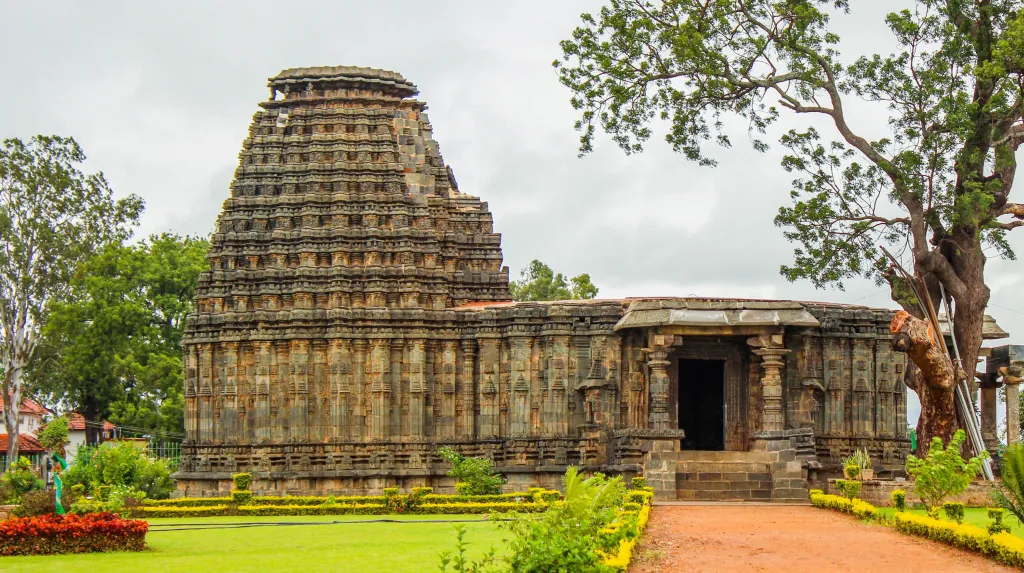
- Recently, several temples built by the medieval Hoysala rulers across Hassan, Mandya, and Mysuru districts of Karnataka came back into national focus.
- These monuments showcase the artistic peak of the Hoysala period (11th–13th century) and are now officially recognised by UNESCO under the title “Sacred Ensembles of the Hoysalas.”
Who Were the Hoysalas?
- The Hoysala dynasty was a powerful medieval South Indian ruling house.
- They ruled roughly from 1000 CE to 1336 CE.
- They were contemporaries of the Chola dynasty.
- Their capital city was Halebidu, earlier known as Dwarasamudra.
- The Hoysalas are remembered mainly for their temple-building tradition, where devotion was combined with extraordinary sculptural skill.
Types of Temple Architecture in India (Background)
| Nagara Style (North India) | Dravida Style (South India) | Vesara Style (Deccan Region) |
| 1. Curved tower (Shikhara) above the sanctum.
2. Smaller subsidiary towers called Urushringa. 3. Absence of large gopurams. 4. Nandi shrine located inside mandapa. 5. Raised Jagati platform separates deity from devotees. |
1. Step-like pyramid tower called Vimana.
2. Tall gateway towers (Gopurams). 3. Temple tank inside premises. 4. Dwarapalas at entrance. 5. Nandi placed outside. 6. No Urushringa system. |
1. Developed in North Karnataka, where northern and southern traditions met.
2. First evolved under the Chalukyas. 3. Later perfected by the Hoysalas. 4. It is a hybrid style, combining: a. Curving Shikhara (from Nagara) b. Stepped Vimana (from Dravida) |
Vesara Style under the Hoysalas (Core Architecture)
- Hoysala temples represent the most refined form of Vesara architecture.
- Key characteristics:
- Multiple projections giving a star-like ground plan
- Pathway for circumambulation (Pradakshinapatha)
- Multiple sanctums:
- Dvikuta – two shrines
- Trikuta – three shrines
- Chatushkuta – four shrines
- This layout allowed worship of several deities within a single complex.
Distinctive Features of Hoysala Temples
- Star-shaped Jagati Platform: Temples stand on elevated star-like platforms that enhance visual complexity.
- Use of Soapstone (Chloritic Schist): Soft stone enabled extremely fine carving, unmatched in Indian temple art.
- Rich Sculptural Tradition: Hundreds of deities on single pillars, Madanika (celestial dancer) figures and decorative elements like Kirtimukha.
- Vaishnavite Influence: Many temples dedicated to Vishnu – influenced by Alvar saints and Vaishnavite literature
Important Architectural Terms
- Sukanasi – Nose-like projection from Vimana
- Mandapa – Pillared hall
- Navaranga – Enclosed hall
- Prastara & Kapota – Upper structural elements
Major Hoysala Temples
| Chennakesava Temple Belur
1. Dedicated to Vishnu 2. Famous for star-shaped plan and intricate carvings 3. Part of UNESCO listing |
Hoysaleswara Temple Halebidu
1. Located at Hoysala capital 2. Shiva temple 3. Known for massive sculptural panels |
Keshava Temple Somanathapura
1. Built in 13th century 2. Classic Trikuta layout |
Veera Narayana Temple Belavadi
1. Built around 1200 CE 2. Noted for grand Ranga Mandapa |
Conclusion
The Hoysala temples symbolise a rare architectural synthesis and artistic excellence in medieval India. Their Vesara style represents the meeting point of North and South traditions. Protecting these monuments is essential not only for cultural preservation but also for understanding India’s historical creativity and craftsmanship.
FAQs
Q1. Who were the Hoysalas?
The Hoysala dynasty ruled South India between 1000–1336 CE, with their capital at Halebidu. They were contemporaries of the Cholas and are remembered for their temple-building tradition.
Q2. What is Vesara style architecture?
It is a hybrid style developed in the Deccan, combining Nagara’s curving shikhara and Dravida’s stepped vimana. The Hoysalas perfected this style, creating star-shaped ground plans and multiple sanctums.
Q3. What are the distinctive features of Hoysala temples?
- Elevated star-shaped jagati platforms
- Use of soapstone for intricate carvings
- Rich sculptural tradition with Madanikas and Kirtimukhas
- Multiple sanctums (Dvikuta, Trikuta, Chatushkuta) for worship of several deities
Q4. Which are the major Hoysala temples?
- Chennakesava Temple, Belur – Vishnu temple, UNESCO-listed
- Hoysaleswara Temple, Halebidu – Shiva temple, known for sculptural panels
- Keshava Temple, Somanathapura – Trikuta layout, 13th century
- Veera Narayana Temple, Belavadi – grand Ranga Mandapa
Q5. Why are Hoysala temples globally significant today?
UNESCO recognised them as the “Sacred Ensembles of the Hoysalas”, highlighting their rare architectural synthesis and artistic excellence.