Context
- India has struggled to expand Genetically Modified (GM) crop cultivation beyond Bt cotton since 2006.
- However, progress in Genome Edited (GE) crops has been much stronger, with new GE rice varieties cleared for release and mustard GE lines under trial.
- GE research in India is advancing rapidly due to indigenous technology, trained manpower, and supportive policy reforms.
What are GM Crops?
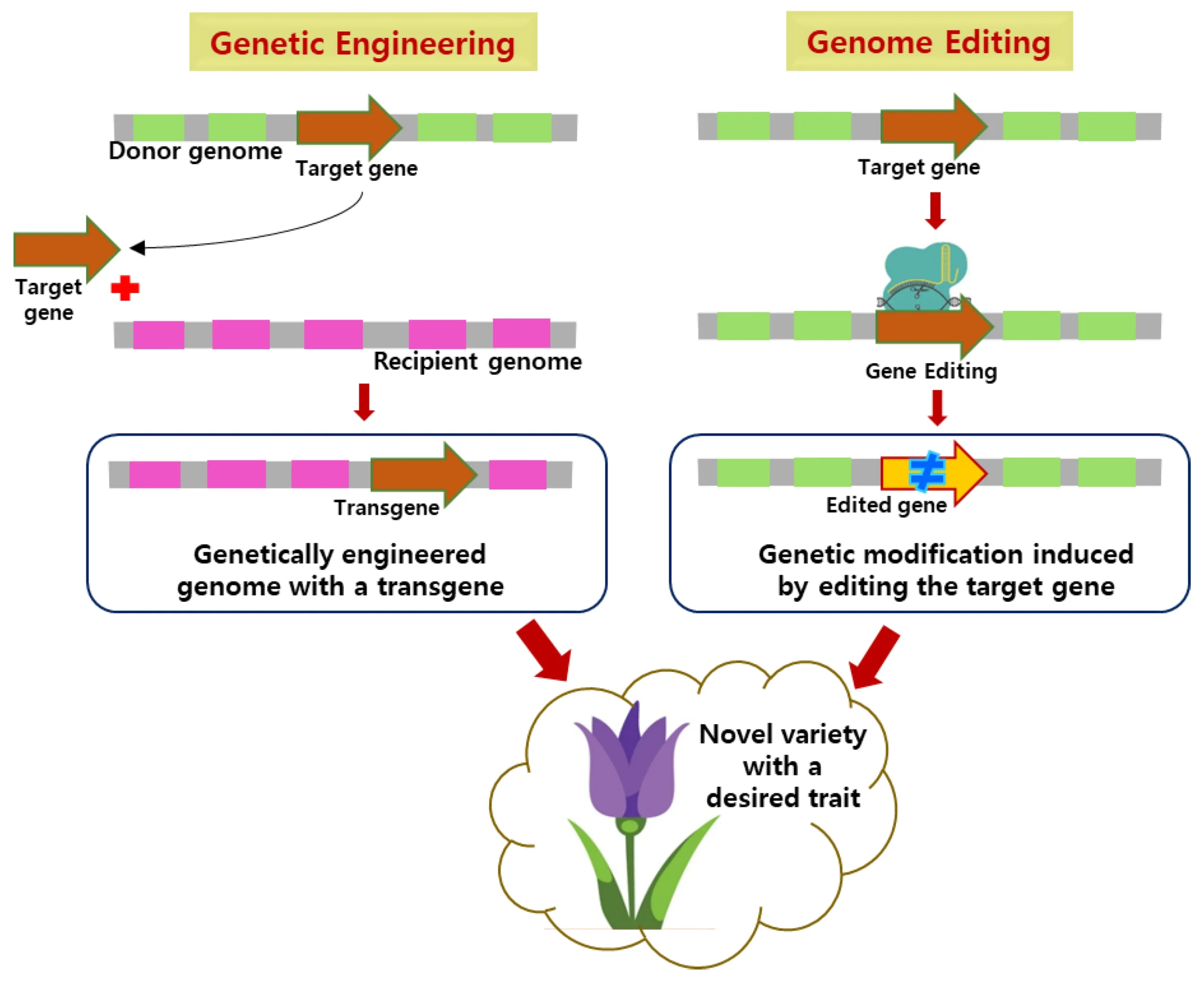
- Genetically Modified (GM) crops are developed by inserting foreign genes from unrelated species into a plant to introduce new traits.
- Example: Bt cotton has a gene from the Bacillus thuringiensis bacterium that produces proteins toxic to bollworm pests.
What are Genome Edited (GE) Crops?
- Genome Editing (GE) means editing or modifying existing genes already present within the plant without adding foreign DNA.
- It results in a mutation or change in the DNA sequence of native genes to enhance useful traits.
- It uses CRISPR-Cas enzymes (molecular scissors) to cut DNA at a target location guided by guide-RNA (gRNA).
- The edited plants later do not contain Cas proteins and are transgene-free, unlike GM plants.
- GE crops behave like naturally bred varieties, which makes them scientifically and politically more acceptable.
| Transgene: A foreign gene inserted from another species. (example: Bt gene in Bt cotton). |
Key Genome Editing Technologies Used
| Tool / Protein | Source | Purpose |
| CRISPR-Cas9 | Bacteria | Editing drought & salt tolerance genes (used in MTU-1010 rice, mustard) |
| CRISPR-Cas12a | Bacteria | Editing yield-related Gn1a gene in Samba Mahsuri |
| TnpB / Transposon- associated proteins | Indigenous Indian development | A smaller, cheaper genome-editing tool developed and patented in India |
Recent Developments in GE Crops in India
| Crop | Trait Improved |
| GE Rice – Samba Mahsuri | ~19% yield increase by editing Gn1a gene |
| GE Rice – MTU-1010 | Tolerant to drought, salinity, and alkaline soils |
| GE Mustard (under trial) | Canola-quality, low pungency, resistant to fungal diseases and pests |
These crops underwent multi-location advanced varietal trials under All India Coordinated Research Project (AICRP) in 2023-24.
GE vs GM Crops: Key Differences
| Feature | GM | GE |
| What has changed? | Adds foreign DNA from unrelated species | Edits native genes already inside the plant |
| Transgene | Present | Not Present (transgene-free) |
| Regulation | Very strict biosafety approvals | Simplified regulatory pathway |
| Examples in India | Bt Cotton only | Rice, Mustard, etc. |
| Public acceptance | Lower due to past controversies. | Higher due to natural-like breeding |
Policy Support and Regulation
- GE crops are exempt from stringent GM biosafety rules as per MoEFCC Office Memorandum (OM) dated 30 March 2022.
- Approval required only from the Institutional Biosafety Committee to certify absence of foreign DNA.
- Government funding:
- ₹500 crore allocation in Union Budget 2023-24.
- Training for Indian scientists in US, Europe, Australia, CIMMYT.
- New indigenous genome-editing tools patented.
India has identified 178 target genes in 24 field crops and 43 in horticultural crops for GE research via ICAR.
Implications
- Boost food security through higher yields
- Make agriculture resilient to climate stress (drought, salinity)
- Reduce pesticide and fertilizer dependence
- Strengthen Atmanirbhar Bharat in biotechnology
- Improve global competitiveness in crop science
- Avoid old controversies around GM crops
Challenges and Way Forward
| Challenges | Way Forward |
| Public mistrust due to past controversies of GM crops | Transparent communication and farmer awareness |
| Need for skilled manpower & advanced labs | Continuous training and infrastructure investment |
| Regulatory clarity needed for commercial rollout | Fast-track guidelines for large-scale GE cultivation |
| Market acceptance & seed system integration | Involve farmers, seed companies, and agri-industry |
| Ethical & biosafety concerns | Strong monitoring & long-term impact studies |
Conclusion
Genome Editing marks a major turning point in Indian agriculture. Unlike GM crops, which stagnated due to regulatory and public resistance, GE crops combine scientific innovation, policy support, and indigenous capability. If implementation continues smoothly, India can lead the next agricultural revolution with climate-resilient and high-yield crops.
| Ensure IAS Mains Question
Q. “Genome editing has the potential to transform Indian agriculture by delivering high-yield and climate-resilient crops, but it needs scientific, regulatory and social preparedness.” Discuss. (250 words) |
| Ensure IAS Prelims Question
Q. With reference to Genome Edited (GE) crops, consider the following statements: 1. GE crops do not contain foreign DNA and are transgene-free. 2. GE crops use CRISPR-Cas technology to modify existing genes within the plant. 3. GE crops in India require the same strict biosafety approval as GM crops. Which of the above statements is/ are correct? a) 1 and 2 only b) 2 and 3 only c) 1 and 3 only d) 1, 2 and 3 Answer: a) 1 and 2 only Explanation Statement 1 is correct: GE editing modifies existing genes without adding foreign DNA. Statement 2 is correct: CRISPR-Cas9/Cas12a enzymes act like molecular scissors to edit genes. Statement 3 is incorrect: GE crops are exempt from GM biosafety rules and require only Institutional Biosafety Committee approval. |