Why in the News?
There have been increasing cases of arbitrary rejection of candidates’ nominations in recent elections. The wide discretion vested in the Returning Officer (RO) under Sections 33–36 of the RPA, 1951 and the lack of timely judicial review (Article 329(b)) make nomination scrutiny a critical governance and electoral-reform issue.
What is the eligibility criteria for contesting elections?
- The eligibility criteria for contesting elections in India depend on the level of election — Lok Sabha, Rajya Sabha, State Legislature, etc.
- The criteria are mainly defined under the Constitution of India and the Representation of the People Act, 1951 (RPA, 1951).
- Common Eligibility Criteria (for all elections)
- Citizenship: Must be an Indian citizen.
- Age:
- Lok Sabha / Legislative Assembly: Minimum 25 years.
- Rajya Sabha / Legislative Council: Minimum 30 years.
- Name in Electoral Roll: The person’s name must be on the electoral roll of any constituency.
- Oath: Must make and subscribe an oath or affirmation before the Returning Officer.
- Security Deposit: Required as per RPA, 1951 (₹25,000 for LS; ₹10,000 for State Assembly for general candidates; half for SC/ST).
- Additional Qualifications (as per Article 84 & 173)
- Must possess any qualifications prescribed by Parliament through law (i.e., RPA, 1951).
- Must not hold any office of profit under the Government (except certain exempted ones).
- Disqualifications
- A person is disqualified if:
- Convicted for certain offences (corruption, crimes ≥2 years imprisonment, etc.).
- Found guilty of corrupt practices or electoral offences.
- A person is disqualified if:
- Undischarged insolvent (bankrupt).
- Not of sound mind, declared by a competent court.
- Holds a profit-making government position.
India’s Electoral Nomination Process
- The nomination process is the first and most crucial step in an election. It determines who is allowed to contest before a single vote is cast. It is governed mainly by:
- Representation of the People Act (RPA), 1951 – Sections 33 to 36
- Conduct of Elections Rules, 1961
- Filing of Nomination (Section 33, RPA 1951)
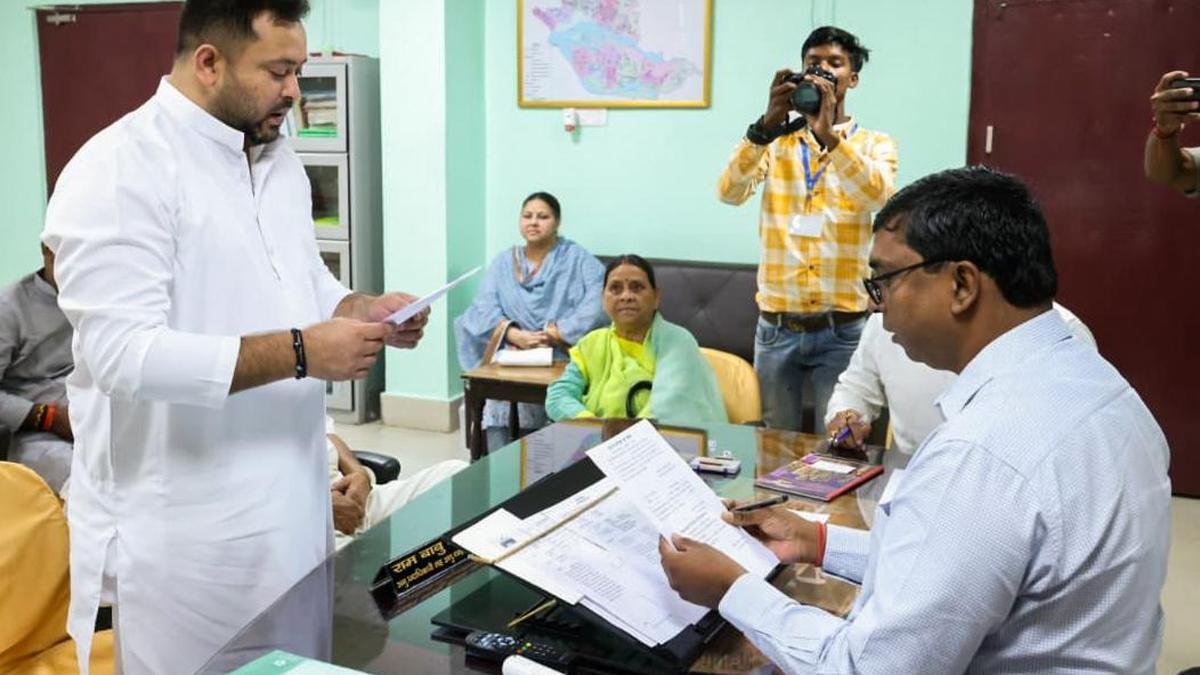
- A candidate must file a nomination paper before the Returning Officer (RO) of the constituency.
- It must be filed between the date of notification and the last date fixed for nominations (usually 7 days after notification).
- The form must include:
- Candidate’s personal details.
- A proposer (1 for recognised parties; 10 for independents).
- A security deposit (₹25,000 for Lok Sabha, ₹10,000 for State Assembly; half for SC/ST).
- The nomination must be delivered in person by the candidate or proposer.
- Oath or Affirmation (Section 33A & 34)
- The candidate must take an oath of allegiance to the Constitution of India before an authorised officer after filing nomination but before scrutiny.
- Failure to take this oath results in rejection of nomination.
- Scrutiny of Nominations (Section 36)
- The Returning Officer (RO) scrutinises all nomination papers on the day fixed by the Election Commission (usually next day).
- RO may reject nominations for:
- Non-fulfilment of qualification criteria.
- Missing or defective affidavits (Form 26).
- Failure to submit “no dues” certificates, missing signatures, or incomplete details.
- Non-payment of security deposit.
- The RO’s decision is final at this stage — courts cannot interfere due to Article 329(b) (bar on judicial intervention during elections).
- Withdrawal of Candidature (Section 37)
- After scrutiny, candidates have two days to withdraw their candidature.
- Withdrawals must be made in writing to the RO.
- Publication of Final List (Section 38)
- The RO prepares and publishes the final list of validly nominated candidates.
- Symbols are then allotted by the Election Commission of India (ECI).
- Election and Results
- Only the candidates whose nominations are accepted appear on the ballot or EVM.
- After polling, counting, and declaration of results, the Election Commission notifies the elected members.
| Returning Officer (RO): A statutory official appointed by the Election Commission to administer elections in a constituency. The RO handles nomination acceptance, scrutiny, polling logistics, counting and declaration of results. The role combines administrative and quasi-judicial functions during the election period. |
Procedural traps that routinely cause rejections
- Oath Trap: Candidates must take an oath before a specified authority after filing nomination but before scrutiny. Too early, too late, or before the wrong authority—nomination gets rejected.
- Notarisation Trap: Form 26 affidavit must be notarised by the correct authority. Missing this step leads to rejection.
- Certificate Trap: Candidates must submit no-dues certificates (from municipal bodies, electricity boards, etc.) and clearance from the Election Commission (for government servants). Each office can delay or block the process.
Related Case of SC
- Resurgence India vs Election Commission (2013): The Supreme Court ruled that false information leads to prosecution but not disqualification; however, incomplete forms can cause rejection — so mistakes are punished more harshly than lies.
Court orders for transparency such as mandatory affidavits on assets, liabilities, and criminal cases have unintentionally increased chances of rejection on technical grounds.
Comparisons and reform proposals
- International practice: UK, Canada, Germany and Australia allow correction windows, notices and facilitation by officials.
- Proposed Indian fixes: Treat deficiencies as three categories:
- Technical/paperwork;
- Authenticity-verification;
- Constitutional/statutory bars.
Implications
- Democratic exclusion: Arbitrary rejections violate the candidate’s right to contest and voters’ right to choose, undermining electoral legitimacy.
- Political weaponisation: Procedural opacity enables incumbents or local officials to filter opponents without visible political accountability.
- Judicial bottleneck and irreversibility: Article 329(b) precludes mid-election judicial relief, making post-poll election petitions an inadequate remedy.
- Erosion of electoral competitiveness: Frequent technical disqualifications reduce contestation and can produce uncontested races or skewed outcomes.
- Need for capacity and digital reform: Modern, integrated systems can reduce human discretion, speed verification, and increase transparency.
Challenges and Way Forward
| Challenges | Way Forward |
| Vague legal standard (“substantial character”) allows wide RO discretion. | Statutorily define categories of defects and limit rejection to constitutional/statutory disqualifications only. |
| No mandatory cure/correction period — immediate rejection is final pre-poll. | Mandate a 48-hour (or 72-hour) correction window after a written notice from RO for technical defects. |
| Multiple bureaucratic chokepoints (no-dues, certificates) create delays and vetoes. | Simplify requirements; make key verifications post-filing or digital-validated; allow provisional acceptance subject to verification. |
| Checklist has no legal force — illusion of protection for candidates. | Convert the checklist into a statutory notice mechanism obliging RO to record defects and preserve candidate reliance. |
| Opacity and lack of data on rejections enables manipulation. | Publish a public dashboard with timestamps, reasons, documents and status for every nomination. |
| Paper-based, error-prone process causes rejections for typos or timing. | Implement a digital-by-default nomination portal with auto-validation against electoral rolls, e-signatures and audit trails. |
Conclusion
Nomination scrutiny is a gatekeeping moment for democracy. The law should prioritise inclusion and facilitation, not paperwork filtration. Clear rules, a statutory cure period, reasoned orders, digital verification and public transparency will protect citizens’ presumptive right to contest and voters’ right to meaningful choice.
| EnsureIAS Mains Question
Q. Examine how the nomination scrutiny process under the Representation of the People Act, 1951, affects electoral competitiveness in India. Suggest legal and administrative reforms to ensure nominations are decided fairly without compromising verification of genuine disqualifications. (250 Words) |
| EnsureIAS Prelims Question
Q. Consider the following statements: 1. Section 36 of the Representation of the People Act, 1951 authorises the Returning Officer to scrutinise and reject nominations for defects of a substantial character. 2. Under Article 329(b) of the Constitution, courts can entertain pre-poll challenges to nomination rejections while elections are ongoing. 3. The Supreme Court in Resurgence India v. Election Commission (2013) held that false declarations always invalidate nominations. How many of the following statements are correct? Answer: c) 1 and 3 only Explanation: Statement 2 is incorrect: Article 329(b) bars courts from interfering during the election process, so courts ordinarily cannot entertain pre-result petitions challenging nomination rejections until after poll completion, making timely judicial remedy unavailable. Statement 3 is correct: In Resurgence India v. EC (2013) the Court distinguished false declarations from incomplete ones — it held false declaration leads to prosecution, but the authority also held that incomplete declarations can invalidate nominations, creating a paradox where incompleteness can be more immediately fatal than falsehood. |