Context
The Foreign Contribution (Regulation) Amendment Bill, 2026 seeks to create a statutory framework for dealing with foreign contributions and assets when an organisation’s FCRA certificate is cancelled, surrendered or ceases to exist, including due to non-renewal.
About FCRA Amendment Bill 2026
- The Bill proposes a Designated Authority, appointed by the Central Government, to supervise, manage and dispose of such foreign contributions and assets.
- The Bill was introduced in the Lok Sabha in March 2026 and has been referred for detailed parliamentary scrutiny. A 31-member parliamentary panel has now been constituted to examine the Bill.
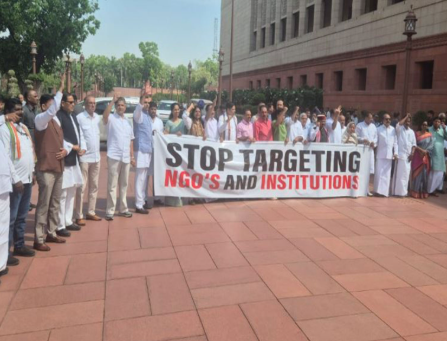
- The proposed framework has raised concerns about the extent to which executive regulation of foreign funding may affect the autonomy of civil society institutions.
Existing FCRA Framework
- The Foreign Contribution (Regulation) Act, 2010 (FCRA) regulates the receipt and utilisation of foreign contributions in India.
- Existing provisions allow cancellation of an FCRA certificate for specified violations and provide for penalties for misuse of foreign contributions.
- The existing law also provides for vesting of foreign contributions and assets created from them after cancellation or surrender of registration.
- The Bill seeks to establish a more detailed framework for provisional vesting, supervision, management, restoration and permanent vesting or disposal of such assets.
Key Provisions
- Designated Authority
- The Central Government will appoint a Designated Authority to deal with foreign contributions and assets covered by the proposed framework.
- Foreign contributions and assets may be provisionally vested in the Authority when an organisation’s FCRA certificate is cancelled, surrendered or ceases to exist.
- The Authority may supervise and maintain such assets and, where permitted under the framework, manage related activities.
- If the organisation does not obtain a fresh certificate or have its certificate renewed or restored within the prescribed period, the vesting may become permanent.
- Restoration and Disposal
- If the organisation obtains a fresh certificate or has its certificate renewed or restored, the provisionally vested assets and unutilised foreign contribution are to be returned as provided under the Bill.
- Assets permanently vested in the Authority are to be used for public purposes.
- Such assets may be transferred to government ministries, departments, authorities or agencies, or disposed of through sale or other prescribed processes.
- Sale proceeds and unutilised foreign contribution are to be credited to the Consolidated Fund of India.
- Appeals and Exemptions
- A person aggrieved by an order of the Designated Authority may appeal to the District Judge within 90 days.
- The Central Government may exempt certain persons from the vesting provisions where considered necessary or expedient in the public interest.
Constitutional Concerns
- Regulation versus Institutional Control
- The State has a legitimate interest in regulating foreign funding to prevent diversion, misuse and threats to public interest.
- However, regulation of foreign contributions is distinct from intervention in the management and functioning of recipient institutions.
- The proposed framework therefore raises questions about the limits of executive control over civil society institutions.
- Proportionality
- A legitimate governmental objective must be pursued through measures that have a reasonable connection with that objective and do not impose an excessive burden.
- Since the Bill may extend State intervention beyond financial regulation to possession, management and eventual disposal of assets, safeguards become particularly important.
- Clear statutory limits on executive discretion are necessary to ensure that regulatory powers do not result in disproportionate interference with institutional autonomy.
Significance
- The Bill could significantly change the consequences of losing an FCRA certificate.
- The issue would move beyond merely losing eligibility to receive foreign contributions to possible State intervention in foreign-funded assets and their management.
- It therefore brings into focus the constitutional balance between national interest, regulatory accountability and autonomy of civil society institutions.
Challenges
- The scope and limits of the Designated Authority’s management powers require clarity.
- Prolonged provisional vesting could disrupt the functioning of institutions whose certificates are subsequently restored.
- Effective and timely appellate remedies are necessary to prevent arbitrary or excessive intervention.
- Assets created partly through foreign and domestic sources may also raise questions regarding the extent of vesting and protection of domestic contributions.
Way Forward
- Clearly define the conditions, duration and limits of intervention by the Designated Authority.
- Ensure due process, transparency and timely review before permanent vesting or disposal.
- Strengthen independent judicial oversight and provide effective remedies against erroneous decisions.
- The regulatory framework should prevent misuse of foreign contributions while preserving the legitimate autonomy of civil society institutions.
FAQs
Q1. What is the main objective of the FCRA Amendment Bill 2026?
It seeks to establish a detailed framework for dealing with foreign contributions and assets when an organisation’s FCRA certificate is cancelled, surrendered or ceases to exist.
Q2. What is the Designated Authority?
It is an authority to be appointed by the Central Government to supervise, manage and deal with foreign contributions and assets covered by the proposed vesting framework.
Q3. How does the Bill differ from the existing FCRA framework?
The existing law already provides for vesting in certain circumstances. The Bill provides a more detailed mechanism covering provisional vesting, supervision, restoration and permanent vesting or disposal.
Q4. What is the key constitutional concern?
The central concern is whether measures intended to regulate foreign funding could extend into excessive executive control over the management and functioning of civil society institutions.
Q5. What role does proportionality play in assessing the Bill?
It requires State action pursuing a legitimate objective to maintain a reasonable balance between the public purpose and the burden imposed on affected rights and institutional autonomy.
Q6. What safeguards are important?
Clear limits on executive powers, due process, timely review, effective appeals and judicial oversight are important to prevent disproportionate intervention.