Context
- Recently, the Reserve Bank of India (RBI) issued updated ECB guidelines through the Foreign Exchange Management (Borrowing and Lending) (First Amendment) Regulations, 2026.
- These changes were made by amending the earlier 2018 regulations, using powers under the Foreign Exchange Management Act, 1999 (FEMA).
- The objective is to liberalise overseas borrowing, improve access to global capital, and support India’s growth needs.
What Are External Commercial Borrowings (ECBs)?
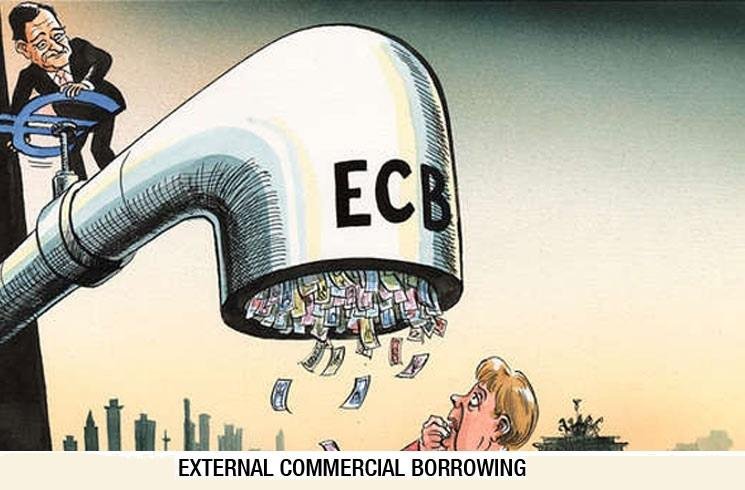
- External Commercial Borrowings refer to funds raised by Indian entities from foreign sources.
- These borrowings can take the form of External loans, Foreign Currency Convertible Bonds (FCCBs) and Other approved international financial instruments.
- An eligible Indian borrower can raise ECBs in Foreign Currency (FCY), or Indian Rupees (INR).
Why Are ECBs Important?
ECBs are encouraged because:
- Overseas interest rates are often lower than domestic rates.
- They provide access to large pools of global capital.
- They help firms finance expansion, infrastructure, and manufacturing.
- They reduce pressure on domestic credit markets.
Thus, ECBs act as a supplementary source of long-term finance for Indian industry.
Who Can Borrow? (Expanded Eligibility)
- Under the updated framework: Any non-individual resident entity incorporated under Central or State law is now eligible to raise ECBs, subject to required statutory approvals.
- This is a major widening of the borrower base compared to earlier rules.
Increased Borrowing Limits and Maturity Norms
- Higher Caps on Borrowing: Eligible companies can now raise up to USD 1 billion, or 300% of their net worth, whichever is applicable under the rules. This significantly increases financial flexibility.
- Minimum Average Maturity Period (MAMP)
- General rule: 3 years minimum average maturity.
- Special relaxation: Manufacturing sector borrowers may access ECBs with shorter maturities (1–3 years) under specified conditions.
- This aims to support industrial growth and faster capital deployment.
Conversion of ECB into Non-Debt Instruments
- Even matured but unpaid ECBs can now be converted into non-debt instruments (such as equity), provided they comply with the Foreign Exchange Management (Non-Debt Instruments) Rules, 2019.
- This offers companies flexibility in managing repayment stress.
Arm’s Length Principle for Related-Party ECBs
- If ECB is raised from a related foreign entity the transaction must follow the arm’s length principle.
- It means that the borrowing terms should be exactly like those between unrelated parties, ensuring:
- No preferential treatment
- No conflict of interest
- Fair market-based pricing
- This safeguards financial integrity.
End-Use Restrictions (Where ECB Money Cannot Be Used)
To prevent speculation and misuse, ECB funds cannot be deployed for:
- Chit funds or Nidhi companies
- Stock market investments
- Certain real estate activities
- Other prohibited speculative purposes
The funds must be used for productive economic activities.
Broader Significance of the Revised ECB Framework
These reforms aim to:
- Improve ease of doing business
- Deepen integration with global financial markets
- Support manufacturing and infrastructure
- Enhance corporate funding options
- Maintain macroeconomic stability through regulated liberalisation
The framework balances capital inflows with financial discipline.
Conclusion
Overall, the revised ECB framework reflects India’s move toward calibrated financial openness, providing Indian firms greater access to global capital while protecting systemic stability.
FAQs
Q1. What are ECBs?
Funds raised by Indian entities from foreign sources in the form of loans, bonds, or other approved instruments.
Q2. Who can borrow under the updated ECB framework?
Any non-individual resident entity incorporated under Central or State law, subject to approvals.
Q3. What are the new borrowing limits for ECBs?
Companies can raise up to USD 1 billion or 300% of their net worth, whichever is applicable.
Q4. What is the minimum average maturity period (MAMP) for ECBs?
Generally 3 years, but manufacturing sector borrowers may access shorter maturities (1–3 years).
Q5. What are the end-use restrictions for ECBs?
Funds cannot be used for chit funds, Nidhi companies, stock market investments, or speculative real estate activities.