Context
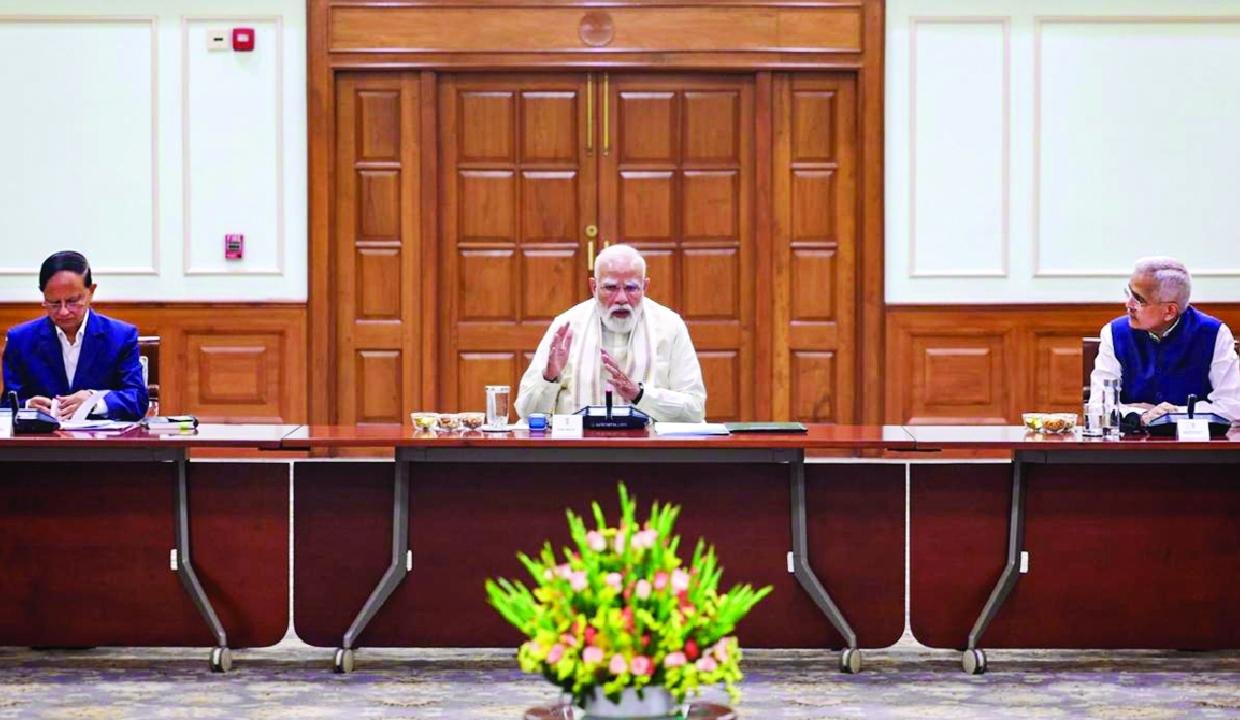
The Prime Minister recently chaired a meeting of the Economic Advisory Council to the Prime Minister (EAC-PM) to review India’s economic outlook, assess emerging risks, and identify policy priorities for sustaining high economic growth. The discussions focused on structural reforms, investment promotion, macroeconomic stability, and climate resilience.
Growth Outlook and Policy Priorities
The Council emphasized the need to sustain India’s growth momentum despite a challenging global environment marked by geopolitical tensions and economic uncertainty.
Key Priorities
- Deepening structural reforms to improve economic efficiency.
- Enhancing Ease of Doing Business (EoDB) and Ease of Living.
- Promoting investment-led growth.
- Strengthening productivity and competitiveness.
- Preserving macroeconomic stability.
India’s Economic Performance
The Council noted the resilience of the Indian economy despite external headwinds.
Key Indicators
- GDP growth stood at 7.8% in the January–March 2026 quarter.
- Provisional GDP growth for FY 2025–26 was estimated at 7.7%.
Significance
- Strong growth reflects the resilience of the economy amid global uncertainties.
- Robust economic performance has strengthened investor confidence.
- Sustained growth provides a favourable environment for reforms and long-term investment.
Capital Inflow and Financial Sector Measures
To strengthen investment flows and deepen financial markets, the government and the Reserve Bank of India (RBI) announced a series of fiscal and monetary measures.
Government Measures
- Removal of Short-Term Capital Gains Tax (STCG) on Foreign Institutional Investor (FII) investments in government securities.
- Removal of Long-Term Capital Gains Tax (LTCG) on such investments.
- Elimination of withholding tax on interest income earned by FIIs from government bonds.
RBI Initiatives
- Relaxation of norms for mobilising foreign currency deposits.
- Revival of the FCNR(B) Deposit Scheme with RBI support for exchange-rate hedging costs.
- Concessional forex swap facilities for Public Sector Undertakings (PSUs) raising External Commercial Borrowings (ECBs).
Significance
- Increased participation of foreign investors in Indian debt markets.
- Improved liquidity in the financial system.
- Lower borrowing costs through higher demand for government securities.
- Greater availability of capital to support investment and economic growth.
Global Bond Index Inclusion
India’s inclusion in major global bond indices has enhanced the visibility of its debt market among international investors.
- JPMorgan Emerging Market Bond Index (2024)
- Bloomberg Emerging Market Local Currency Index (2025)
- FTSE Russell Emerging Market Bond Index (2025)
Potential inclusion in the Bloomberg Global Aggregate Bond Index could deepen India’s integration with global financial markets and enhance foreign investor participation.
Geopolitical Uncertainty
- The Council reviewed the implications of the ongoing conflict in West Asia.
- Key concerns include volatility in energy prices, disruptions in trade flows, and instability in global financial markets.
- While no immediate threat to India’s growth outlook was identified, developments continue to be closely monitored.
Climate Vulnerability
- Possible El Niño conditions may result in below-normal rainfall.
- Dependence on monsoon performance continues to pose risks to agricultural output and rural demand.
Policy Response
- Promotion of climate-resilient agriculture.
- Expansion of irrigation infrastructure.
- Improved water resource management.
- Diversification of growth drivers beyond agriculture.
About the EAC-PM
Nature
- The EAC-PM is a non-constitutional, non-statutory, and advisory body constituted by the Union Government.
- It was reconstituted in 2017 and is currently chaired by S. Mahendra Dev.
Functions
- Advise the Prime Minister on economic and related policy matters.
- Assess macroeconomic trends and emerging risks.
- Recommend reforms for sustainable and inclusive growth.
- Provide analytical inputs on development priorities and policy formulation.
Conclusion
The EAC-PM meeting highlighted India’s emphasis on sustaining growth through structural reforms, investment promotion, and prudent macroeconomic management. While geopolitical tensions and climate-related uncertainties remain important challenges, strong economic fundamentals, improving investor confidence, and continued reform momentum provide a solid foundation for long-term, inclusive, and resilient economic growth.