Why in the News?
- A sudden blizzard (a severe snowstorm with high winds) and heavy snowfall near Mount Everest (on the Tibetan side) trapped hundreds of trekkers (later rescued), shows how fast mountain weather can turn deadly.
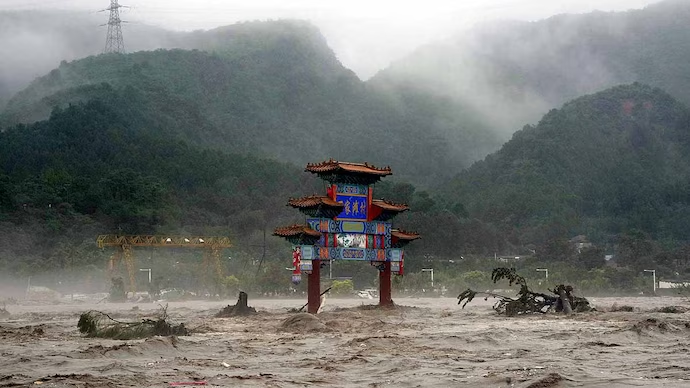
- The Himalayas have seen a sharp rise in disasters like landslides, floods, glacial lake outburst floods (GLOFs) and extreme storms over recent decades.
Key Highlights
- Long calm, then a sudden change
- For much of the early 20th century, the Himalayan region recorded relatively few disasters (Between 1902-1962, the region recorded just 5 disasters).
- Gradually, starting around the 1960s, disasters began to increase decade by decade.
- As per the Down To Earth (DTE) report, in 1963-1972, the region reported 11 disasters, followed by 13 disasters in 1973-82. The last decade (2013-2022) saw the highest number of disasters at 68, and they accounted for 44% of all the disasters reported in India.
- The rising frequency shows that the mountain environment is changing, and the old patterns no longer guide safety.
- Why are the Himalayas becoming more hazardous?
- The Himalayas are warming faster than the global average, causing glaciers to melt and lakes to grow.
- Thawing and changing rainfall patterns destabilise slopes and increase the chance of sudden floods and landslides.
- Human activities like roads, hydropower construction and deforestation also increase vulnerability by disturbing fragile mountain systems.
- What is the present status of the Early Warning System (EWS) in India?
- India does not have enough valley-level EWS that are low-cost, weather-proof and operable by local people.
- Drones and satellites help, but each has limits. Drones cannot cover the whole range and satellites can be expensive or slow for real-time alerts.
- Hope from technology and local action
- AI and improved models can turn complex sensor and weather data into usable warnings if the data are timely and local.
- Pilot projects like lake monitoring, hailstorm alerts for orchard owners and community-run sensors show that EWS can work when communities are involved.
- The real solution blends technology with training, trust and local ownership so that people know what to do when the alarm sounds.
Key Terms
- Early Warning System (EWS)
- An EWS watches for hazards and sends alerts so people can act before disaster strikes.
- It includes sensors, data processing, alert communication and community response plans.
- For mountains, EWS must be rugged, low-cost and able to work without full mobile networks.
- A good EWS links alerts to practical local actions—evacuation routes, safe shelters and local responders.
- Glacial Lake Outburst Flood (GLOF)
- A GLOF happens when the natural barrier of a mountain lake fails suddenly, releasing a large flood.
- Causes include glacier melt, ice avalanches into lakes, or weakening of moraine dams.
- GLOFs send fast-moving water and debris downstream, causing sudden damage to villages and roads.
- Monitoring lake levels, dam stability and early evacuation is critical to reduce GLOF losses.
Implications of having Early Warning System
- Life-saving impact: EWS can alert mountain communities before disasters strike, helping people evacuate in time and reducing casualties.
- Economic protection: Timely warnings prevent loss of infrastructure, roads, hydropower plants and crops, saving crores in disaster-related damages.
- Tourism safety: In regions like Uttarakhand, Himachal and Sikkim, EWS ensures safer trekking, mountaineering and eco-tourism, maintaining local incomes.
- Stronger disaster governance: Integrating EWS into local and national disaster frameworks builds institutional preparedness and accountability.
- Community empowerment: When locals are trained to operate EWS, it promotes self-reliance and participation in managing regional risks.
- Reduced rescue burden: Early alerts mean fewer emergency operations in extreme terrain, easing the load on NDRF, SDRF and the Army.
- Cross-border cooperation: Many Himalayan rivers are shared; EWS enables data sharing and joint response with Nepal, Bhutan, and China.
- Climate adaptation: Continuous monitoring helps understand long-term trends, strengthening India’s resilience to climate change in the Himalayas.
- Public awareness and trust: Regular alerts and drills create a culture of safety, where people trust and act on warnings quickly.
Challenges and Way Forward
| Challenge | Way Forward |
| Limited valley-level EWS | Install low-cost, rugged sensors in each high-risk valley and link them to local warning centres. |
| Poor data links and connectivity | Use hybrid communication (satellite, radio, local mesh networks) so alerts reach remote villages. |
| High cost and scale limits of drones/satellites | Combine satellites for broad monitoring with cheap local sensors for continuous, local detection. |
| Lack of local capacity to operate systems | Train and pay local teams to maintain equipment and lead evacuations; make EWS community-owned. |
| Weak coordination across agencies and borders | Create a national Himalayan EWS programme with state, district and cross-border protocols and shared data. |
Conclusion
The Himalayas are changing rapidly, and every lost life reminds us that technology must meet people on the mountain paths and in the villages. Investing in valley-level early warning systems, resilient communications, AI-informed monitoring, and local training will save lives and livelihoods. If the nation treats Himalayan EWS as a clear priority and ensures funding, cross-border cooperation and community ownership, we will be far better prepared for the next storm, flood or glacial event.
| EnsureIAS Mains Question
Q. Critically examine the growing disaster risk in the Himalayan region. Propose a practical plan for early warning systems that combines technology, community training and policy measures. (250 words) |
| EnsureIAS Prelims Question
Q. Consider the following statements: 1. The frequency of disasters in the Himalayan region increased substantially after the 1960s. 2. Drones alone can provide continuous, wide-area monitoring across the entire Himalayan arc. 3. Effective early warning systems require both technological tools and trained local response capacities. How many/ Which of the following statements are correct? Answer: c) 1 and 3 only Explanation: Statement 1 is correct: Historical records show a clear rise in Himalayan disasters from the 1960s onward, driven by climate shifts, glacier changes and increased human exposure. Statement 2 is incorrect: Drones are useful for local surveys but face limits in range, endurance and bad weather; they cannot alone provide continuous monitoring for the entire Himalayan arc. Statement 3 is correct: Technology (sensors, satellites, AI) must be paired with trained local teams, clear evacuation plans and trusted communication to ensure warnings actually save lives. |