Context
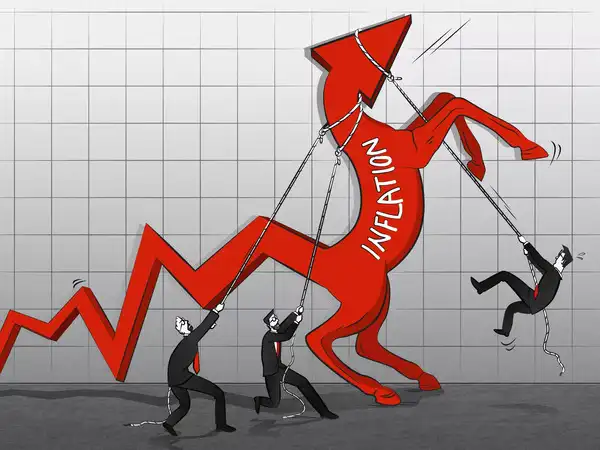
India is facing economic uncertainty reflected by the IMF’s revised outlook. The IMF has revised India’s 2025-26 GDP growth to 6.6% (up from 6.4%) but reduced 2026-27 growth to 6.2% (from 6.4%).
What is the Current Economic Situation?
India’s growth is being shaped by a mix of positive supports and negative pressures:
| Positive Factors | Negative Factors |
| Lower GST and income tax rates → increase disposable income and boost consumption demand.
Good monsoon and higher MSPs → raise farm income and improve rural purchasing power. Moderating inflation → keeps essential prices stable, helping households spend more. Healthy services exports → bring in foreign exchange and keep the current account deficit low. Strong central capital expenditure → creates jobs and pushes investment in infrastructure. Rising private investment→ signals improving business confidence and future growth capacity. |
High U.S. reciprocal tariffs → reduce export competitiveness, especially for labour-intensive sectors.
Weak job creation and slow wage growth → limit household income and weaken long-term consumption. Moderation in services sector indicators → reduces growth support from a major contributor to India’s GDP. Volatile capital flows (FII outflows, weak FDI) → create financial instability and reduce long-term investment. Expected decline in goods exports as front-loaded shipments (i.e., exporters sending shipments earlier than usual to avoid future tariff impacts) taper → reduces momentum in manufacturing and external demand. |
This combination of positive domestic support and negative external pressures is creating uncertainty about whether India can maintain growth momentum once festive demand subsides.
Why is this important?
- India needs strong domestic demand to offset weak global conditions.
- High U.S. tariffs threaten labour-intensive export sectors (textiles, leather, gems).
- Lower taxes can boost consumption but cannot substitute for long-term income growth.
- Weak hiring and slow wage growth limit household purchasing power.
- Structural reforms are needed to ensure sustained private investment and job creation.
How is the Economy Responding to this Situation?
| Area | Key Developments |
| Rural & Agriculture | 1. Good monsoon + higher MSPs improved rural sentiment
2. Higher tractor sales and two-wheeler recovery 3. Increased govt spending on agriculture & allied sectors 4. Growth in agricultural exports |
| Manufacturing | 1. Higher steel production
2. Improved IIP for manufacturing 3. Growth in non-oil and non-agricultural exports |
| Services Sector | 1. Shows mixed trends.
2. E-way bill generation and toll revenues have improved. 3. Air passenger traffic and services exports have moderated, signalling emerging weaknesses. 4. Services Exports: still a strong pillar, with Compound Annual Growth Rate (FY 2018-25) of 10% (vs 5% for goods exports) |
| Goods & Electronics Exports | 1. Goods exports grew due to front-loading before U.S. tariffs
2. Non-oil exports grew by 7% (vs 4.6% last year) 3. Electronics exports grew by 40% 4. After tariffs (Sept): US-bound exports fell by 12%. Exports of all major items except electronic goods contracted. |
| External Sector & Capital Flows | 1. Current Account Deficit to remain around 1% of GDP in FY 2026 due to strong services exports, supporting remittances and benign (beneficial) global crude oil prices.
2. Persistent FII outflows and weak FDI makes capital flows volatile but $690 billion foreign reserves provide stability. |
| Domestic Demand & Investment | 1. Lower taxes + Low inflation + Low interest rates + Good monsoon spurred festive demand
2. Centre’s capex up by 40% (29% after adjustments) 3. Private investment rising in power, cement, construction, pharma, logistics. |
| Growth Outlook | 1. Q1: 7.8% growth rate and Q2: ~7.2% growth rate
2. Second half of the year (H2): expected moderation to ~6.3%. 3. FY growth around 6.9% (boosted partly by low GDP deflator) |
| Inflation & Monetary Policy | 1. Inflation expected at ~2% in H2 (vs 2.2% in H1)
2. RBI gets more room for rate cuts if growth slows. |
Way Forward
To manage the current uncertainty and sustain economic momentum, India needs a mix of short-term stabilisation and long-term structural measures:
- Strengthen job creation in labour-intensive sectors: Expanding textiles, leather, footwear, food processing, and tourism can absorb large numbers of workers and increase household incomes.
- Accelerate private investment through policy stability: Clear regulations, faster approvals, and improved logistics will encourage domestic and foreign investors.
- Expand rural incomes beyond MSP increases: Promote crop diversification, irrigation support, and allied activities (dairy, fisheries) to stabilise farm earnings.
- Boost skill development for new-age sectors: Invest in high-skill domains such as electronics, digital services, green technologies, and logistics to raise productivity and wages.
- Diversify export markets and build domestic value chains: Reducing dependence on the U.S. will help cushion the impact of high tariffs. Strengthening local manufacturing capacity can support long-term export competitiveness.
- Enhance social protection for vulnerable households: Stronger safety nets can maintain consumption during periods of income stress, especially in urban areas.
- Improve credit access for MSMEs: MSMEs generate the highest employment but face major credit constraints. Targeted lending and simplified compliance can help them expand.
- Continue GST simplification and rationalisation: Simplifying rates and reducing compliance burden can further boost consumption and business confidence.
Conclusion
India’s economy has remained resilient due to strong domestic demand, services exports, and supportive government policies. However, high U.S. tariffs, weak job creation, and volatile global conditions pose real challenges. For growth to remain stable beyond the festive period, household incomes must rise, private investment must deepen, and labour-intensive sectors must be strengthened. Sustained reforms in jobs, exports, and investment will determine whether India can maintain its momentum in an uncertain global environment.
| Ensure IAS Mains Question
Q. India’s domestic demand remains strong due to lower taxes, moderating inflation, and rising investments, yet household incomes and export prospects face significant pressures. Discuss the key factors driving this divergence and suggest measures to sustain growth beyond the festive period. (250 words) |
| Ensure IAS Prelims Question
Q. Consider the following statements regarding India’s recent economic trends: 1. Services exports have grown at a faster pace than goods exports between FY 2018 and FY 2025. 2. India’s foreign exchange reserves stand at around 690 billion USD. 3. The IMF has revised India’s 2026-27 GDP growth projection upward from 6.2% to 6.4%. Which of the above statements is/are correct? a) 1 and 2 only b) 2 and 3 only c) 1 and 3 only d) 1, 2 and 3 Answer: a) 1 and 2 only Explanation: Statement 1 is correct: Between FY 2018 and FY 2025, services exports grew at a CAGR of about 10%, faster than goods exports at 5%. Statement 2 is correct: India’s foreign exchange reserves are around 690 billion USD. Statement 3 is incorrect: The IMF revised India’s 2026-27 GDP growth downward from 6.4% to 6.2%, not upward. |