Context
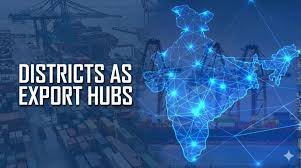
The government recently updated Parliament on the progress of the Districts as Export Hubs (DEH) Initiative, which aims to make every district a contributor to India’s exports.
Q1. What is the Districts as Export Hubs (DEH) Initiative and what is its objective?
- The DEH initiative was launched in 2019.
- It is implemented by the Directorate General of Foreign Trade under Department of Commerce.
- Main objective:
- Identify and promote unique products from each district.
- Help sell them in both, domestic markets and international markets.
Q2. How does the DEH initiative work (decentralised export promotion mechanism)?
- Export promotion is shifted from central level → district level.
- Districts become active players in export growth.
- This ensures local industries get direct support and export growth becomes regionally balanced.
Q3. What is the institutional structure of DEH?
- State level: State Export Promotion Committee (SEPC)
- District level: District Export Promotion Committee (DEPC)
- These bodies:
- Identify products
- Solve local export problems
- Coordinate with government and exporters
- Covers all districts (734 districts) across India
- Focus sectors include agriculture, toys, GI-tagged products and local manufacturing clusters.
- Aim: Promote district-specific strengths
Q4. What are District Export Action Plans (DEAPs) and why are they important?
- They are district-level plans for export promotion as a roadmap helps each district export better and faster.
- They identify problems (bottlenecks) in production and supply chain.
- They then suggest solutions to improve exports of the products.
Q5. How does DEH support local producers and exporters?
- Helps small producers improve production scale and connect with international buyers
- Promotes branding of local products and better market access.
- Focus is on local to global transformation
Conclusion
The DEH initiative is a major step towards decentralised and inclusive export growth, helping India transform local products into global brands while ensuring balanced regional development.