Context
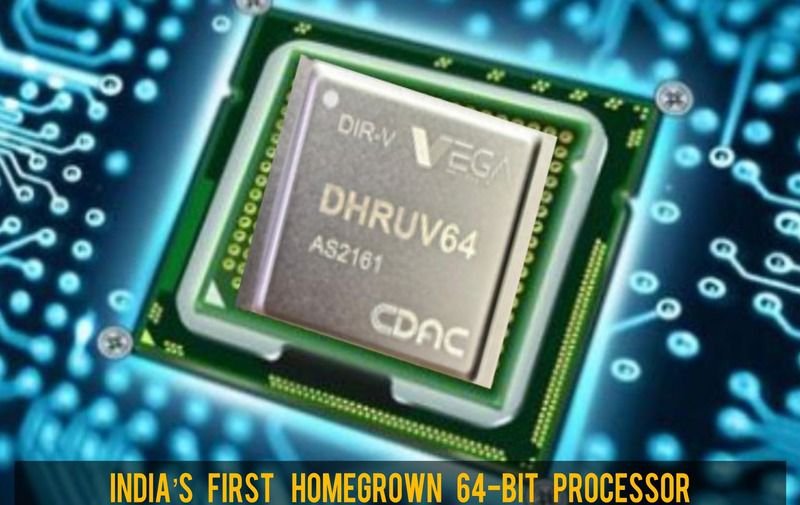
- The Ministry of Electronics and Information Technology (MeitY) announced the launch of DHRUV64, an indigenous microprocessor, on December 15.
- The chip is projected as a step towards technological self-reliance in processors, a sector where India remains heavily import-dependent.
What is a Microprocessor?
A microprocessor is an integrated electronic circuit that functions as the central processing unit (CPU) of a system. It executes instructions, processes data, and controls the functioning of electronic devices by performing arithmetic, logic, and control operations. It is often called the “brain” of electronic systems.
What is DHRUV64?
- DHRUV64 is a 64-bit, dual-core microprocessor developed by the Centre for Development of Advanced Computing (C-DAC) under MeitY’s Microprocessor Development Programme.
- It runs at a clock speed of 1 GHz, making it capable of:
- Running modern operating systems
- Supporting embedded and industrial applications
Why Indigenous Microprocessors Matter for India
- India is one of the largest consumers of electronic devices, yet it depends on foreign-designed processors and global supply chains.
- Control over processor design gives countries:
- Better cybersecurity and data sovereignty
- Resilience during export controls or geopolitical disruptions
- Indigenous processors reduce dependence on foreign intellectual property and licensing regimes.
Understanding DHRUV64’s Technical Position
- DHRUV64 is not a high-end consumer chip like those used in smartphones or laptops.
- Advanced chips today have:
- Many CPU cores
- High clock speeds
- Specialised units such as GPUs for artificial intelligence
- However, most industrial and infrastructure applications do not need top-end performance.
- Sectors such as:
- Telecommunications base stations
- Industrial automation
- Automotive electronics
- Routers and control systems
prioritise reliability, efficiency, and long-term support over raw speed.
India’s Processor Ecosystem
- India is developing a portfolio of processors for different strategic and industrial needs:
- SHAKTI – Developed by IIT Madras
- AJIT – Developed by IIT Bombay
- VIKRAM – Developed by ISRO–Semiconductor Laboratory
- THEJAS64 – Developed by C-DAC
- DHRUV64 – Latest addition by C-DAC
- These processors target:
- Strategic and defence systems
- Space and satellite missions
- Factory automation and embedded systems
- MeitY also envisions DHRUV64 as a platform for startups, academia, and industry to prototype systems without relying on foreign chips.
What is RISC-V and DIR-V?
- RISC-V
- RISC-V is an open instruction set architecture, meaning:
- Its basic design rules are publicly available
- No licence fees are required to use it
- An instruction set is like a language that a processor understands, such as commands to add numbers or move data.
- Unlike proprietary instruction sets controlled by companies, RISC-V allows sovereign and cost-effective chip design.
- RISC-V is an open instruction set architecture, meaning:
- DIR-V
- Digital India RISC-V (DIR-V) is India’s initiative to build RISC-V-based processors.
- Earlier DIR-V chips include:
- THEJAS32 – Fabricated in Malaysia
- THEJAS64 – Fabricated at SCL Mohali
- DHRUV64 is the third DIR-V chip, but MeitY has not disclosed where it was fabricated.
What is Not Clear About DHRUV64?
Despite the announcement, several important details remain undisclosed:
- Performance clarity is missing, as there are no benchmark results, memory details, or power-efficiency data.
- Fabrication details are absent, including the foundry, process node, reliability standards, and lifecycle guarantees.
- The term “fully indigenous” is ambiguous, as it is unclear whether design, fabrication, tools, and intellectual property are entirely Indian.
- There is no clarity for manufacturers, such as software support, operating system compatibility, security features, or availability of developer boards.
- The future roadmap is uncertain, although MeitY has mentioned upcoming processors:
- DHANUSH (1.2 GHz, quad-core, 28 nm)
- DHANUSH+ (2 GHz, quad-core, possibly 14–16 nm)
Government Schemes Supporting Chip Development
- India has launched multiple initiatives to strengthen the semiconductor ecosystem:
- Chips to Startup Programme – ₹250 crore over five years for training and innovation
- Design Linked Incentive (DLI) Scheme – Encourages domestic chip design
- INUP-i2i Initiative – Improves access to nanofabrication facilities
- India Semiconductor Mission (ISM) – Approved 10 projects across six States, with investments of ₹1.6 lakh crore
- These schemes aim to develop:
- Skilled talent
- Startup ecosystems
- Fabrication, testing, and packaging capacity
What Lies Ahead?
- The government’s long-term goal is to develop system-on-chip families, robust software ecosystems, and reliable manufacturing capacity.
- Success depends not only on chip design but also on:
- Ecosystem adoption
- Cost competitiveness
- Long-term reliability
- The ultimate objective is for Indian consumers and manufacturers to choose Indian chips without facing higher risk or cost.
Challenges and Way Forward
| Challenges | Way Forward |
| Lack of performance benchmarks and technical transparency reduces industry confidence. | Publish standardised benchmarks, power-efficiency data, and reliability metrics. |
| Unclear fabrication and supply-chain details create doubts about resilience. | Develop domestic fabrication, packaging, and testing capacity under the India Semiconductor Mission. |
| Ambiguity around “fully indigenous” claims limits trust among manufacturers. | Clearly define indigenous design, IP ownership, toolchains, and fabrication stages. |
| Weak software and developer ecosystem hinders adoption. | Build strong software stacks, operating system support, and developer boards. |
| Limited industry uptake due to cost and maturity concerns. | Use government procurement and anchor deployments to create early demand. |
Conclusion
DHRUV64 represents an important milestone in India’s pursuit of technological self-reliance in semiconductors. While it is not a cutting-edge consumer processor, it addresses critical needs in strategic and industrial sectors. However, transparency on performance, fabrication, and deployment is essential for real-world adoption. India’s semiconductor journey will succeed not merely through announcements, but through ecosystem building, credible manufacturing, and sustained policy support.
| EnsureIAS Mains Question
Q. India’s push for indigenous microprocessors is critical for technological sovereignty. Discuss the significance of the DHRUV64 microprocessor and the challenges in building a self-reliant semiconductor ecosystem in India. (250 Words) |
| EnsureIAS Prelims Question
Q. Consider the following statements regarding DHRUV64 and India’s semiconductor initiatives: 1. DHRUV64 is a 64-bit, dual-core microprocessor developed by C-DAC under the Ministry of Electronics and Information Technology. 2. RISC-V is a proprietary instruction set architecture that requires licensing fees. 3. The India Semiconductor Mission aims to strengthen domestic semiconductor manufacturing and design capabilities. Which of the statements given above are correct? A. 1 and 3 only Answer: A. 1 and 3 only Explanation: Statement 1 is correct: DHRUV64 is a 64-bit, dual-core general-purpose microprocessor developed by the Centre for Development of Advanced Computing (C-DAC) under the Ministry of Electronics and Information Technology as part of India’s Microprocessor Development Programme. Statement 2 is incorrect: RISC-V is an open instruction set architecture whose specifications are publicly available. It does not require licensing fees for using the instruction set, which distinguishes it from proprietary architectures controlled by private companies. Statement 3 is correct: The India Semiconductor Mission aims to strengthen India’s semiconductor ecosystem by promoting domestic chip design, fabrication, testing, and packaging through policy support, financial incentives, and large-scale investments across multiple States. |