Context
A recent incident near the Strait of Hormuz involved a fire on a traditional wooden dhow, resulting in the death of an Indian sailor and injuries to several others.
About Dhow
- In regions like the Indian Ocean, Arabian Sea, East Africa, and the Middle East, people have used the dhow for centuries in trade, fishing, and transport.
- Historical evidence places its existence before 600 C.E., though scholars still debate whether it first developed in Indian or Arab maritime traditions.
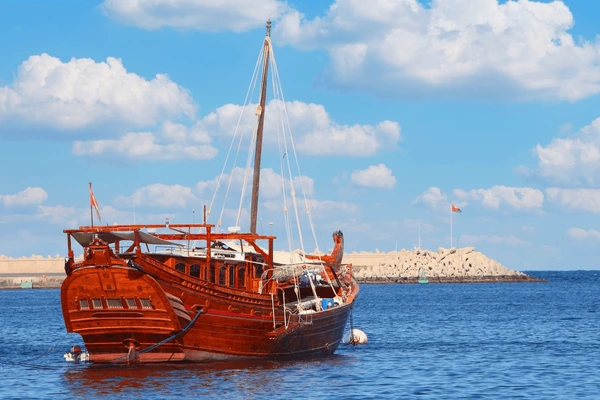
- The vessel is built with a long, narrow wooden hull and moves only with wind-powered sails for navigation.
- Typically, it carries one or two masts fitted with triangular or quadrilateral sails, which help it sail across seas.
- Larger dhows often have a decorated or windowed stern, while the front is designed to be sharp and forward-leaning for better movement.
- Today, the term “dhow” is used broadly for traditional sailing vessels used in coastal and ocean navigation in this maritime region.
Beypore Uru – Traditional Wooden Shipbuilding
- In Beypore, Kerala, skilled artisans construct a large wooden dhow known as the Uru using traditional techniques.
- This entire ship is built without machines or written blueprints, relying fully on inherited craftsmanship.
- Around 50 craftsmen work together for nearly four years to complete one vessel.
- The construction process depends on the experience and memory of master shipbuilders, passed down through generations.
- The Khalasis play a key role in assembling and launching these wooden ships.
- This tradition has historical roots in India’s maritime trade with Mesopotamia and was supported by Arab traders.