Why in the News?
- The Philippines is set to host Southeast Asia’s first coral larvae cryobank, a major step in marine conservation.
- The initiative aims to preserve coral genetic diversity and restore damaged reefs amid rising climate threats.
- It is part of a regional collaboration across the Coral Triangle nations to protect the world’s richest marine ecosystem.
Key Highlights
- What are corals?
- Corals are invertebrate animals belonging to a large group of colourful and fascinating animals called Cnidaria.
- A coral is made up of individual animals called polyps.
- Each polyp has a stomach that opens at only one end and is surrounded by tentacles.
- Food enters the stomach through that opening (mouth) and after consumption, waste products are expelled through the same opening.
- They live in groups of hundreds to thousands of genetically identical polyps that form a ‘colony’.
- The colony is formed by a process called budding, which is where the original polyp literally grows copies of itself.
- Corals are generally classified as either “hard coral” or “soft coral”.
- Colonial hard corals are made up of hundreds to hundreds of thousands of individual coral polyps that cement themselves together by the calcium carbonate they secrete.
- Soft corals do not produce rigid calcium carbonate skeletons and do not form reefs, though they are found in reef ecosystems. Soft coral colonies tend to resemble trees, bushes, fans, whips, and grasses.
- What are coral reefs?
- A coral reef is a term used to describe the collective structure of hard corals that help shape a coral reef ecosystem.
- Coral reefs begin to form when free-swimming coral larvae attach to submerged rocks or other hard surfaces along the edges of islands or continents.
- As the corals grow and expand, reefs take on one of three major characteristic structures—fringing, barrier, or atoll.
- Fringing reefs are the most common, projecting seaward directly from the shore, forming borders along the shoreline and surrounding islands.
- Barrier reefs also border shorelines, but at a greater distance. They are separated from their adjacent land mass by a lagoon of open, often deep water.
- If a fringing reef forms around a volcanic island that sinks completely below sea level while the coral continues to grow upward, an atoll
- Coral reefs are the largest living structure on the planet, and the only living structure to be visible from space.
- The largest coral reef in the world is Australia’s Great Barrier Reef.
- The Coral Triangle – The ‘Amazon of the Seas’
- Covers 7 million sq. km across Indonesia, Malaysia, Papua New Guinea, the Philippines, Solomon Islands, and Timor-Leste.
- Home to 76% of world’s coral species, 33% of reef fish, and 6 of 7 marine turtle species.
- Supports over 120 million people through fisheries and tourism.
- Faces threats from climate change, pollution, and destructive fishing, leading to coral bleaching and habitat loss.
- Global Coral Decline
- As per Status of Coral Reefs of the World 2020, 14% of corals lost between 2009–2018.
- Scientists warn that 70–90% of coral cover could vanish by 2050 if global warming exceeds 1.5°C.
- Even under best scenarios, ocean temperatures may take decades to stabilise, leaving corals vulnerable.
- The Coral Cryobank Initiative
- Led by: University of the Philippines Marine Science Institute.
- Process: Coral larvae (tiny free-swimming coral “seeds”) are frozen and preserved using cryopreservation
- Goal: To store genetic material for reef restoration and research in future.
- Regional network: Linked with research bodies in Taiwan, Malaysia, Indonesia, and Thailand under the Coral Research & Development Accelerator Platform.
- The Science Behind Cryopreservation
- Technique: Vitrification — larvae are treated with protective solutions, then frozen rapidly in liquid nitrogen at –196°C.
- This prevents ice crystal formation, preserving delicate coral tissues.
- Thawing: Done using laser-based rapid warming to prevent re-crystallisation.
- Revival: Rehydrated larvae are observed for movement and settlement in ocean, then transferred to tanks for growth.
- It acts as a “genetic insurance policy”, safeguarding coral biodiversity for future generations.
- Broader Regional Collaboration
- Cryobanks for coral symbionts (algae living in corals) are also being developed in Thailand.
- Scientists stress that all coral species are endangered, not just a few.
- The initiative combines science, community awareness, and policy, aiming to ensure resilience and sustainable livelihoods in the Coral Triangle.
Key Terms
- Coral Bleaching
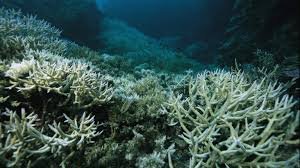
- Occurs when ocean temperatures rise, causing corals to expel symbiotic algae (zooxanthellae).
- Leads to loss of color and energy starvation of corals.
- Major cause: climate change, pollution, and ocean acidification.
- Repeated bleaching events can lead to mass coral death.
- Considered one of the most visible impacts of global warming on marine ecosystems.
- Blue Economy
- Refers to sustainable use of ocean resources for economic growth, improved livelihoods, and jobs.
- Includes fisheries, aquaculture, renewable energy, and tourism.
- Balances economic development with ecological sustainability.
- Promoted under SDG 14 – Life Below Water.
- Key for coastal nations like India and ASEAN countries.
Implications
- Scientific Breakthrough: Cryobanks create a long-term backup of coral biodiversity, enabling future restoration even if species go extinct.
- Climate Adaptation Tool: Offers resilience against warming oceans and mass bleaching events.
- Regional Cooperation: Strengthens ASEAN-level marine conservation through shared research and innovation.
- Livelihood Protection: Sustains the fishing and tourism sectors dependent on healthy coral reefs.
- India’s Relevance: Provides lessons for Indian Ocean coral systems (Lakshadweep, Andaman & Nicobar) on how to integrate science with conservation.
Challenges and Way Forward
| Challenges | Way Forward |
| 1. Climate change and ocean warming threaten coral survival. | Strengthen global commitments under the Paris Agreement and promote blue carbon ecosystems. |
| 2. High cost and complexity of cryopreservation technology. | Increase international funding and share technological expertise through joint research platforms. |
| 3. Limited local awareness among coastal communities. | Launch community education and eco-tourism programmes to promote reef protection. |
| 4. Pollution and destructive fishing practices persist in the region. | Enforce marine protected areas (MPAs) and promote sustainable fishing methods. |
| 5. Lack of policy integration across Coral Triangle nations. | Develop a unified regional framework for coral conservation and data-sharing. |
Conclusion
The Coral Cryobank marks a turning point in marine conservation, combining scientific innovation with regional solidarity. As coral reefs face existential threats from warming oceans and pollution, cryopreservation offers a genetic safety net for future restoration. However, true success depends on climate action, community participation, and long-term international cooperation to preserve the planet’s underwater rainforests.
| EnsureIAS Mains Question
Q. Discuss the significance of Cryobanking in the context of the Coral Triangle and global ocean conservation. (250 Words) |
| EnsureIAS Prelims Question
Q. Consider the following statements regarding the Coral Triangle: 1. The Coral Triangle is spread across six countries in the Indo-Pacific region. 2. It contains more than 50% of the world’s coral species. 3. The Philippines hosts Southeast Asia’s first coral larvae cryobank to restore reef ecosystems. Which of the above statements are correct? Answer: D. 1, 2, and 3 Explanation: Statement 1 is Correct: The Coral Triangle spans six nations — Indonesia, Malaysia, Papua New Guinea, the Philippines, Solomon Islands, and Timor-Leste. Statement 2 is Correct: It hosts about 76% of the world’s coral species, the richest biodiversity on Earth. Statement 3 is Correct: The Philippines has initiated Southeast Asia’s first coral larvae cryobank, marking a scientific milestone in reef restoration. |
|
Also Read |
|
| UPSC Foundation Course | UPSC Daily Current Affairs |
| UPSC Monthly Magazine | CSAT Foundation Course |
| Free MCQs for UPSC Prelims | UPSC Test Series |
| ENSURE IAS NOTES | Our Booklist |