Context
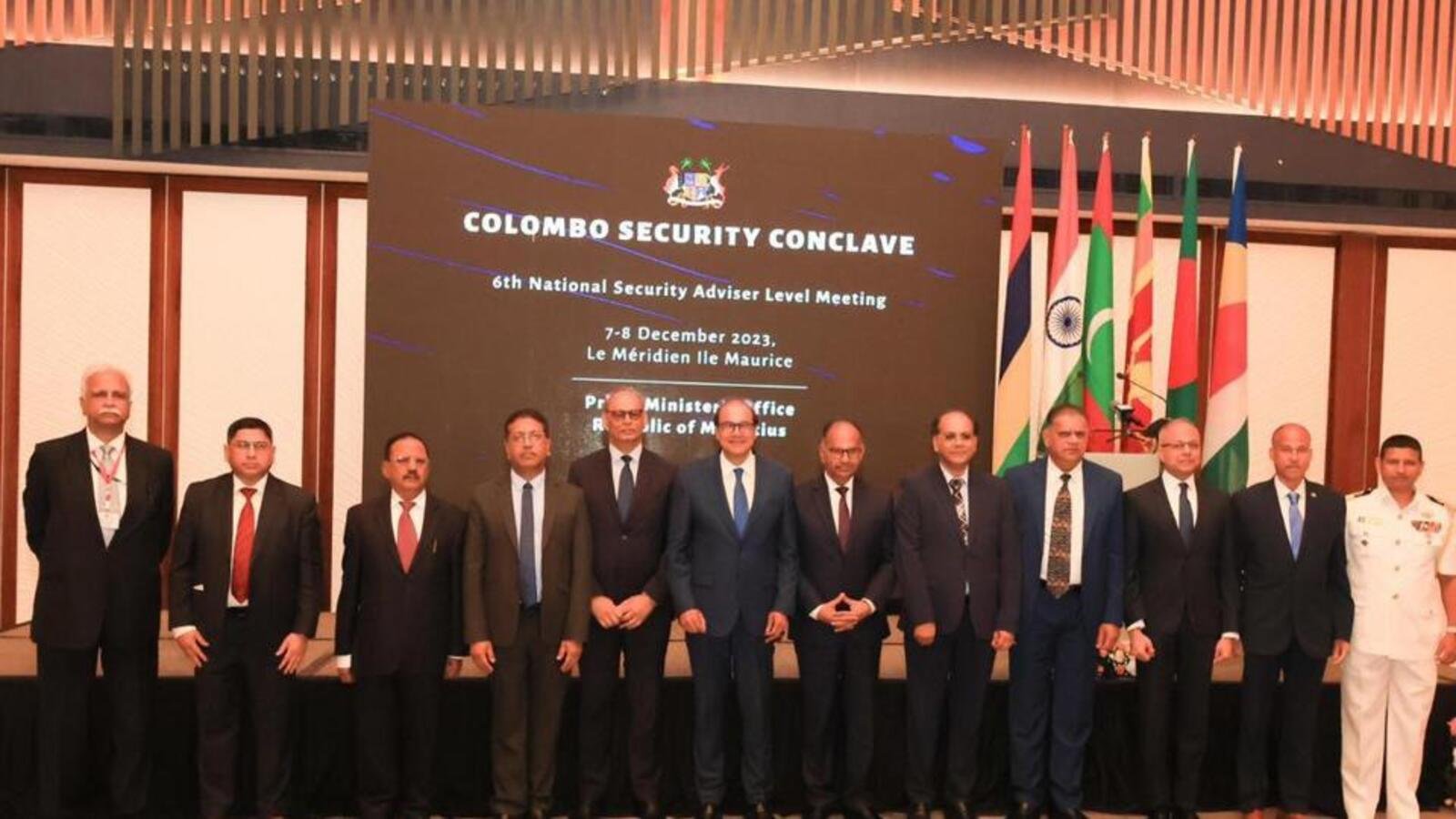
- In November 2025, India hosted the 7th NSA-level Summit of the Colombo Security Conclave (CSC). Seychelles joined as a full member; Malaysia attended as guest.
- The summit took place during major geopolitical shifts in the Indian Ocean Region (IOR), especially with China’s expanding presence.
What is the Colombo Security Conclave (CSC)?
- A maritime security and regional cooperation platform for the Indian Ocean.
- Started in 2011 as a trilateral: India–Sri Lanka–Maldives.
- Reactivated in 2020 with a broader mandate.
- Full Members (2025):
- India
- Sri Lanka
- Maldives
- Mauritius
- Bangladesh (joined 2024)
- Seychelles (joined 2025)
- Observers/Guests: Malaysia (2025).
- Key security areas:
- Maritime security
- Counter-terrorism
- Anti-trafficking and organised crime
- Cybersecurity
- Humanitarian Assistance & Disaster Relief (implicit through cooperation)
Why is CSC Important Today?
2011–2015: Started as a trilateral, but slowed due to political transitions in Sri Lanka and Maldives.
2020 onwards:
- Revival as CSC, expansion of membership, creation of working groups.
- Renewed focus due to frequent maritime incidents, trafficking networks, cyberattacks, and climate-driven disasters.
2025 Summit Significance:
- Expansion – Seychelles became full member.
- India’s maritime neighbourhood diplomacy deepened.
- Rising geopolitical tensions in IOR made CSC a crucial platform.
- Malaysia’s presence hints at future expansion to ASEAN-linked states.
Why Are CSC Countries Focused on Maritime Security?
- The IOR lacks a single, unified maritime security architecture.
- Littoral economies depend heavily on:
- Fisheries
- Sea-borne trade
- Coastal livelihoods
- Challenges are non-traditional, e.g.:
- Drug trafficking routes
- Human smuggling
- Illegal fishing
- Cyberattacks on ports
- Climate-related disasters
- Economic development is directly linked to ocean stability.
How is the CSC Evolving?
- Expanding membership and agenda.
- Increasing cooperation in:
- Joint maritime exercises
- Information sharing
- Coast guard coordination
- Disaster response
- India positions CSC as a regional security anchor to counter fragmentation in IOR mechanisms (IORA, QUAD maritime initiatives, SAGAR vision).
Implications
- Strengthens India’s maritime leadership in the Indian Ocean.
- Provides smaller states a collective security platform beyond bilateral dependence on major powers like China.
- Enhances regional stability through coordinated responses to trafficking, piracy, cyber threats, and environmental risks.
- Adds geopolitical weight to India’s SAGAR doctrine (“Security and Growth for All in the Region”).
- Helps India balance China’s economic and military footprint without confrontation.
- Encourages a shift from ad-hoc cooperation to institutionalised, rules-based mechanisms.
Challenges and Way Forward
| Challenges | Way Forward |
| Different threat perceptions—China seen as a security challenge only by India, not by others dependent on Chinese investments | Build trust, emphasise non-traditional threats where all members agree; use development-based maritime cooperation |
| CSC not fully institutionalised; currently NSA-level only | Create permanent secretariat, technical committees, annual action plans |
| Domestic political instability (e.g., Bangladesh, Maldives shifts) affecting continuity | Establish legally-backed cooperation frameworks independent of political cycles |
| Fragmented IOR security architecture | Align CSC work with IORA, IPOI, and regional coast guard networks |
| Limited maritime capabilities of smaller states | India-led capacity building, shared domain awareness, joint patrols |
| Risk of over-expansion diluting focus | Expand membership gradually with clear benchmarks |
Conclusion
The CSC is emerging as a core pillar of Indian Ocean security. Its success will depend on deeper institutionalisation, sustained trust among members, and balancing geopolitical realities while focusing on shared maritime threats. A cohesive, resilient CSC can strengthen regional stability at a time when the IOR is becoming increasingly contested.
| EnsureIAS Mains Question
Q. Discuss the strategic relevance of the Colombo Security Conclave (CSC) for India in the evolving security architecture of the Indian Ocean Region. What challenges must be addressed to make the CSC an effective regional institution? (250 Words) |
| EnsureIAS Prelims Question
With reference to the Colombo Security Conclave (CSC), consider the following statements: 1. CSC was originally established as a trilateral grouping among India, Sri Lanka and Maldives. 2. Bangladesh and Seychelles joined as full members only after 2022. 3. The primary mandate of the CSC includes maritime security, counter-terrorism and cybersecurity. 4. CSC functions under a permanent secretariat established in New Delhi. Which of the statements given above are correct? Answer: C Explanation: Statement 1 is Correct: CSC started as the India–Sri Lanka–Maldives trilateral maritime cooperation mechanism in 2011. Statement 2 is Correct: Mauritius joined in 2022, becoming the 4th member. Bangladesh joined in 2024. Seychelles became a full member in 2025. Statement 3 is Correct: CSC’s mandate covers maritime security, counter-terrorism, anti-trafficking/organised crime, and cybersecurity. These are explicitly part of CSC’s working groups. Statement 4 is Incorrect: CSC does not have a permanent secretariat yet. It is a NSA-level mechanism, and institutionalisation is a future need, not a current feature. |