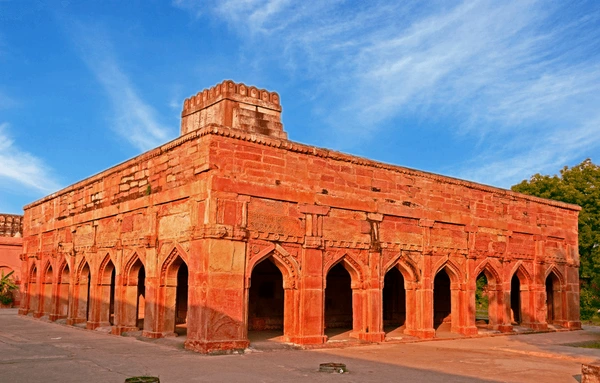
Chunar Fort, a sentinel of history located in the Mirzapur district of Uttar Pradesh. Known variously as Chandrakanta Chunargarh and Charanadri, this fort has stood for over two millennia as a key to controlling the heart of Northern India.
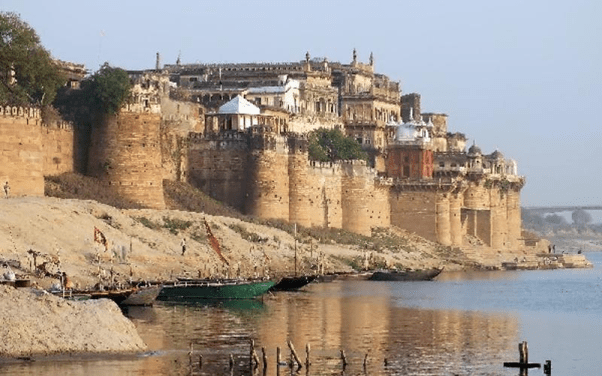
Where is Chunar Fort located and why was it strategically invincible?
The fort’s location is its most defining feature. It is perched on a rocky spur of the Vindhya Range, standing 85 meters above sea level.
- River Dominance: It overlooks a strategic bend of the Ganges near the Kaimur Hills. The hill rises sharply from the water, allowing artillery batteries to dominate the river channel. In the past, this meant the fort could control all navigation of heavy boats, making it the “Gateway to Eastern India.”
- Natural Defense: The steep, rocky bluff made a direct military assault nearly impossible, providing a massive tactical advantage to whoever held the ramparts.
What are the architectural and religious highlights of the fort?
The architectural details reflect the long timeline of the fort’s occupation, from the Mauryan era to the British Raj.
- Stone and Structure: The fort is built using local sandstone from quarries that date back to the Mauryan period. It spreads nearly 690 meters north to south, with massive ramparts extending over 1,600 meters.
- Key Structures: Sonwa Mandap: Built in 1538, this structure features 28 pillars and a deep, 61-meter well connected to the Ganges.
- The Citadel: Contains specialized cannon placements and underground dungeons.
- Religious Legends: The name Charanadri is linked to the footprints of King Bali. It is also traditionally associated with Maharaja Vikramaditya of Ujjain and the saint Bharthari, who is said to have meditated here.
How did the fort shape the political history of India?
Chunar Fort is a perfect example of how a single fortification can witness the rise and fall of multiple empires.
- The Afghan-Mughal Duel: Sher Shah Suri captured the fort in 1532, using it as a base to challenge the Mughals. Later, Akbar captured it in 1575 and added the impressive West Gate.
- The Colonial Era: The British took control in the 18th century, using it as an artillery depot and a high-security prison. Notably, Rani Jind Kaur (the widow of Maharaja Ranjit Singh) was imprisoned here in 1849 before her daring escape to Nepal.
What is the recent development regarding Chunar Fort?
To preserve this history while boosting the regional economy, the government is transforming the fort into a heritage tourism hub.
- The Heritage Hotel Project: Under a ₹150 crore Public-Private Partnership (PPP) model, a 100-room heritage hotel is being developed within the premises.
- Objective: This initiative aims to integrate the fort into the River Tourism circuit of the Ganges, linking it with nearby Varanasi and Mirzapur to promote “Experience-based Tourism.”