Context
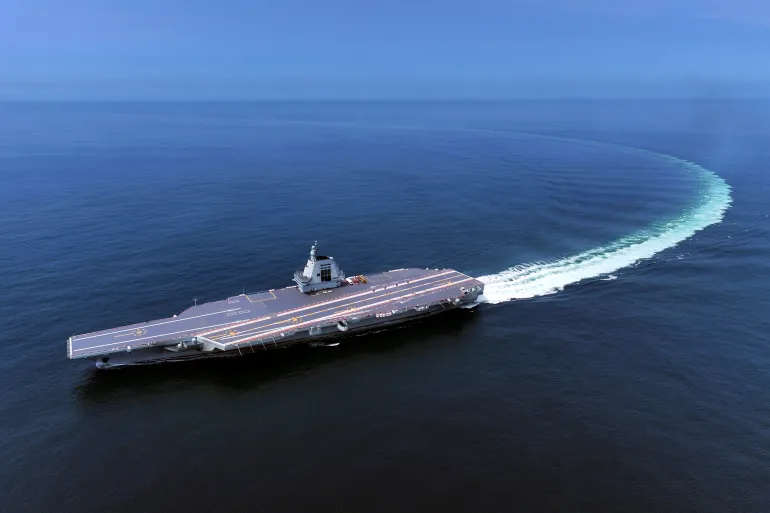
China has officially commissioned its third aircraft carrier, Fujian, after several months of sea trials. This marks a major step in China’s naval modernization and power projection, especially in the Indo-Pacific region and near Taiwan, raising regional security concerns.
What is Fujian?
The Fujian is China’s first indigenously designed and built aircraft carrier with advanced launch technology, representing a significant leap in its maritime capabilities. It is named after Fujian Province, which faces Taiwan across the Taiwan Strait.
Key Features of Fujian
- Type: Conventionally powered aircraft carrier (not nuclear-powered).
- Technology: Uses Electromagnetic Catapult Launch System (EMALS), similar to U.S. carriers, to launch aircraft more efficiently.
- Flight Deck: Has a flat deck instead of the ski-jump ramps used in earlier carriers (Liaoning and Shandong).
- Aircraft Capacity: Can carry more and heavier-armed jet fighters, including:
- J-35 stealth fighters (carrier-based version)
- KJ-600 early warning aircraft
- Variants of the J-15 fighter
- Commissioning Ceremony: Attended by President Xi Jinping in Hainan Province on November 5, 2025.
Relevance
- Strategic Expansion: Enhances China’s ability to project power beyond its coastline, especially in the South China Sea and Taiwan Strait.
- Technological Advancement: Reflects China’s progress toward building modern blue-water naval capabilities, reducing dependence on foreign designs.
- Deterrence and Regional Influence: Strengthens China’s deterrence capabilities amid tensions with the U.S. and allies in the Indo-Pacific.
- Symbol of National Pride: Showcases China’s growing industrial and technological self-reliance.
- Operational Efficiency: The EMALS allows quicker and more powerful take-offs, improving the operational readiness of aircraft missions.
Recent Data Trends and Global Comparisons
- China’s Naval Expansion: China now has three aircraft carriers: Liaoning (2012), Shandong (2019), and Fujian (2025).
- Global Context:
- The S. Navy operates 11 nuclear-powered carriers, far ahead in capability.
- India operates two carriers: INS Vikramaditya and INS Vikrant.
- Strategic Geography: The naming of Fujian highlights China’s focus on Taiwan and its desire to secure dominance in the Western Pacific.
Challenges and Way Forward for India
| Challenges | Way Forward |
| 1. Strategic imbalance in the Indo-Pacific: Fujian enhances China’s blue-water capabilities, potentially altering the naval power balance in the Indian Ocean and Western Pacific. | Strengthen the Indian Navy’s carrier and submarine fleet; accelerate INS Vishal project and indigenous warship production under Atmanirbhar Bharat. |
| 2. Increased Chinese presence near India’s maritime zone: Likely expansion of Chinese patrols and surveillance missions in the Indian Ocean Region (IOR). | Deepen coordination with QUAD partners (U.S., Japan, Australia); enhance maritime domain awareness (MDA) through satellites and joint patrols. |
| 3. Pressure on India’s maritime influence: China’s modern carrier could support military operations near India’s trade routes and choke points like the Malacca Strait. | Bolster Andaman & Nicobar Command, improve naval logistics agreements (e.g., with France, Indonesia, Philippines) for regional access. |
| 4. Technological and operational gap: India’s carriers (Vikramaditya and Vikrant) still rely on ski-jump take-offs, unlike China’s advanced electromagnetic catapults. | Invest in EMALS technology and naval aviation research through partnerships with the U.S. and European countries. |
| 5. Regional security tension over Taiwan and South China Sea: Any confrontation could spill over into the wider Indo-Pacific, indirectly affecting India’s trade and security. | Advocate for freedom of navigation, strengthen ASEAN and IORA ties, and pursue strategic neutrality while safeguarding Indian interests. |
Conclusion
The commissioning of Fujian marks a milestone in China’s naval modernization, signaling its ambition to become a global maritime power. However, its success will depend on operational maturity, regional stability, and how responsibly China exercises its growing influence.
| Ensure IAS Mains Question
Q. Discuss the strategic implications of China commissioning its third aircraft carrier, Fujian, for regional security and India’s maritime strategy. (250 words) |
| Ensure IAS Prelims Question
Q. Which of the following statements about China’s aircraft carrier Fujian are correct? 1. It is China’s first nuclear-powered aircraft carrier. 2. It uses an electromagnetic catapult system for launching aircraft. 3. It is named after a province facing Taiwan. Select the correct answer using the code below: a) 1 and 2 only b) 2 and 3 only c) 1 and 3 only d) 1, 2 and 3 Answer: b) 2 and 3 only Explanation: Statement 1 is incorrect: Fujian is not nuclear-powered; it is China’s first indigenously designed conventionally powered aircraft carrier. China has not yet built a nuclear-powered carrier. Statement 2 is correct: Fujian uses an electromagnetic catapult launch system (EMALS), allowing it to launch heavier and more advanced aircraft compared to earlier ski-jump carriers like Liaoning and Shandong. Statement 3 is correct: The carrier is named after Fujian province, which is located on China’s eastern coast and faces Taiwan across the Taiwan Strait. |