Context
Researchers from Indian Institute of Technology Madras and Indian Institute of Science have synthesised a stable carbon-free molecule resembling ferrocene, resolving a scientific challenge that remained unanswered for more than seven decades.
Ferrocene and Its Applications
Ferrocene is an important organometallic compound discovered in the 1950s. It consists of an iron atom positioned between two cyclopentadienyl carbon rings, forming a characteristic “sandwich” structure.
Its discovery transformed the understanding of chemical bonding and contributed significantly to the development of modern organometallic chemistry. Owing to its exceptional stability, ferrocene is used in:
- Catalysis and industrial chemistry
- Pharmaceuticals
- Energy-storage systems
- Electronics and advanced materials
Its unique molecular arrangement encouraged scientists to examine whether similar stable complexes could exist without carbon-based rings.
The Long-Standing Scientific Challenge
For decades, researchers attempted to develop ferrocene-like compounds using non-carbon elements. However, carbon’s exceptional bonding capability made it difficult to reproduce such stable molecular structures.
The central scientific challenge was to determine whether stable sandwich complexes could exist entirely without carbon.
The Indian Scientific Breakthrough
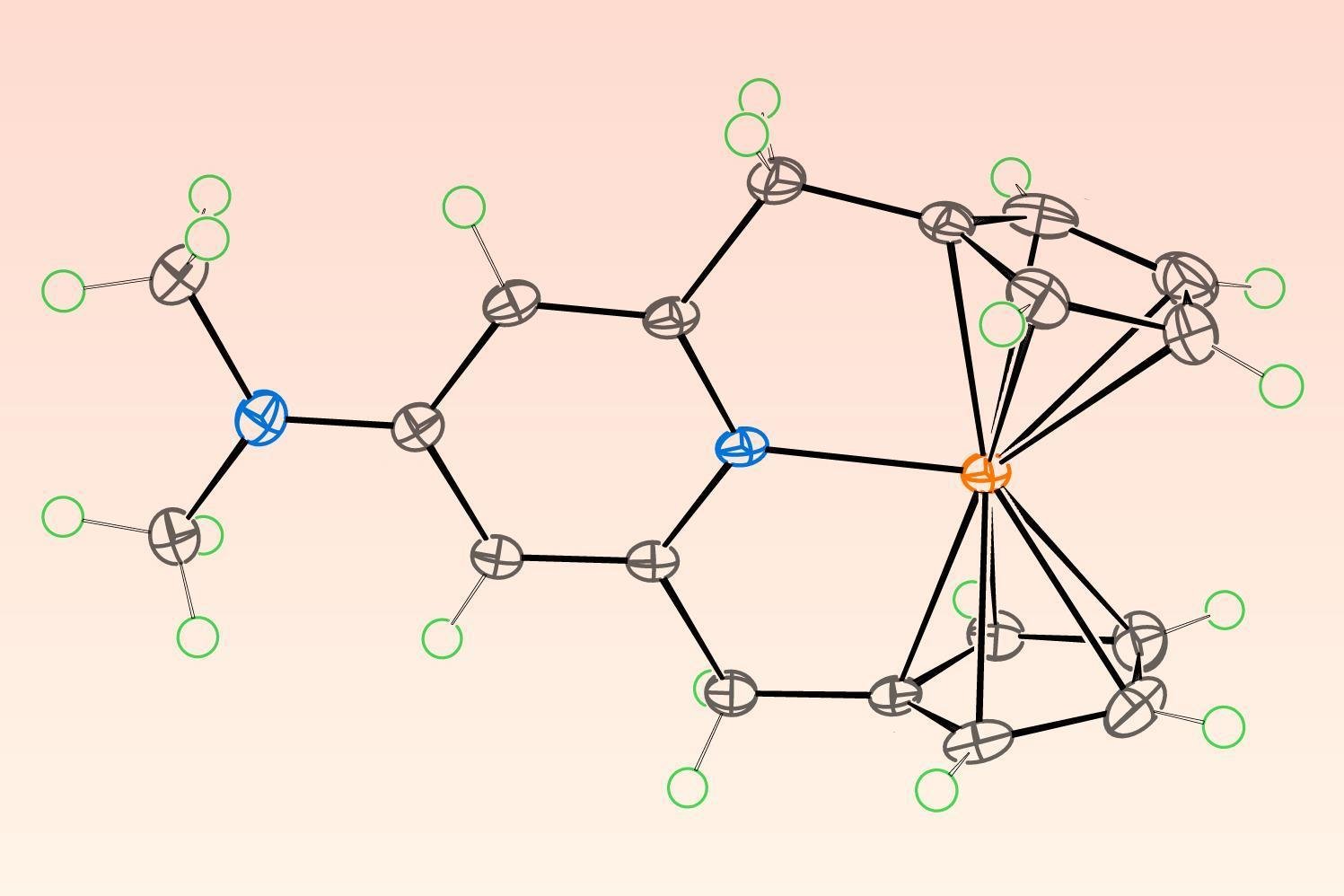
Researchers led by Prof. Sundargopal Ghosh and Stutee Mohapatra from IIT Madras, along with Prof. Eluvathingal Jemmis from IISc Bengaluru, successfully developed a carbon-free analogue of ferrocene.
The newly synthesised molecule contains:
- Osmium as the central metal atom
- Boron-based rings replacing carbon rings
The molecule exhibits strong bonding between osmium and boron-based rings. Preliminary studies indicate that it may be as stable as, or even more stable than, conventional ferrocene under certain conditions.
The findings were published in the journal Science.
Significance of the Discovery
The breakthrough demonstrates that stable sandwich complexes are not exclusive to carbon-based systems. It expands the scope of organometallic chemistry and may support advances in:
- Advanced electronic materials
- Industrial catalysis
- Energy-storage technologies
- Boron-based material science
- Molecular engineering and nanotechnology
The discovery also highlights India’s growing contribution to frontier scientific research.
Challenges and Way Forward
| Challenges | Way Forward |
| The discovery remains at an early experimental stage | Conduct extensive studies to evaluate technological and industrial applications |
| Osmium is costly and scarce, limiting large-scale use | Explore alternative low-cost metals with similar properties |
| Large-scale synthesis of such molecules is technologically complex | Develop scalable and energy-efficient synthesis techniques |
| Long-term stability and reactivity require further investigation | Strengthen computational chemistry and advanced materials research |
| Commercial applications remain uncertain | Promote industry-academia collaboration for applied research |
Conclusion
The synthesis of a carbon-free ferrocene-like molecule marks a major advance in organometallic chemistry. By proving that stable sandwich complexes can exist without carbon, the discovery opens new avenues in molecular design, catalysis, and advanced materials research.