Context
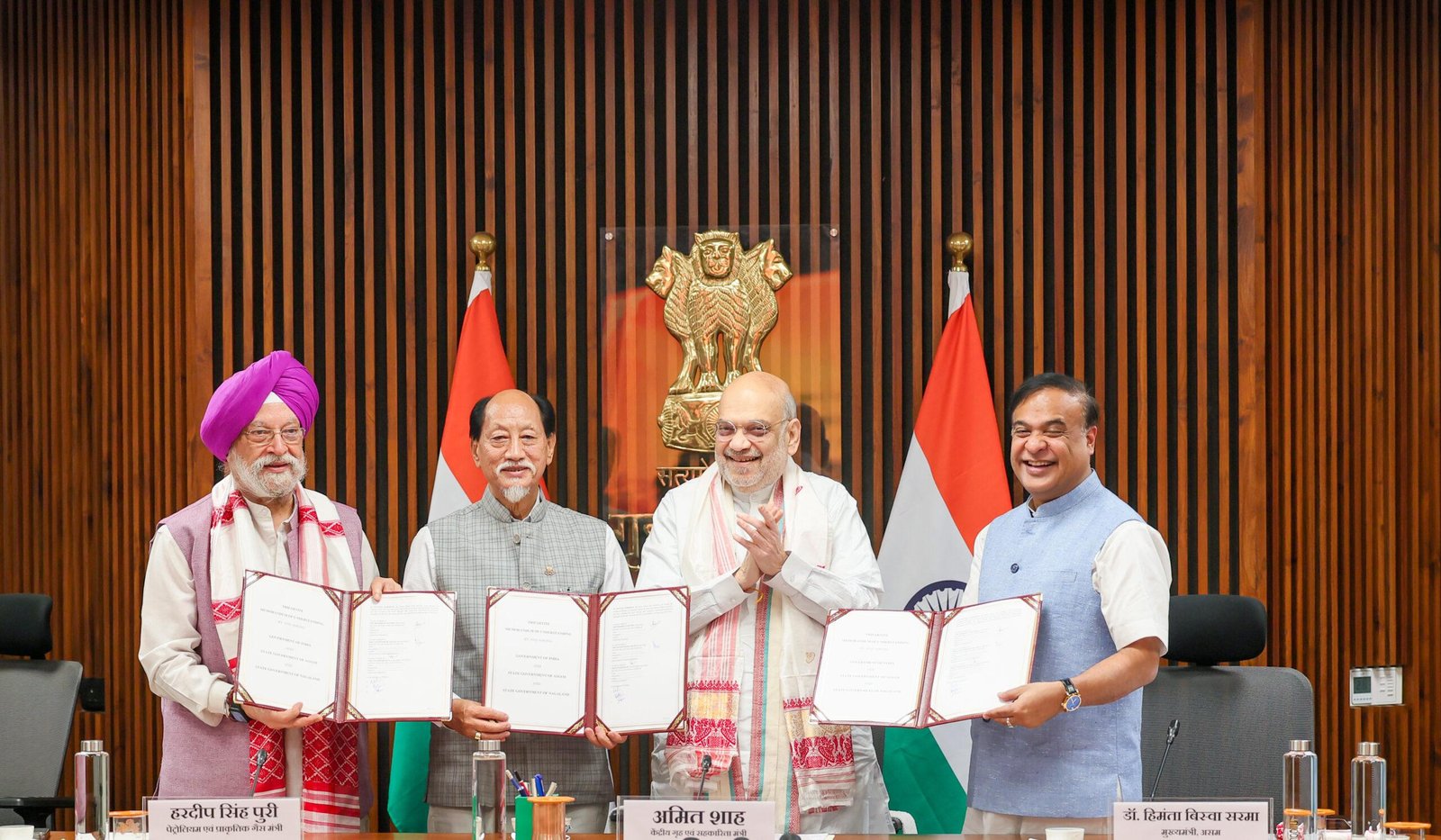
The Union Government, Assam, and Nagaland have signed a tripartite MoU to resume oil and gas exploration in the Disputed Area Belt (DAB) along their border. Exploration in this hydrocarbon-rich region had remained suspended for nearly three decades due to boundary disputes and security concerns. The agreement seeks to facilitate resource development without affecting the ongoing territorial dispute.
Key Features of the MoU
- Covers over 1,000 sq km of the disputed border region.
- Establishes a coordinated mechanism for petroleum exploration and production.
- Provides a framework for operational coordination and security management.
- Enables exploration activities without affecting the legal positions of either state in the boundary dispute.
- Recognises hydrocarbon resources in the region as assets of national importance.
- Extends exploration beyond previously identified oil and gas fields to other prospective areas.
Significance
- Energy Security: India remains heavily dependent on imported hydrocarbons:
- More than 88% of crude oil requirements are met through imports.
- Nearly 50% of natural gas demand relies on external sources.
In this context, enhanced domestic production can:
- Reduce import dependence.
- Strengthen energy security.
- Mitigate risks arising from geopolitical disruptions and supply shocks.
- Advance the objective of energy self-reliance (Atmanirbhar Bharat).
- Hydrocarbon Potential:
The Northeast possesses substantial untapped petroleum resources.
- Assam accounts for nearly 22% of India’s crude oil reserves and around 15% of natural gas reserves.
- Nagaland contains significant hydrocarbon prospects within the Naga-Schuppen Belt, a part of the Assam–Arakan Basin.
The agreement provides a framework for harnessing untapped reserves and enhancing the Northeast’s contribution to India’s energy security.
Developmental Significance
The MoU is expected to:
- Attract investment into resource-rich regions.
- Generate employment and livelihood opportunities.
- Enhance state revenues.
- Improve infrastructure in border areas.
- Support the economic integration of the Northeast with national development priorities.
Challenges and Way Forward
| Challenges | Way Forward |
| Unresolved boundary disputes may create future operational and administrative uncertainties. | Strengthen institutional dialogue, confidence-building measures, and coordination mechanisms between the two states. |
| Exploration activities may affect ecologically sensitive regions | Ensure strict environmental safeguards and adopt sustainable extraction practices. |
| Concerns related to land rights, resource ownership, and benefit-sharing may emerge among local communities. | Promote community participation, transparent consultations, and equitable sharing of developmental gains. |
| Infrastructure deficiencies in remote border areas may hinder exploration and production. | Invest in transport, communication, and energy infrastructure to support resource development. |
| Security and governance challenges could affect project implementation. | Enhance coordination among central agencies, state governments, and local stakeholders. |
Conclusion
The Assam–Nagaland Oil Exploration Agreement demonstrates how cooperative governance can unlock strategic resources despite unresolved territorial disputes. By advancing energy security, regional development, and cooperative federalism, it offers a pragmatic model for converting long-standing disputes into opportunities for shared growth.