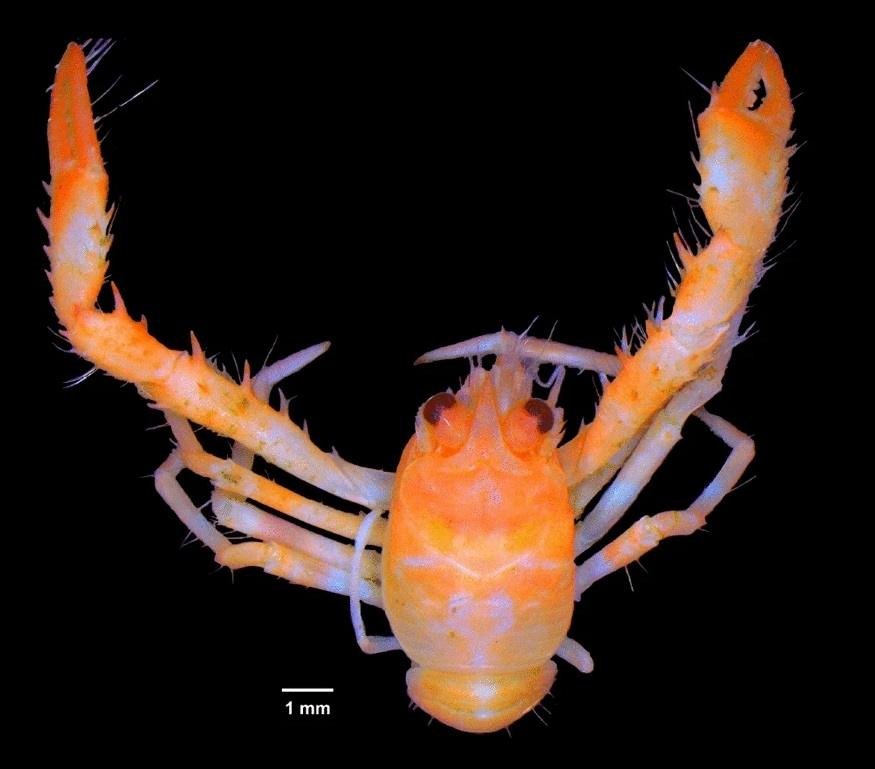
- Indian researchers discovered a new species of squat lobster named Leiogalathea samudragiri in deep waters (360 metres below sea level) near Minicoy which is part of the Lakshadweep island group.
- It was found during a research cruise conducted under India’s Deep Ocean Mission (Samudrayaan programme) which focuses on exploring deep marine environments, mapping the seabed, and studying ocean biodiversity.
- About Squat Lobsters:
- Squat lobsters are marine crustaceans that look like small lobsters, but they are not true lobsters.
- They are more closely related to hermit crabs and porcelain crabs.
- There are over 900 known species worldwide. They inhabit almost every type of marine environment, from shallow reefs to deep oceans, across many latitudes.
- Their bodies are small and flattened, usually measuring between 0.7 and 3.5 inches.
- As decapods, they possess ten legs, with the front pair being very long and ending in large claws.
- They keep their tail folded under the body, giving them a short, “squat” appearance, which is how they got their name.
- Like many crustaceans, squat lobsters can rapidly flick their tail to propel themselves backwards, allowing quick escape from predators.
- Unique features of the species:
- It has smooth, continuous ridges on the upper shell, unlike similar species where these ridges are broken.
- Exactly six horizontal ridges are present on the rear half of its body.
- A particular spine on the antennules (feelers)—normally seen in related species—is completely absent.
- The animal is bright orange, making it visually distinct.