NEWS: Scientists have captured the clearest view of a star collapsing directly into a black hole without exploding as a supernova.
How are stars born and what powers their long lives?
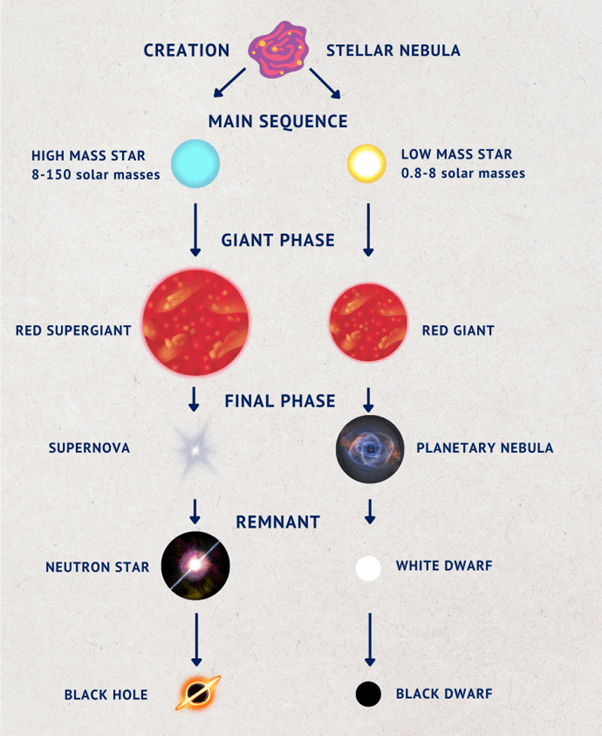
Every star begins its journey in a Stellar Nebula, which is a massive, cold cloud of hydrogen gas and interstellar dust.
- Protostar Formation: Gravity causes high-density pockets within these clouds to clump and collapse. As the material falls inward, it heats up, forming a Protostar.
- The T-Tauri Phase: Before a star becomes stable, it enters this turbulent adolescent stage where it sheds surrounding gas and dust but is not yet hot enough for nuclear fusion.
- Main Sequence: This is the “adulthood” of a star. Once the core reaches about 15 million degrees Celsius, nuclear fusion begins—converting hydrogen into helium. This releases immense energy, creating an outward pressure that balances the inward pull of gravity.Sun is currently in this stable phase and will remain here for another 5 billion years.
Why do low-mass and high-mass stars die so differently?
The mass of a star is the single most important factor in determining its end.
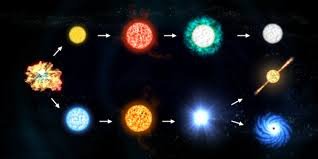
- Low-Mass Stars (like our Sun):
- Red Giant: When hydrogen runs out, the core collapses and heats up, causing the outer layers to expand and cool, turning the star into a Red Giant.
- Planetary Nebula: The star eventually sheds its outer layers in a beautiful glowing shell of gas.
- White Dwarf: The remaining hot, dense core is a White Dwarf. It no longer performs fusion and slowly cools over billions of years into a cold Black Dwarf.
- High-Mass Stars (8–10 times the Sun’s mass):
- Red Supergiant: These stars fuse heavier elements like carbon, neon, and oxygen until an Iron core is formed. Since fusing iron consumes energy rather than releasing it, the star loses its stability.
- Supernova: The core collapses in a fraction of a second, triggering a gargantuan explosion called a Supernova.
- Neutron Star or Black Hole: Depending on the remaining mass, the core becomes either a Neutron Star (so dense that a sugar-cube-sized piece would weigh a billion tons) or collapses further into a Black Hole, where gravity is so strong that even light cannot escape.
What is the “Failed Supernova” discovery of 2026?
In a groundbreaking development on February 12, 2026, scientists led by Kishalay De (Columbia University) published findings in the journal Science regarding a massive star in the Andromeda Galaxy (M31-2014-DS1).
The Discovery: Direct Collapse
- The Event: Astronomers observed a massive supergiant (13 times the mass of our Sun) that simply disappeared. Instead of the expected brilliant supernova explosion, the star underwent Direct Collapse.
- The Significance: This confirms a long-theorized but rarely seen “failed supernova” pathway. The core’s gravity was so overwhelming that it swallowed the star inward directly into a Black Hole without the outward explosive rebound.
- Strategic Impact: This discovery reshapes our “inventory” of how stars die. It suggests that many black holes in our universe might be born “quietly,” explaining why we sometimes see fewer supernovae than theoretical models predict.
Key Terms :
- Chandrasekhar Limit: The maximum mass (44 times the Sun’s mass) a white dwarf can have before collapsing into a neutron star or black hole.
- Nucleosynthesis: The process of creating new atomic nuclei (elements) inside stars; supernovas are responsible for creating elements heavier than iron, like gold and uranium.
- Event Horizon: The boundary around a black hole beyond which nothing can return.