| Important Questions for UPSC Prelims / Mains / Interview
1. What is the Delhi Declaration, and in what geopolitical context was it adopted? 2. Why is the second India–Arab Foreign Ministers’ Meeting significant for India’s West Asia policy? 3. How does the Delhi Declaration reflect India’s position on conflicts in Sudan, Libya, and Somalia? 4. What does the Declaration indicate about India’s stance on Yemen and Red Sea security? 5. Why does the Delhi Declaration adopt a cautious tone on Syria? 6. How does the Declaration address the Israel–Palestine issue, and what does it avoid? 7. Why is the omission of Iran-related tensions significant in the Delhi Declaration? 8. What does the Delhi Declaration reveal about India’s overall Middle East diplomacy? |
Context
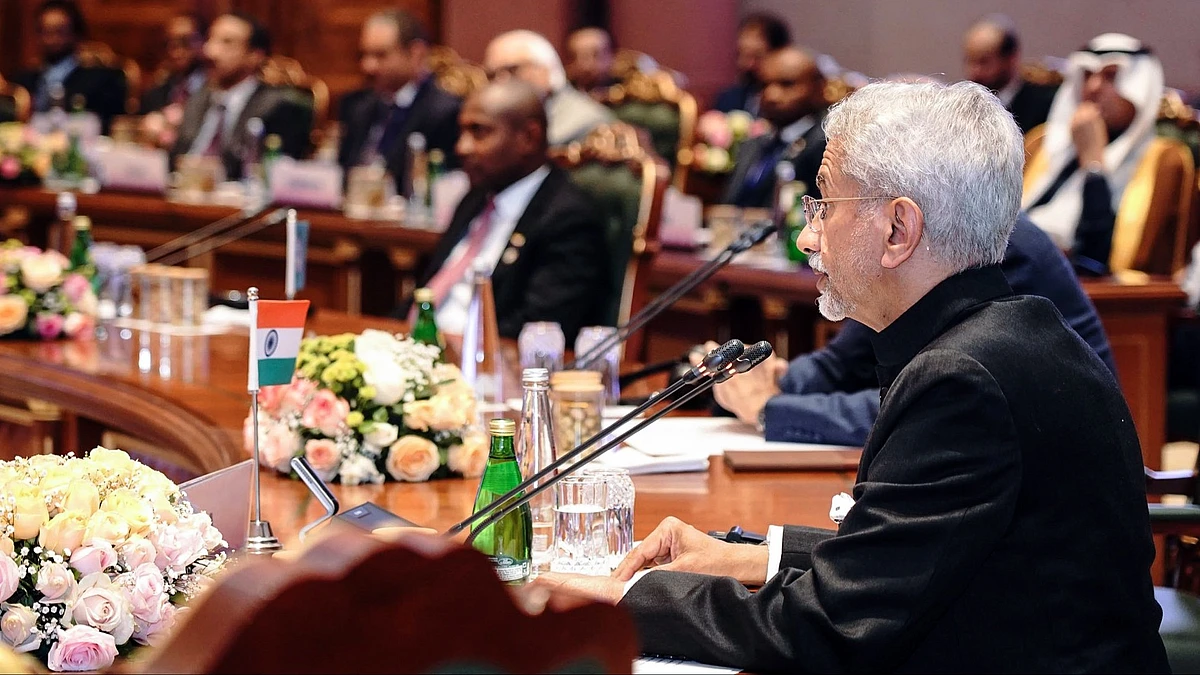
India hosted the second India–Arab Foreign Ministers’ Meeting in New Delhi, bringing together all 22 members of the League of Arab States for the first time since the inaugural meeting in Bahrain a decade ago.
The meeting took place amid intense geopolitical churn in West Asia, including the Gaza conflict, instability in Yemen, divisions among Gulf states, and heightened US–Iran tensions. The outcome document—the Delhi Declaration—sets out shared positions and signals India’s calibrated, stability-focused approach to Middle East diplomacy.
Q1. What is the Delhi Declaration, and in what geopolitical context was it adopted?
- The Delhi Declaration is a joint political statement adopted at the second India–Arab Foreign Ministers’ Meeting.
- It outlines shared positions and future cooperation between India and Arab League countries.
- The declaration was adopted amid rising instability across West Asia and North Africa.
- Ongoing conflicts in Gaza, Yemen, Sudan, Libya, and Somalia shaped the discussions.
- Strategic rivalry among regional powers added complexity to the meeting’s backdrop.
- The declaration reflects a collective preference for stability and recognised governments.
- It also reaffirms India’s active but balanced engagement in Middle East affairs.
Q2. Why is the second India–Arab Foreign Ministers’ Meeting significant for India’s West Asia policy?
- It marks a revival of structured India–Arab political dialogue after ten years.
- The meeting brought together all 22 Arab League members in New Delhi.
- It highlights India’s growing diplomatic weight in West Asia.
- The timing reflects India’s intent to stay engaged amid regional turbulence.
- The forum allows India to engage collectively, not just bilaterally, with Arab states.
- It strengthens India’s position as a neutral and reliable partner.
- The meeting institutionalises India’s long-term engagement with the Arab world.
Q3. How does the Delhi Declaration reflect India’s position on conflicts in Sudan, Libya, and Somalia?
- The declaration stresses respect for sovereignty and territorial integrity of all three countries.
- It explicitly supports internationally recognised governments in these conflict zones.
- Violence against civilians is condemned without ambiguity.
- External interference in domestic conflicts is firmly rejected.
- India aligns itself with the Arab League’s official position on these crises.
- This stance avoids legitimising parallel or breakaway authorities.
- It reinforces India’s norm-based approach to international conflicts.
Q4. What does the Declaration indicate about India’s stance on Yemen and Red Sea security?
- The Delhi Declaration explicitly condemns attacks on shipping in the Red Sea.
- For the first time, India joins Arab states in naming the Houthis directly.
- This marks a shift from India’s earlier cautious language on Yemen.
- The declaration emphasises Yemen’s unity and territorial integrity.
- It aligns more closely with Saudi Arabia’s position on the conflict.
- Maritime security is recognised as a shared international concern.
- The stance reflects India’s interest in protecting global trade routes.
Q5. Why does the Delhi Declaration adopt a cautious tone on Syria?
- Syria remains one of the most sensitive and polarising conflicts in West Asia.
- The declaration limits itself to praising counter-terrorism efforts.
- It avoids taking a strong political position on Syria’s internal governance.
- India maintains diplomatic engagement without public alignment.
- This cautious approach preserves room for future engagement.
- It avoids complicating India’s relations with multiple regional stakeholders.
- The tone reflects India’s broader strategy of strategic restraint.
Q6. How does the Declaration address the Israel–Palestine issue, and what does it avoid?
- The declaration explicitly supports the Arab Peace Initiative of 2002.
- It reiterates the land-for-peace principle and Palestinian statehood.
- Violence in Gaza is condemned, and calls for peace are reiterated.
- The declaration avoids endorsing new or controversial peace frameworks.
- It does not align with the US-led “Board of Peace” initiative.
- India maintains its long-standing support for a two-state solution.
- This reflects continuity rather than departure in India’s Palestine policy.
Q7. Why is the omission of Iran-related tensions significant in the Delhi Declaration?
- US–Iran tensions are among the most destabilising issues in West Asia.
- The declaration avoids mentioning military build-up or escalation risks.
- This silence appears deliberate and diplomatic.
- It allows member states flexibility in managing bilateral ties with Iran.
- India preserves its strategic engagement with Iran despite sanctions.
- The omission avoids public confrontation with the United States.
- It reflects India’s careful balancing in a sanctions-constrained environment.
Q8. What does the Delhi Declaration reveal about India’s overall Middle East diplomacy?
- India prioritises stability, sovereignty, and recognised governments.
- It avoids taking sides in regional power rivalries.
- Economic and energy cooperation remains a central pillar of engagement.
- Political positions are guided by long-standing principles, not short-term alliances.
- India maintains transactional partnerships without ideological alignment.
- The approach allows India to engage across competing blocs.
- The declaration reinforces India’s role as a balanced and credible regional actor.
Conclusion
The Delhi Declaration underscores India’s carefully calibrated Middle East diplomacy, rooted in sovereignty, stability, and norm-based engagement. While New Delhi deepens cooperation with the Arab League across economic and strategic domains, it avoids entanglement in regional rivalries or experimental peace frameworks.
By aligning with recognised governments, supporting established peace initiatives, and maintaining strategic restraint, India reinforces its image as a steady, pragmatic, and independent actor in West Asia—a posture increasingly valuable in a fragmented and volatile regional order.